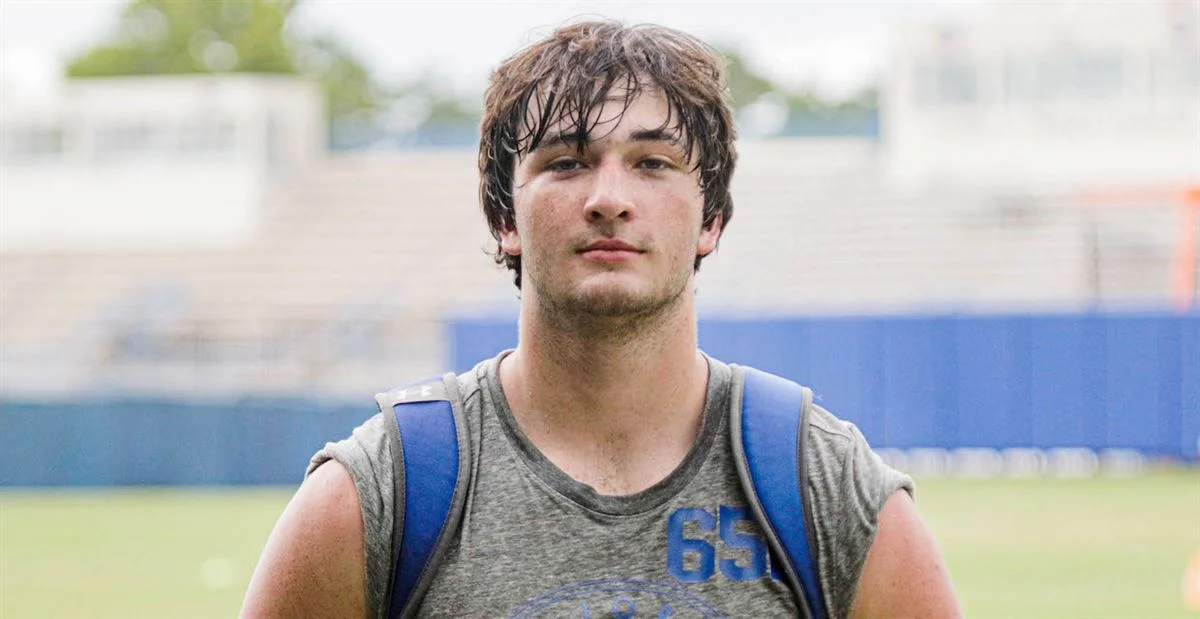
“He’s the biggest motivator for me,” Mann said of Lea. “He practices what he preaches, and just like me, he bleeds black and gold. He reminded me a lot of my high school coaches, just the way he loves football. [My head coach] loved football; it’s like football was his first language and English was his second. I kind of felt like that was the same with Coach Lea.”
Vanderbilt was not a winning program when Mann arrived; his commitment coincided with a 2-10 season in 2021. But Mann believed in the program, and that he and his recruiting class would spearhead a change in Nashville.
“When I first got here, there was definitely a difference in the guys who had been recruited by Coach Lea,” Mann said. “I’m not discrediting anything the team had done before, but there were some people who weren’t believers. They were just like, ‘Well, we’re still Vanderbilt.’ I rejected that. I feel like my recruiting class did a great job with that too.
“We just kept getting punched in the mouth, but every time we got back up,” Mann continued. “It’s like Coach Lea says, head, body, head, body. It didn’t really matter what happened. We took every punch as a learning opportunity. ‘Okay, they exposed this, how can we fix that issue?’ I’m a fifth-year now, and you can obviously see the impact the people in my group had in shaping the culture and upholding the standard the coaches set.”
In an unpredictable era of NIL and a transfer portal that feels almost always open, Mann has stayed the course. The effect of Vanderbilt’s brotherhood has never led him to consider anywhere else.
“I’m going to have some of my teammates in my wedding,” Mann said. “I’ve been in some of those guys’ weddings. I feel like a bunch of other teams preach brotherhood, but they don’t practice it. If you talk to anybody who’s transferred into this program and adopted our culture, they talk about how different it is here. If you see a Vanderbilt football player, he’s probably with another Vanderbilt football player.”
But Vanderbilt has been more than brotherhood for Mann; Vanderbilt is also the place that stood by him through his injuries.
“I’ve torn my ACL twice and had around five knee surgeries,” Mann said. “The opportunity that Vanderbilt has given me, the way it supported me through those times, is something you can’t recreate anywhere else. I don’t think any other school could offer me the opportunity I’ve gotten, the people I’ve been able to meet and the resources we have here.
“And even last year, I tore the meniscus in my left knee twice,” Mann continued. “Even though the doctor told me I shouldn’t, I kept playing throughout the season. I honestly probably shouldn’t have done that, but I would have had it no other way. That group of guys we had last year, and the things we were doing — I could not have sat out that year. This program means too much to me.”
Mann’s first ACL tear came when he was a freshman, to which he admits did not leave him in a great mental state.
“When I tore my ACL the first time, I took a victim mindset,” Mann said. “I was like, ‘Everybody’s against me.’ I let that plant a seed in my brain for a decent amount of time. I wasn’t going to class, my grades were dropping and I wasn’t taking my rehab as seriously as I should. But it just hit me one day, I was like, ‘Okay, screw this. I’m going to find a way.’”
Part of accomplishing that mindset was through what the program refers to as ‘forge points.’ Players can earn forge points for every activity done within the facility, such as lifting, watching film or other extra work. After his injury, Mann set out to max out as many as he could.
“Even though I couldn’t do much, I could still do something,” Mann said. “I was very small when I got here, like 260 pounds, and through my rehab work, I gained like 40 pounds. It was just me going to the weight room and lifting, getting right on my nutrition, because I saw it as an opportunity. I was like, ‘All right, I’m not moving that much right now. This is an opportunity to gain healthy weight.’”
A crucial part of Mann’s recovery process was that he did not have to do it alone. Around the same time of his ACL injury, graduate edge rusher Miles Capers also suffered a torn ACL. And from then on, the two’s path of returning to the field became intertwined.

“We pushed each other,” Mann said of Capers. “When we wanted to quit and we were doing some crazy workout, I would look over at Miles and he’d keep pushing. I’d see how committed he was to his progress and completing that goal. It was extremely helpful to have him alongside me in the process.”
“That was a tough time for both of us,” Capers said. “But we just found a way to make it through, to push each other. Knowing that somebody else going through the same thing that you're going through, it shifts your mind to not feel bad for itself. Bradley is one of the toughest dudes I’ve ever met — he has battled through a lot.
“It was just a motivation for both of us, I think, to get back right and help the team win,” Capers added. “We’re doing this for the program, for our brothers.”
“Miles and I became super close through that — he’s one of the best dudes in the world,” Mann said. “He’s a great leader for us and just a great human being overall.”