

April 2, 2010
 Pitching in college baseball, as Vanderbilt assistant coach Derek Johnson sees it, is about handling change and gaining momentum.
Change, meaning evolution, adaptation and movement in the ranks. Momentum, meaning a winning streak, a strong conference series and helping in a big rally.
So far in 2010, the 17th-ranked Commodores have engineered serious momentum in all three of those definitions by not having to undergo much change.
“I don’t think, not since I’ve been here, we’ve changed it as little as we have this year,” said Johnson, the team’s pitching coach since 2002. “You go into every year thinking that you have to find roles, and you know that a couple of those are going to change just because it’s the nature of college baseball.
“We haven’t changed much. We’ve kind of kept the same format from the beginning. Basically it’s because the guys have responded to that. They’ve pitched well in those situations, so we’ve been able to keep them.”
Despite losing three principle starters from 2009 in Mike Minor, Caleb Cotham and Nick Christiani, Vanderbilt’s staff has settled into myriad roles and sports a combined earned run average of 3.02 and a 23-4 record, six games better than the same time a year ago.
“We have established roles,” said Vanderbilt head coach Tim Corbin. “I think everyone goes in and does what they have to do.”
Senior right-hander Drew Hayes has been through the ups and downs of the pitching staff the past two seasons, when it had a combined earned run average of 4.67. There was a lot of fluctuation, and so there was a lot of inconsistency. 10 different pitchers started in 2008, and 12 did in 2009, when the Commodores struggled to a 12-17 record in Southeastern Conference play.
“I just think it was a situation where we had a lot of guys who could do a lot of different things and fit into a lot of different roles,” Hayes said regarding the up-and-down season. “So maybe we didn’t have as much consistency as we do this year.”
In Vanderbilt’s record-breaking 2007 campaign, when the Commodores were ranked No. 1 in the country and won the SEC regular season and tournament titles, only eight different pitchers were used as starters.
In 2010, there have only been seven, and 25 of the 27 games have been accounted for by five players.
The Commodores (23-4, 4-2) have won eight straight games since losing to Alabama 8-2 on March 20, and they’ve held opponents to three runs or less 15 times on the year.
They’re a gaudy 15-0 when they do so.
“I think it’s always helpful as a pitcher to know what situation you’re going to come into in the game. If you’re starting, you can prepare yourself throughout the week,” Hayes said. “That’s kind of your deal throughout the whole year and you prepare yourself leading into the season that way as well by the way you train, the way you train your body to go more than one or two or three innings at a time.”
Friday night is Gray’s area
Every staff needs an anchor, an ace, a go-to guy. For Vanderbilt, that role has generally been one for an upperclassman, but every now and then a young gun comes along that demands the ball for that Friday night game that sets the tone for a pivotal weekend series.
The Commodores have such a weapon in standout right-hander Sonny Gray, who’s only a sophomore. And such a tone was set in Vanderbilt’s recent sweep of Kentucky, when Gray threw seven shutout innings, allowing just four hits and striking out six, in an 8-0 victory on March 26.
“Any time you get to watch Sonny pitch, it’s a treat,” Hayes said. “He throws the ball hard, he’s got good command, he’s got great off-speed stuff.”
Gray may be unusual among Commodore Friday night pitchers for his youth, but one thing has tied them together; they’ve been unusually good too. First-round draft picks like Minor, Jeremy Sowers and David Price have also taken the ball for those crucial games over the years.
“(Sonny) always thinks he’s going to win everything, and that’s a little bit like Price was,” Corbin said. “He was very competitive and positive and thinking he was going to come out on top, and Sonny’s got that type of characteristic.”
Hard to blame his confidence given his consistent dominance so far this season. Gray has held opposing hitters to a meager .208 average, struck out 39 hitters in 40 innings and gone 4-2 while going up against the best pitchers the opposition’s had to offer.
His freshman season in 2009 demonstrated inconsistency but also brilliance. There were some rocky outings in relief, but Gray threw eight shutout innings in an NCAA regional win over Indiana in his final start to keep Vanderbilt’s season alive in June.
“Any time you run a freshman out there, you’re going to get inconsistency,” Johnson said. “That’s just the way it is. David Price was inconsistent, Mikey Minor was inconsistent.”
They both turned out fine.
Gray started just four games in 2009 after serving as a closer for a time, when Minor was Vanderbilt’s main man. There was doubt he wanted the ball in his hands in that capacity for the Commodores this season after Minor was drafted last year by the Atlanta Braves.
“He thrives in that sort of environment,” Johnson said. “He was a former quarterback who won a lot of state titles, so I think that’s sort of his domain.”
Starting to settle in
Not everyone’s role has been as clear cut as Gray. The other Commodore starters have taken a tour through every line of duty a pitcher can have, from middle relief to spot starts to closing, before settling into their current spots.
Take junior right-hander Chase Reid for instance, who’s made nine appearances this year and five starts, and sports a 4-1 record and sparkling 1.76 earned run average, down over two runs from his 4.46 ERA in 2009.
He’s been all over the map since arriving in Nashville in 2008, and this season has been no different. He’s a mid-week starter but also someone counted on for long relief.
Luckily for the Commodores, it hasn’t been overtaxing.
Take the first week of March. On March 3, Reid got the win in a start against Tennessee Tech with 4 2/3 innings of solid work; four days later, the W was by his name again when he threw 3 2/3 innings of scoreless relief in an extra-inning victory over Indiana.
Since developing a change-up in the offseason, Reid has been able to supplement his fastball and curveball and keep both left and right-handed hitters off-balance.
“He’s evolved a lot, but he’s also been a big time pitcher since he’s been here,” Corbin said. “The bigger the game, the better he is.”
6-foot-6-inch right-handed sophomore Jack Armstrong made only six appearances in his freshman season, all in relief, but he won a weekend starting job after a strong showing over the summer and fall. After allowing nine walks in just 7 2/3 innings total in 2009, he’s only walked 11 hitters over 30 2/3 innings in his six starts this season and has gone 3-0 in earning his first collegiate wins.
Taylor Hill has struggled in recent weeks, but his pinpoint control has his coaches confident he will settle in over the remainder of the season. A junior, he’s another Vanderbilt pitcher who’s been asked to do a little bit of everything during his time in Nashville, and he’s been a solid No. 2 behind Gray, compiling a 3-1 record and 3.25 ERA.
“The main thing with Taylor is he throws strikes,” Johnson said. “That’s really the bottom line for him. He has to understand what kind of pitcher he is, which is a sinkerball guy. If he can keep the ball downstairs and use his off-speed effectively, he’s going to be pretty good.”
Steady as they go
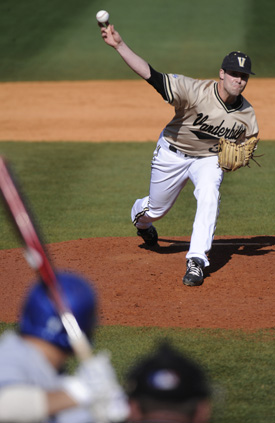 Vanderbilt’s starting line-up, with a robust .340 batting average, and solid starting pitching have generally put the Commodores up early in games this season.
Of course, sometimes things go awry. The bats go cold. A starter gets shelled.
The inglorious task of keeping the game `stabilized’, as Corbin put it, has been relished by Vanderbilt’s bullpen and it’s turned what could be tough losses into rousing wins. The Commodores have gone 6-0 in one-run games after going just 5-10 in such contests in 2009, and the bullpen has yet to suffer a loss.
Junior closer Russell Brewer has four saves and hasn’t allowed a run in 16 innings of relief. In perhaps the most mentally challenging role in baseball, Brewer has found a way to zone in to his pitching and zone out the pressure.
And this comes from a pitcher who doesn’t possess a blinding fastball that so many big-name closers have in their arsenal.
“I just think he’s completely immune to where he is,” Corbin said. “I just think he knows, `This is me, this is where I go, and this is what I have to do.’ There’s really no thought to what he does. He goes out there and competes at a high level. He knows where to put his pitches; he’s got believability in his pitches.
“And I think for a pitcher, if you don’t throw 95 or above, it’s really how much you believe that ball is going to work when it leaves your hand. There are some pitchers who have great stuff but they don’t believe the ball’s going to do anything or it’s probably going to get hit. He’s got great energy to his ball.”
Brewer’s been helped by consistent middle relief from Hayes, Richie Goodenow, Corey Williams and Will Clinard, among others.
Hayes has only made two starts and appeared in relief nine times. His and others’ comfort with their positions in the rotation have allowed them to settle in mentally during games and be more aware of when they will be called to take the mound.
“If you know your role, you can look at the game and see how it’s playing out. Ok, I probably need to start getting mentally ready by the third or fourth inning if I’m going to be the fifth or sixth inning guy,” Hayes said. “Or for Russell, in the eighth, ninth inning, if we got a lead in the fifth, sixth, seventh, I need to start getting ready because it’s going to be my situation. So I think it really helps, because it provides consistency throughout the staff.”
That stabilizing role came to a head in Vanderbilt’s most thrilling victory so far this season, when Kentucky took a 7-0 lead early in the second game of a Saturday doubleheader on March 27.
The Commodores had already won the series by taking the first two games. So a loss in Game 3 wouldn’t have been catastrophic.
But a sweep was greatly preferable.
So six Vanderbilt relievers took a committee approach to stifling the Wildcats, allowing one run over the final four innings, and gave Vanderbilt hitters a chance to claw back.
“What’s happened is the momentum of the other team is now down. Now you’ve got the lead dog looking behind them rather than looking in front of them,” Corbin said. “That’s what relief pitching does. It just kind of stabilizes the game, neutralizes it to the point that the momentum’s done.”
Kentucky’s bullpen, on the other hand, wilted down the stretch. Vanderbilt’s bats came to life, slowly but surely cutting the deficit to 7-6 in the eighth. Then, down two in the ninth, the Commodores scored three, getting the winning run when Riley Reynolds walked with the bases loaded.
“Any time you come back from that kind of a deficit in an SEC game, no matter who it is, no matter what the situation, that’s a big deal,” Johnson said. “From a pitching perspective, we kind of pieced it together and that’s what needed to happen and it worked out in our favor. We had to recycle a couple of guys which is never easy to do, but it was a huge boost for us.”
That kind of stability also gave the Commodores one of their biggest wins at the beginning of the season against a local rival.
Reid stifled Austin Peay for six innings on Feb. 23 but left the game trailing 1-0. Four Vanderbilt relievers combined to shut out the Governors over the final five frames. After tying the game in the seventh, a walk-off Andrew Giobbi RBI single in the 11th inning gave the Commodores a come-from-behind 2-1 victory to improve to 4-0.
“I think it’s going to build some momentum, because last year we didn’t have any walk-off wins like that and we’ve already had a couple this year,” Hayes said. “So I think it’s building the team morale that even if we’re down 5 or 6 runs in the third, fourth inning, we can still come back.
“Just feeling the energy in the dugout, feeling the energy in the stadium that last seventh, eighth, ninth inning on Saturday (against Kentucky), I think it was really big for us, and I think it’ll be real helpful for us as we go forward and build momentum.”
This weekend’s road series against the 11th-ranked Florida Gators, who are 15-1 at home this year, could be a roadblock.
“What we’ve done so far has worked,” Johnson said. “We’ve kept it that way and we’ll see what happens.”
No need to fix what most decidedly isn’t broken.