
Sept. 14, 2011
Commodore History Corner Archive
Editor’s Note: Nashville sports historian Bill Traughber has enlightened Vanderbilt fans over the years with his thoughtful essays on Commodore history. The award-winning author has recently written another book, Vanderbilt Football: Tales of Commodore Gridiron History. The 160-page paperback book includes 55 photos and can be ordered on historypress.net for $19.99.
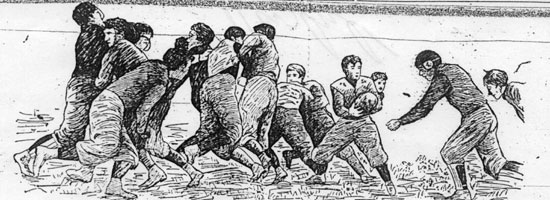
Vanderbilt was in its eighth season of playing football when a shocking event occurred in 1897 at the Thanksgiving Day match with in-state rival Sewanee on the original Dudley Field. The word “hell” had been used in the line of a popular cheer on campus by Vanderbilt students and spread into events as football. This caused uproar with the university administration and the city of Nashville.
The Nashville Banner gave this report:
“Promptly at 2:15 o’clock the Vanderbilt eleven came running onto the field, with Capt. Boogher at their head. The Sewanee team came on in a few seconds afterward. Both teams commenced to pass the ball around for the purpose of limbering up. Throughout this preliminary the students of both colleges gave their respective yells and sung their several songs written for the occasion. There was one yell given with great frequency by the Vanderbilt students which was very offensive to decent people. It starts off “Hippity Huz, Hippity Huz; What in the h–l is the matter with us.” It has become so popular with a certain element at Vanderbilt that it is ever uppermost in the minds and causes them to be oblivious to the fact that it is not exactly proper to shock refined ladies by such utterances.
“The delightful (?) little piece of college nonsense rolls off the tongue very nicely, but Vanderbilt students have learned by long acquaintance with sounds and frequent giving’s of yells how to send this one forth solely and alone, altogether in a class by itself. The first bar of the yell is given lustily. The voice gradually falls on the second, until it is almost a whisper. When it reaches that word intimately associated with Mephistopheles’ realm the voices break forth in one clear, low-drawn shout with startling effect. The general sentiment expressed by the spectators was that this particular piece of college literature ought to be burned up.
“Just preliminary to the game Dr. J. H. Kirkland, Chancellor of Vanderbilt University, called members of both teams, substitutes and all, together and read to them a communication that he had received from the Chairman of the Board of Public Works and Affairs. This letter was a notice of the fact that the policemen had been instructed to put a stop to the college yell and any other noise in the city limits by members of the football teams or students of either college. The letter had the desired effect, for things were extremely quite up town last night and scarcely a Vanderbilt student was seen on the streets or in hotel lobbies.”
Vanderbilt had entered the game undefeated and unscored on with wins over Kentucky (24-0), Central (KY) (14-0), VMI (12-0), Kentucky State (50-0), and North Carolina (31-0). Vanderbilt was coached by R. G. Acton (1896-98). His 1896 squad was 3-2-2. The Commodores would make it six straight games without being scored on with a 10-victory over the men from the mountain.
The Banner reported that as the whistle blew to end the game, Vanderbilt players Howard Boogher and Phil Connell “dived between the lines to secure the ball as a trophy of the victory.” The ball was taken to the gymnasium and placed in Connell’s locker. The gymnasium refereed is the Old Gym, which remains on the Vanderbilt campus today.
Mr. Taylor, the umpire who had officiated in several Vanderbilt-Sewanee games, said after the game that it was the cleanest he had ever seen, and that it was the best of any games between the two that he had officiated. He thought, “Sewanee’s playing was magnificent, and that the Vanderbilt boys were a little better. It was a harmonious game, and altogether very friendly, when the intense rivalry between the two colleges is taken into consideration.”
After the Sewanee game, all talk in Nashville was about Vanderbilt being the champions of the South. The other southern university with an outstanding season was the University of Virginia. The Cavaliers were 6-2 with losses to Navy and Pennsylvania. That university agreed to come to Nashville for a game on December 7 with a guarantee of $600, plus half of the net receipts.
Virginia alumni in Nashville sent this telegram to their alma mater, “As Virginia alumni here we strongly urge you to fulfill contract and play Vanderbilt, as no excuse exists. Otherwise Vanderbilt will publish correspondence and be awarded championship.”
Virginia only brought four substitutes and journeyed 26 hours on the train that brought them to Nashville. A “huge” crowd of 2, 400 watched the game end, 0-0. The Nashville American reported, “Unquestionably it was the greatest game ever played in the South. The assaults on the line were terrific, the tackling was brutal, the entire play fierce. Only once was the 20-yard line of either team invaded. Almost immediately after McAlester kicked off, the terrors of the tandem play were displayed. This play meant to bend one side of the line so that the end, the tackle and the guard reinforced the four backs in their charges at the line. Whether the force was directed was not known.”
Said Acton, “It was the best game ever played in the South. Virginia was heavier and made most of her weight, using mass plays almost entirely. Our men played a more scientific game. My team can beat any team in America of the same weight.” It was said that Vanderbilt’s average weight was 165 pounds.
Vanderbilt and Virginia would share the southern title. The American also reported that, “The Vanderbilt players were in a jolly humor yesterday with their miniature football pinned upon the labels of their coats. Joe Goodson, quarterback, was apparently out of training from a large ten-cent cigar he smoked, a gift of Benjamin Childers of Pulaski. `Tab’ Farrell had his hair cut and other members were more or less changed in appearance.”
In the Vanderbilt 1898 yearbook, The Comet, a tribute by Dr. D. R. Stubblefield was printed:
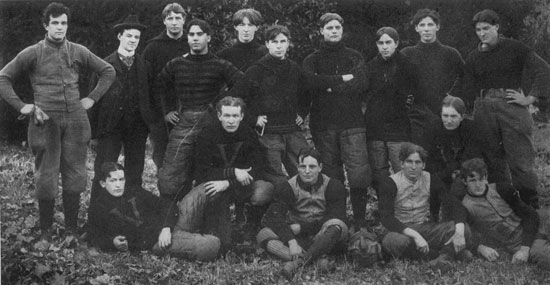
“The team of 1897 was the greatest Vanderbilt University ever put on the gridiron. They studied themselves; they intelligently utilized those things that helped to make them; they analyzed their opponents. The proof of this high praise is their unheard of record.
Hail, the team of `Ninety-Seven,
Heroes every one!
Raise their triumph up to Heaven,
For the deeds they’ve done!
The shared football championship must have given cause to forgive those “radical” students that earlier had the nerve to use a one-word obscenity in cheering on their Vanderbilt Commodores.
The photos attached to this story are the 1897 Vanderbilt football team and a drawing in the Nashville Banner from the 1897 Vanderbilt–Sewanee game.
Traughber’s Tidbit: During the 1897 season, in the second half of the Georgia game with Virginia in Atlanta, a Georgia fullback named Richard Gammon was fatally injured on a play. The Georgia, Georgia Tech and Mercer football teams soon disbanded. The Atlanta Journal ran a headline, the “Death Knell of Football” and the Georgia legislature passed a bill to outlaw football in the state of Georgia. A letter from Gammon’s mother to the state legislature asked that the bill not be passed because her son loved football so much. Georgia Governor William Atkinson vetoed that bill to ban football in Georgia.
If you have any comments or suggestions you can contact Bill Traughber via email WLTraughber@aol.com.