

May 27, 2009
Subscribe to Commodore Nation Magazine / Archive
There is a saying about small towns that if you blink, you might miss them. Chapel Hill, Tenn., is one of those towns. Just 36 miles south of Nashville in Marshall County, Chapel Hill has a little more than 1,000 residents and two stoplights.
From Rex’s Foodland to the Country Diner, as in most small towns, most everything in Chapel Hill is locally owned and operated. The only franchised restaurants are Sonic and Subway, which have both opened in the past five years.
What Chapel Hill may be most known for in the southeast is the annual Lions Super Pull of the South each July. The event is so renowned that it has been named the national tractor pull competition of the year on seven occasions and annually attracts close to 20,000 spectators.
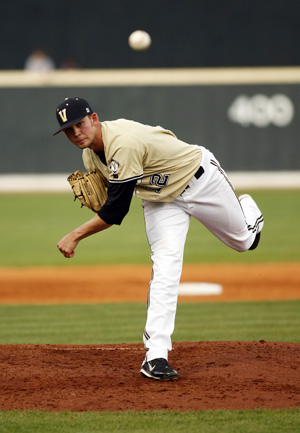
Chapel Hill also is the hometown of Vanderbilt ace Mike Minor, who has proved once again that being from a small town has nothing to do with being small-time. Minor has gobbled up accolade after accolade in his tenure at Vanderbilt. He was named a Freshman All-American by just about every baseball publication in 2007 and he was named Baseball America’s 2008 Summer Player of the Year.
Success on the baseball diamond is nothing new to the junior left-hander, who was a three-time all-state selection at Forrest High School, where he led the school to a runner-up finish at the 2006 Class A state tournament. The same season Minor won 13 games, including 12 by shutout, and had a 0.08 ERA with 188 strikeouts in 86 innings.
“We’ve had a lot of good players and we’ve had a lot of good pitchers, but we haven’t had any in his class,” said Forrest High School Baseball Coach Wayne Hardison, who began the program in 1986. “He was as automatic as they come.”
Minor didn’t just win in high school, he won with numbers that are usually seen only on video games. The stories of how he pitched are those that grandfathers could tell their grandkids. Stories that sound mythical as time passes much the same way as the distance of Mickey Mantle’s home run that cleared the right field roof at Tiger Stadium or Babe Ruth calling his shot.
There is the story of Minor pitching a perfect game in the second game of a home and road doubleheader one night. There is the story of him recording all 21 outs of a 7-inning game by strikeout. Ironically, his 21-strikeout game was also the only game he allowed an earned run his senior year. There are also stories of him backing up his words on the mound such as when he told his coach, “Coach, the ball game is over,” after a late-inning mound visit.
Minor’s success in high school games helped put him on the map as a baseball player, but in order for people to find a player in Chapel Hill, Tenn., Minor and his father Mike Sr. knew he had to first go where the scouts were.
“When I was younger, my dad made me go to all the camps and all the showcases,” Minor said. “I had to go to every single thing someone invited me to because he knew there was no other way. No one is going to go to Chapel Hill to watch a small-town pitcher throw.”
Minor also knew that his numbers could easily be pushed aside by the fact that he played against lesser competition at smaller schools.
“People would say even if he does good, no one cares because the hitters aren’t very good,” Minor said. “I needed to prove myself and throw against the better hitters.”
Needless to say, he proved he was good no matter the competition and eventually word began to spread. Soon Forrest High School was receiving the type of attention from college and Major League Baseball scouts that Class A programs rarely get. Each time Minor pitched there were 15-20 scouts behind home plate with radar guns in hand.
Minor had never received so much attention, and neither had Hardison, who got bombarded with telephone calls from college and professional teams that wanted to see Minor pitch.
“Mike’s junior year was when (the scouts) first really started coming and I left a message on my phone that said, `If you are calling about Mike pitching, he is throwing on this day and that day and those games are at this particular time and I will replace this message if any plans are changed,'” Hardison said. “That saved me a whole lot of calls. It was just hard to keep up with everyone calling.”
The scouts kept coming and each time they came, they left even more impressed. Eventually, Minor’s success led him to one of the hardest decisions he ever had to make when the Tampa Rays drafted him in the 13th round of the 2006 MLB Draft.
“It was pretty tough because to come from a middle-class family, that kind of money sounds like a lot of money,” Minor said. “When you see that money right in front of your face, it is kind of hard to turn that down.
“My dad and I sat down almost every night going back and forth trying to figure out what to do. I didn’t know what I wanted. I was 18 years old and I had all this money in my face and my dream was to go play Major League Baseball. It was really hard, but at the end, it was so overwhelming and the money wasn’t enough to make me say yes, so I chose Vanderbilt.”
His decision to come to Vanderbilt couldn’t have turned out better. He is in his second season as the team’s No. 1 starter and is regarded as one of the top pitchers in the country.
As Minor continues to improve, so has his support level from fans, but no set of fans are prouder to see Minor succeed than the residents of Chapel Hill, who view Minor as a role model despite being just 21 years old.
“All the grownups and younger kids look up to him,” Hardison said. “People not just in Chapel Hill, but around the county and around the area are proud of Mike. I hardly ever play a game or go somewhere where there are coaches and people around where baseball is being played that somebody doesn’t ask me how Mike is doing.”
Chris Messick operates Rex’s Foodland in Chapel Hill with his father Rex, who owns the business. He has known Minor since the Vanderbilt ace was just a kid, and like everyone in town, he couldn’t be happier with how Minor has represented Chapel Hill.
“Everybody around here pretty much knows everybody if you’ve been here long enough,” Messick said. “We all follow what (Mike) is doing.
“There has always been a connection with everyone in town, and he has kind of put Chapel Hill and Forrest High School on the map you could say.”

His importance to his hometown is something Minor understands and embraces, but he is still getting used to the attention. Even though there are a little more than 1,000 residents in the town, there is usually a good-sized contingent of Chapel Hill residents in the crowd when Minor pitches. Against Florida on April 3, a group of 80 people from Chapel Hill purchased tickets to watch Minor pitch.
“I still have people come up to me anytime I go home and tell me how proud they are I went to a Division I college,” Minor said. “In a bigger city, people go to Division I colleges all the time and you don’t have people come up to them and say how proud they are that they went Division I. I think I might have been the third person ever to go to Vanderbilt from Chapel Hill.”
Further adding to the significance of Minor playing at VU is that he is the only player from Chapel Hill to ever play Division I baseball. Seeing Minor play Division I has given hope to others that they, too, could make it to where he has.
“We are a small school and we play good baseball, but when you get a D1 scholarship at a Class A school, the rest of the players think maybe I don’t have to go to a private school or a big school to play D1 ball,” Hardison said.
The hope Minor has provided other kids in his hometown is something he is proud of.
“When I go home, I get a lot of kids who are athletes asking me what I do there in terms of weight training, running and throwing,” Minor said. “It is pretty cool to tell them what we do because they take that to heart. They will actually try it, so it is motivation to them because they know Vanderbilt does it.”
By Vanderbilt doing it, the students know that not only is Minor doing those drills, but so did former Commodores David Price and Pedro Alvarez, who went on to become the No. 1 and No. 2 draft picks, respectively. In Minor’s first two years, the spotlight was on Price and Alvarez, but now it is on him. That adjustment has taken some time to get used to.
“It is hard to fill (Price’s) shoes with him going as the No. 1 pick and the way he carried himself on the field and off the field,” Minor said. “He was a big leader and very vocal, but I’m just not that kind of guy. I’m the type of guy that is pretty quiet and just tries to lead by example.”
As someone who would prefer to let his actions speak louder than his words, it would be hard to find someone who has set a better example with their play on the field than Minor.
In addition to his stellar play for the Commodores, Minor has been a key cog for the U.S. National Team the past two summers. Last year alone, Minor served as the ace for the team that went 24-0 over the summer and won the International University Sports Federation World Championships. With the team, Minor went 3-0 with a 0.75 ERA with 37 strikeouts in a team-high 36 innings pitched.
“I really noticed the significance of how I did when I watched the World Baseball Classic,” Minor said. “My dad asks questions all the time and I used to just give him the short answers, but you don’t realize how significant it is. I realized how lucky I was to go with the U.S.A. team two years in a row and this past year go undefeated. It is something I’ll never forget.”
Minor’s biggest moment with the U.S.A. team came in the biggest game. Playing Japan in the gold medal game, Minor threw 9.2 innings of shutout baseball in a contest that the U.S. won 1-0 in 12 innings.
“So far it is best experience I’ve had in baseball,” Minor said.
Even with his success on the diamond, Minor is always striving for constant improvement. In his first two seasons at Vanderbilt, he was limited to a fastball and a changeup. He has since added a slider to his repertoire and is getting more comfortable with a curve ball.
However, maybe his biggest improvement has come with his mental game. Growing up, it was rare for another team to score a run off Minor, but when someone did, Minor was always his own worst critic and emotions would sometimes affect his play on the field. With the help of Vanderbilt pitching coach Derek Johnson, Minor has focused on harnessing his emotions.
“I am always a guy who gets really upset with myself and is very competitive within myself. If I gave up a hit, a double, a home run, I was so mad at myself I couldn’t come back from it,” Minor said. “I couldn’t bounce back and just say, `It was one pitch and we can still win this thing.’
“This year, I thought about how stupid it was and how it is one pitch at a time and you have to move on and you have to have a short memory. That is a big part of my game right now that I had to improve on and it is going to help me in the long run, and has helped me. I’ve just got to have confidence in myself to know that I’m going to be better than anybody that comes up to the plate.”
So far, Minor has been better than pretty much anyone he has faced at the plate and because of that he will be one of the most coveted players in June’s MLB Draft. Inevitably, Minor will be faced with another difficult decision of whether to sign or return to school. But no matter what route he goes, earning his degree will remain a priority.
“Neither one of my parents went to college because they didn’t have a lot of money,” Minor said. “I would be the first one in the family to graduate, so it is very important to me to get a degree.”
Chapel Hill may be small enough that you might miss it if you blink, but Mike Minor has shown that just because you are from a small town it doesn’t mean you can’t have a big-time game.