Like Charley, with whom she overlapped for a year with the Commodores, Hopkins didn’t have a labor background. At Vanderbilt, she earned her bachelor’s degree in medicine, health and society and minored in business before eventually earning her master’s in exercise physiology at Virginia. But after helping Vanderbilt win the 2020 SEC Tournament and earning All-ACC honors in back-to-back seasons with the Cavaliers, she was selected by North Carolina in the first round of the 2023 NWSL Draft. Even while working with an agent, looking at the contract she was about to sign drove home that a soccer career was about much more than playing the game.
“It was the first time I’d been put in the position that I had to learn to represent myself and assign that monetary value to myself as an athlete,” Hopkins said.
Never short on curiosity about much of anything she encounters, she sought out more information on how the league’s financial model worked and what it meant for her. The questions led her into the orbit of players involved with the NWSLPA.
“I think that a lot of my experiences at Vanderbilt unknowingly shaped my critical thinking and asking the right questions,” Hopkins said. “And just asking questions that most people have but don’t necessarily feel confident enough to ask.”
As with Charley’s experience three years earlier, all of this unfolded against the backdrop of negotiations for a second CBA. Hopkins joined the new bargaining committee, and never one for half measures, threw herself into studying labor issues even as she simultaneously put in the hours on the field and in the training room to establish herself as a starter with North Carolina. Ratified last year, the new CBA further expands player rights and notably made the NWSL the first major North American professional league to eliminate the college draft.
Earlier this year Hopkins was elected president of the players association after former president Tori Huster was appointed deputy executive director following her retirement from playing. It’s a remarkable ascent for someone in just her third season, accomplished even as she navigated an offseason trade to Kansas City and signing a contract extension with that team.
“Bottom line, the role of the players association is essentially always going to be protecting the players and ensuring that their health, wellness and safety are going to be contractually protected,” Hopkins said. “At the same time, we’ve established a lot of that groundwork and that framework over the last couple years, and we can kind of shift into terms how best to capitalize.”
Much of that involves high-visibility issues like revenue sharing, but she’s also identified the transitionary period between playing and life after soccer as a personal priority. Careers aren’t long, and NWSL earnings don’t provide generational wealth. She wants to enhance opportunities for tools like career mentoring, internships and continued education—especially as the number of players entering the league from high school increases.
Elected vice president this year, Charley also has policy interests informed by her own journey. Although part of Orlando’s regular season and postseason champions a year ago, Charley wasn’t able to play because of injury. She’s again sidelined this season by injury. Even as she rehabs and works to restart her on-field career, she founded a support group for injured players through the NWSLPA. Being injured can be isolating. Coaches and healthy teammates have to carry on around you. Led by a sports psychologist, players who participate in the group meet via video conferencing once a month to walk through their recoveries and discuss the mental, physical and emotional toll.
“It feels like therapy for me too on the calls,” Charley said. “There’s something powerful in just knowing you’re not alone. Going through an injury, you don’t have the answer—we can’t wave a wand and heal you. But I think it still feels healing knowing that, hey, there are other people who’ve had the same struggles as you and are who are going through it but who can also celebrate you and pick you up.”
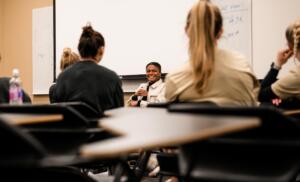
Simone Charley speaks with Vanderbilt soccer student-athletes (Vanderbilt Athletics).
Lifting Up the Next Generation
Hopkins lived a distinctly modern soccer life even before she started negotiating collective bargaining agreements. The transfer portal didn’t exist when she arrived at Vanderbilt, but she eventually utilized the newfound freedom of movement to pursue a graduate degree and play at Virginia. She doesn’t shy from acknowledging that path created some tension in her relationship with a coach and a program that would have dearly loved to keep watching her bang in goals and compete for SEC titles for a couple of additional seasons.
Such wounds are only human. But tension fades with time, space and eventually conversations. What doesn’t fade are the bonds forged across four years in Nashville—with the school, with teammates and certainly with a mentor who helped unlock her potential.
“When I think about my years at Vanderbilt and how that shaped me as a person and a player, it was the resilience learned and Darren’s core values,” Hopkins said. “I still find myself quoting those to this day, and I will pass along messages to let him know—he knows those are pretty well instilled in all of his alumni’s brains. It’s the resilience. You’re put through some hard times. Playing soccer at Vanderbilt, it was not easy.”
She didn’t hesitate when Ambrose asked her about being part of his mentoring program that pairs current Commodores with alumnae. Always looking for parallels, Ambrose paired her with Teater, a midfielder who is in many ways her mirror image after transferring from the ACC and North Carolina to Vanderbilt and the SEC prior to her junior year.
 “One of my struggles that I’ve talked to Haley about is just transferring and everything that goes with it,” Teater said. “I appreciate her being able to just kind of ease my mind and be like, ‘Look, you’re where you need to be, everything’s going to work out.’ We’ve had multiple conversations like that, where she’s been so helpful.”
Teater was barely in elementary school when the NWSL was founded. Some of her earliest soccer memories growing up in the Midwest involve the Chicago Red Stars, a team that was also part of the short-lived WPS prior to the NWSL. She’s always been able to dream of playing professionally in her own country, distant as that dream was for earlier generations.
By reaching the upper echelon of Division I, driving the midfield and sharing the team lead in assists a season ago for an NCAA Tournament entrant, that dream has morphed into more of a realistic career goal. Whether it’s in the NWSL or abroad, playing professionally is achievable. In Hopkins, she has an invaluable direct line to advice from someone currently living that. All the more in a world without the draft, Hopkins has been a fount of helpful information about what to look for in agency representation and how to think about playing systems and philosophies that would set her up to succeed at the next level.
Although soccer is scarcely less central in the life of someone who already represented Grenada in senior international competition and will intern with MLS’ FC Dallas this summer, Fullerton can envision leaving the cleats behind after college. Maybe. Let’s just say she’s keeping her options open. When she calls or texts Charley, the conversations sometimes involve training tips. But soccer is just as likely to be the jumping off point for talking about life off the field, whether that’s their shared Grenadian heritage or their faith. Or Ambrose stories, although Fullerton wisely demurs when it comes to those details.
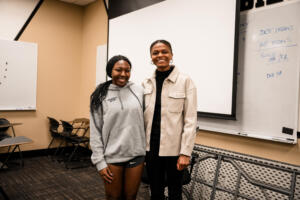 “She reminds me of a young me finding myself and finding God in college,” Charley said. “Seeing her relationship with God grow and how that’s changed her is honestly inspiring for me. We had a phone call the other week, just talking, and she asked to pray for me at the end of the call and I’m tearing up.”
In a reminder of just how quickly time passes, Fullerton was stunned when Charley told her the story of going undrafted (granted, the younger player was in middle school at the time). She learned about her mentor’s difficult path to establishing herself in the league and even experiences some of Charley’s current comeback ups and downs in real time. That helps in the present, giving Fullerton perspective on her own experiences trying to get on the field for the Commodores. It will likely prove even more useful in the future.
“She’s just very humble, and the way she carries herself and speaks is something I can learn from her,” Fullerton said. “Even when she was going through her Achilles journey, she would post appreciation for her teammates, her coaches, the Pride. It’s encouraging to have someone like that make time to speak with me. She’s really admirable, and her resilience and humility are examples I can use through any struggle I may have.”

Hopkins embraces head coach Darren Ambrose after winning the 2020 SEC Tournament (Vanderbilt Athletics).
Alumni With a Legacy
With Charley and Hopkins the most accomplished examples, Ambrose is proud of his program’s record of helping players follow through on their ambition to play professionally. Seven Commodores were selected in the NWSL draft during its existence, not to mention numerous other like Juventus’ Abi Brighton who pursued professional opportunities abroad. If they have the talent and resilience, they leave better prepared for the next level.
They also leave Vanderbilt ready to make the next level a better place. All while turning around and extending a hand to those who stand where they once were.
“The coolest thing about seeing those players in the league is the impact they’re having, not only on an athletic basis, but a personal basis where they’re impacting the league in a way that will have an importance years down the road,” Teater said. “And I think it’s cool to go into a program and leave your mark. That’s something that I’ve wanted to do at Vanderbilt, and seeing Haley do that has been something that gives me footsteps to follow in.”

