
Jan. 12, 2015
By Jerome Boettcher | Subscribe to Commodore Nation
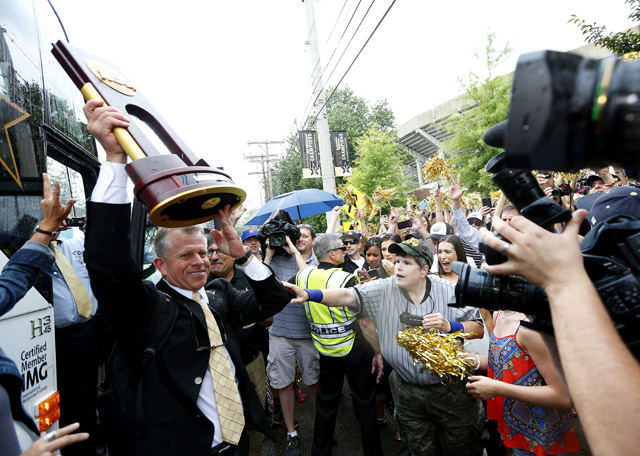
For many Commodore fans, their favorite Christmas gift came about six months early – back in June when the baseball team captured the national championship.
The title was a long time coming for many hungry Vanderbilt fans who had waited their entire lives for this moment. The championship ended a long drought for Commodores men’s sports, which had never won a national title – and it was the first since the women’s bowling team won the school’s first team championship in any sport in 2007. Individually, Ryan Tolbert won the women’s national championship in the 400-meter hurdles in 1997.
But while bowling coach John Williamson and baseball coach Tim Corbin are the only coaches to deliver team national titles at Vanderbilt, they’re not the only ones on staff to know what that moment feels like.
Championship pedigree can be found throughout the athletic department – from lacrosse to track and field to tennis to football to golf. Current Vanderbilt assistant and head coaches have won 26 national championships as either a student-athlete, assistant coach or head coach.
“I just think a national champion is a different beast,” lacrosse head coach Cathy Swezey said. “You are a champion inside before you accomplish that goal. You just have to be willing to go through whatever wall is put in front of you in order to win. I think the people that are that gritty are the ones that succeed.”
Swezey, in her 18th year at Vanderbilt, tops the list with a mind-boggling eight national championships over two sports. She won five lacrosse and field hockey national championships as a player and three more as a graduate assistant – all at Trenton State (now The College of New Jersey).
Men’s golf coach Scott Limbaugh won back-to-back national championships at Central Alabama Community College to start his playing career. Men’s tennis associate head coach Jamie Hunt also had the same good fortune, winning two national championships at Georgia. Assistant track coach Clark Humphreys was crowned an NCAA champion after setting the Auburn school record in the pole vault with a mark of 18 feet, 4.5 inches.
Men’s tennis coach Ian Duvenhage has coached two doubles teams and two singles players to national crowns (at Miami and Florida). Head cross country and track coach Steve Keith was the distance coach at UTEP when two of his runners claimed NCAA championships.
Football assistant coaches Charles Bankins and Keven Lightner were on the staffs of Richmond and Western Kentucky, respectively, for national championship runs.
Pitching coach Scott Brown and hitting coach Travis Jewett collected their first national titles, along with Corbin, this past summer at the end of Vanderbilt’s triumphant run through the College World Series. And assistant bowling coach Josie Earnest was a freshman when Williamson and the Commodores, in just the third year of the program, won the 2007 national championship.
“They’re so hard to come by – championships,” Humphreys said. “The stars have to line up. You have to have everything right and healthy. They are hard to come by. They should be celebrated.”
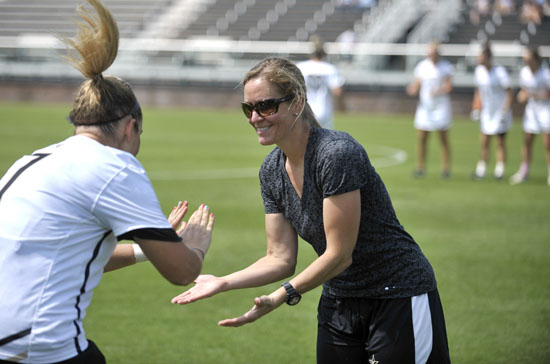
Swezey knows a thing or two – or eight – about celebrating national championships. Trenton State was on its way to becoming a Division III powerhouse when Swezey arrived in 1990. Swezey turned down Division I offers for the chance to add to the legacy of both the lacrosse and field hockey programs, which were both and are still led by coach Sharon Pfluger.
As a player, Swezey helped the Lions win national championships in 1991, 1992 and 1994 in lacrosse. In 1993, Trenton State also claimed the crown but Swezey took a redshirt because of an injury. She then served as a graduate assistant in 1995 and 1996 as the Lions won their sixth straight championship. The two-sport All-American was also on the field hockey team for two titles and a third as a graduate assistant.
“Every time we won it was just as sweet,” Swezey said. “The excitement level and energy. Just knowing that you put so much effort into something and you get a positive outcome. I often tell my teams now that I want you guys to realize the fruits of your labor. I want you to know because you worked this hard, good things will come.”
Hunt also walked into a juggernaut as a freshman.
The Georgia men’s tennis team was ranked No. 1 in the preseason and lived up to the billing. The Bulldogs went 32-0 in 2006-07, winning 18 matches against Top 25 opponents and cruising to the fifth national championship in school history on its home courts in Athens.
But it was probably Hunt’s second national title that was more satisfying. The 2008 crown was unexpected, as the Bulldogs had lost two seniors, including current pro tennis player John Isner, to graduation and missed their top two players for an extended period of time during the season.
“I would say the second one was more rewarding,” he said. “We weren’t expected to win. We were able to grow as a team because more was asked of each guy behind them… It took a little while to hit us. That is one of the main reasons why you play and you work so hard in the year and you sacrifice so much is really that moment. You are all celebrating together. It is a really special moment.”
And the second crown wouldn’t have happened if it weren’t for Hunt.
Before the Bulldogs defeated Texas in the national championship match, they had to get past No. 1 and undefeated Virginia in the semifinals. With the match knotted at three games apiece, it came down to the No. 4 singles match. With all eyes on Hunt as Georgia tried to defend its crown, the sophomore rallied from losing the first set to win the next two and upset the top ranked team and heavy favorite.
“It was 3-all and I was the last guy on the court so that was pretty intense,” he said. “But it was also an incredible moment for me, knowing my team and coaches and the whole Bulldog nation were behind me. To be able to come through and beat the undefeated team was pretty awesome.”
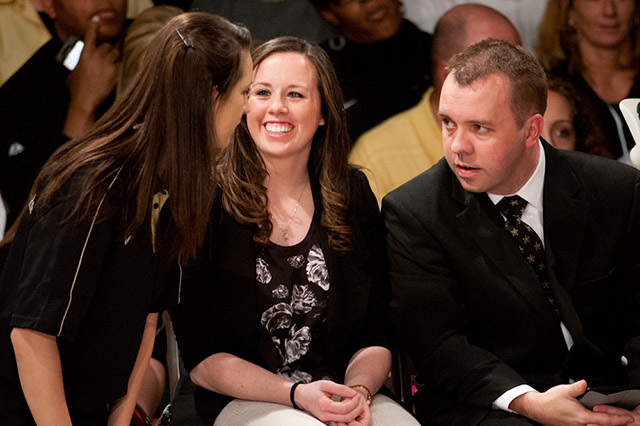
When the Vanderbilt women’s bowling team won the school’s first team national championship in any sport in 2007, it was a surreal and thrilling moment as well. But head coach John Williamson immediately began to think about the moments that almost certainly loomed ahead, especially with four sophomores and a freshman – All-American and current assistant coach Josie Earnest – in the starting lineup.
“When we actually won it, I think I wasn’t prepared to actually win it,” Williamson said. “I instantly started thinking about how great we could be as a group with four sophomores and a freshman. I instantly started thinking about numbers 2, 3 and 4. Ultimately, what it showed me was winning a championship on any level and any sport is pretty difficult. It would definitely be something I’d appreciate more and I would probably stay more in the moment now and not get too far ahead of myself.”
Williamson and the Commodores are still searching for their second bowling national championship.
They have reached the NCAA Tournament every year since and made the championship match in 2011 and 2013. But they haven’t been able to duplicate that feeling from 2007.
And Williamson, who began the program in 2005, says eight years later he is learning that it can’t be duplicated. Getting caught up in trying to live up to the expectations that come after winning a championship, can be nerve-racking and ineffective.
“We focused steadily on the last few years on not necessarily talking about winning the championship, more so on taking care of our stuff, more about our process and more about our event,” he said. “If we handle ourselves and compete against ourselves we should have a pretty good result. I think you get in trouble if you start trying to recreate things or you start trying to relive things you’ll never recapture it.”
Ask any of the Vanderbilt coaches with national championships on their resume what it takes to stake claim as the country’s best and they’ll give you a myriad of answers.
For Williamson, he believes the 2007 crown was won because he had a team that was good enough and caught some lucky breaks – which is the case for most championship runs – along the way. The fact that his team was so young – it was only the third year of the program – probably didn’t hurt either. Their youth and inexperience may have kept them from grasping the magnitude of the moment.
Tim Corbin had a mixture of youth and experience this past year. And like the bowling team’s title, Vanderbilt baseball’s first crown was unexpected. A team that lost 21 games and were bounced early from the SEC Tournament seemed to develop and form right when it mattered the most – with its season on the line.
“There was a mental toughness component of their team that certainly grew. It was not there at the beginning of the year,” Corbin said. “…When they gained that, the team became more confident. You could see better things starting to happen. The energy was all directed in that way. It was a perfect storm. It was a storm that came together, and it grew. I felt at the end of the year they weren’t going to let this moment go.”
Hunt says Georgia’s championships team possessed discipline to make the right decisions on and off the court that benefited the entire team – not just the individual. He also agreed with Corbin that team chemistry was a key ingredient.
“It is not the most talented teams that win a lot of time but it is the closest team,” Hunt said.
For Humphreys, he refused to lose. His individual championship was on his shoulders. When a rain delay threatened to keep him from jumping, Humphreys shooed away the official running the pole vault competition and raced down the wet and slick runway to leap more than 18 feet. After a four-hour rain delay, in which he sat by himself and stayed in his zone, he pushed to 18 feet, 4 1/2 inches to claim the crown.
Swezey says her teams at Trenton State also had a fear of losing, more than they wanted to win. Three and a half hour practices were the norm so much so that the Lions assumed everyone else was working just as hard to win.
“In the end, now do I realize we outworked everybody in the country? Yeah,” she said. “But at the time I don’t think we necessarily knew. Hard work was just part of the equation.”
In addition, Swezey credits great leaders who made the difference on those teams. Understanding the importance of leadership – athletically, academically and socially – has benefitted her most successful teams at Vanderbilt, including the Final Four squad in 2004. Athletic director David Williams believes those same qualities resonate in his coaches – in all sports. They demand the best from their student-athletes and want them to experience the championship moment.
“We’re very blessed to have a cadre of coaches that have the ability, the qualifications and the credentials that they have,” Williams said. “I really think we have the best collection of coaches in the country. It is not only that they are good coaches, they are good colleagues. Everybody is cheering for everybody else.”