
Dec. 1, 2014
By Jerome Boettcher | Subscribe to Commodore Nation
Really, this is a book 25 years in the making – even if Andrew Maraniss didn’t know it at the time.
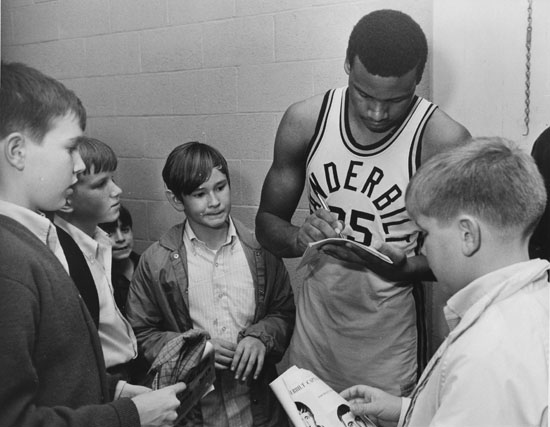
In 1989, as a sophomore at Vanderbilt, he read a student magazine article about Perry Wallace. This was Maraniss’ introduction to Wallace  who played basketball at Vanderbilt from 1968-70 at the height of the Civil Rights Movement and was the first African-American basketball player in the Southeastern Conference.
A history major and recipient of Vanderbilt’s Fred Russell-Grantland Rice sportswriting scholarship, Maraniss saw both of his loves – history and sports – colliding. He was so intrigued by the article that he wrote a paper on Wallace for his black history class.
“Being someone who really cared about Vanderbilt and Vanderbilt basketball and that this person made history at our school, it was something that really grabbed me,” Maraniss said. “I didn’t really comprehend the full story until I began doing the research for this book. But I always knew it would be an interesting story.”
In 2006, Maraniss conducted his first interview for a book on Wallace with former Vanderbilt men’s basketball coach, the late Roy Skinner. Since then, Maraniss has gotten married, had two children and moved. And, he has also interviewed more than 80 people, traveled to numerous SEC towns and spent more than four years researching, including scouring the Vanderbilt Archives and the National Library.
The end result? His first book, “Perry Wallace and the Collision of Race and Sports in the South,” which hit bookstores this month.
“I didn’t write the book just for a Vanderbilt audience, but obviously Vanderbilt people are an important audience for this book,” Maraniss said. “I hope they’ll really come to understand better somebody that is such an important person in the history of the university and athletic department. My personal opinion, Perry’s story is the most interesting story in the history of the school. To be lucky enough to write about that means a lot to me.”
Wallace is one of just two VU men’s basketball players to have his jersey retired in Memorial Gymnasium.
Now a law professor at American University Washington College of Law, Wallace witnessed racism throughout his childhood. He grew up in segregated Nashville and as Maraniss points out key moments in the Civil Rights Moment lined unfolded in Wallace’s early years.
He was a kindergartener the same year as Brown v. Board of Education. He was a young kid when 14-year-old Emmett Till was tortured and killed by two white men after Till reportedly whistled at a white cashier in Mississippi. At 12 years old, he went into downtown Nashville to watch sit-ins at lunch counters. Martin Luther King, Jr.’s “I Have a Dream” speech was a week before he began his freshman year at Pearl High School.
“He felt like the country was changing and doors were opening at just the right time for him and for his generation,” Maraniss said. “When he visited Vanderbilt on his recruiting trip he was impressed by the basketball program and the fact that the student-athletes were going to class. He was a very serious student. He was a valedictorian of his high school class. He was an engineering double major at Vanderbilt. He actually decided to go to Vanderbilt despite what he knew were going to be the difficulties, despite the fact he would be this trailblazer – not because of it.”
Traveling on the road, Wallace faced threats on his life and heard racist chants in and out of the gym. Ole Miss cancelled both games with Vanderbilt’s freshman team during Wallace’s first year with the Commodores due to “schedule conflicts,” according to the Louisville Courier-Journal. Maraniss actually traveled to Oxford, Miss., and dug up newspaper articles about Wallace’s first game at Ole Miss.
But the “gold mine” moment for Maraniss and his book came when he was sifting through papers in the Vanderbilt University Archives. He discovered a transcript of Wallace’s speech he gave to Vanderbilt’s Human Relations Committee at Kirkland Hall. The emotional Wallace addressed his experiences of integrating the SEC and being one of the few black students on campus.
“Perry is such a brilliant person that even as a young student you could see it in the words that he gave that day,” Maraniss said. “… Really that experience sticks with you the rest of your life and it hasn’t always been an easy thing for Perry to have to deal with. But he’s dealt with it as well anyone possibly could.”
He first interviewed Wallace back in 1989 for his black history class paper. Maraniss, a 1992 VU grad, kept in touch while working as Vanderbilt’s men’s basketball sports information director for five years. And, eight years ago, when he decided he wanted to write his first book it was his future father-in-law who suggested his subject be Wallace.
“I always feel better about the world and myself and human nature after I get off the phone with Perry,” Maraniss said. “Even as much hard times he has been through, he is such a smart, thoughtful person that he always puts things in perspective and has a way at looking at the world that is really honest and refreshing.”
The entire process has been satisfying and challenging for Maraniss, who is a partner at local public relations firm McNeely Pigott & Fox and stays busy at home with two young children. He has followed in the footsteps of his father, David Maraniss, a Pulitzer-Prize winning journalist and author. Maraniss cried when he received a complimentary email along with a review for the back cover of the book from legendary Sports Illustrated writer Frank Deford.
The book is on sale now and more information can be found at andrewmaraniss.com. On Wednesday, Wallace and Maraniss will be at the downtown Nashville Public Library at 6 p.m. to speak about the book and sign copies. They’ll also be on hand to speak the next day, Thursday, at 2 p.m. at the Vanderbilt Library. Later that night they’ll be at Memorial Gym signing copies of the book before and after the Commodores’ game against Baylor.