
Nov. 25, 2014
Commodore History Corner Archive
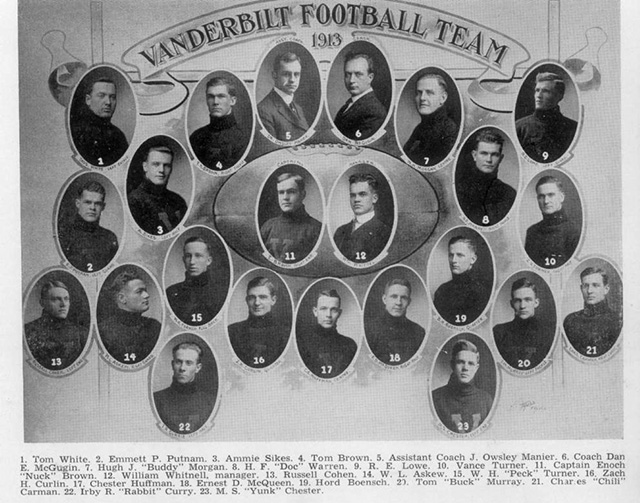
When the Tennessee Vols’ football team arrived at Vanderbilt’s original Dudley Field for a Nov. 8, 1913 game, they were winless against the Commodores. The Orange and White were 0-11-1 since the series began in 1892. They left Nashville that autumn afternoon still without a victory.
Z.G. Clevenger was in his third year guiding the Vols while the legendary Dan McGugin was in his 10th season at the helm of the Commodores. This is the actual summary of that 1913 game as reported by Tennessean sports writer Jack Nye:
Out rushing the Commodores and playing them to a standstill in every department of the game, the University of Tennessee eleven was robbed of a well earned and deserved tie yesterday through failure to kick a goal after touchdown.
Evenly matched in speed and weight, the two elevens fought fiercely and desperately through the sixty minutes of play and the Commodores felt themselves lucky to be able to claim a 7-6 victory when the final whistle sounded. It will go down on the records as a Vanderbilt triumph, but those that saw the game will concede that Tennessee was fully the equal of the Commodores in every department of play and that when Carroll’s kick after touchdown wavered and went wide of the uprights, the Orange and White were unfortunate to be deprived of a tie that was rightly deserved.
Showing a versatile attack and employing with much success the famous Minnesota shift, the Volunteers started the game with a rush and during the first period had the ball in Vanderbilt’s territory a greater part of the game. “Red” Rainey, the little halfback of whom so much has been heard, was the mainstay of the Tennessee attack. And the manner in which he skirted the Vanderbilt ends as soon as the ball was put in play, threw consternation in the Vanderbilt camp.
TENNESSEE SCORES FIRST
Getting the ball on Vanderbilt’s 45-yard line on a punt, Tennessee whirled it down field in a series of line-plunges and dashes around end depending on the elusive Rainey when a gain was badly needed and the spectators were dumb with surprise when the fiery-headed youth was given the ball on Vanderbilt’s 14-yard line and skirted the opposing right end for a touchdown before the quarter was up. With the speed of a deer, he eluded all Vanderbilt tacklers with the exception of midget Boensch, who made a dive at him, only to be shaken off as a cat would shake a rat.
The touchdown was made at the extreme eastern corner of the field and Carroll kicked out to May, who heeled the call easily. However, Carroll’s kick went wide of the crossbars and consequently lost the game.
The quarter ended with Tennessee leading by one touchdown and the supporters of the Orange and Blue were wild with delight. But the Commodores, nothing daunted made the best of their opportunity in the second period and under equally as sensational circumstances scored the touchdown with a successful goal saved their colors from the degradation of defeat.
PENALTY HELPS VANDY
Vanderbilt’s touchdown can be attributed directly to Right Guard Bayer, whose action in slugging Martin Chester caused Tennessee to be penalized half the distance to the goal shortly after the quarter opened, a distance of 33 yards, which put the ball on Tennessee’s 35-yard line. Bayer was sent from the game by Umpire Bradley Walker.
Boensch, quick to grasp the opportunity, caught the opposing defense unaware by making a forward pass on the first down He hurled the ball 25 yards into the outstretched arms of Capt. E. Brown, who whirled and rushed 10 yards across the goal line, shaking off several tacklers. Boensch, kicked out to Sikes who heeled the ball, and Boensch then cleaved the goal posts with a pretty goal.
The line-up:
Vanderbilt Position Tennessee
Chester Left End Carroll
White Left Tackle Haley
Putnam Left Guard Kerr
Huffman Center McLean
S. Turner Right Guard Bayer
Warren Right Tackle Kelly
E. Brown Right End McClure
Curlin Quarterback May
Sikes Left Half Thomason
McQueen Right Half Rainey
Turner Fullback Lindsay
Throughout the remainder of the game the two teams battled on even terms in a see-saw manner, nether being able to cross the other’s goal line although threatening several times. Tennessee’s much vaulted strength did not proved to be overrated, for they had a team that was well coached in every particular and easily the equal of that of the Commodores. Also in Rainey they had the most brilliant individual star of the game, unless it was Horde Boensch whose offensive work was splendid.
As long as Rainey was in the game Commodore supporters were on the anxious seat, for this youth appeared to be a second Bob McWhorter and liable to break away for a long gain and a touchdown at any minute.
Tennessee would defeat Vanderbilt the next season for the first time with a 16-14 victory in Nashville. The 1913 Commodores were 5-3 while the Vols finished at 6-3. Enock Brown was Vanderbilt’s captain that season and was selected to the All-Southern Team.
Traughber’s Tidbit: These are the historical scoring values for college football:
Seasons TDs Field Goal PAT Safety
1887-1897 4 points 5 points 2 points 2 points
1898-1903 5 points 5 points 1 point 2 points
1904-1908 5 points 4 points 1 point 2 points
1909-1911 5 points 3 points 1 point 2 points
1912-1957 6 points 3 points 1 point 2 points
*1958-date 6 points 3 points 1 point for kick 2 points
*2 points for run or pass on extra point
If you have any comments or suggestions you can contact Bill Traughber via email WLTraughber@aol.com.