April 20, 2013
Subscribe to the Commodore Nation | April issue
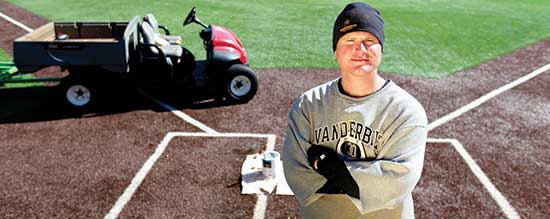
As Vanderbilt baseball’s volunteer assistant coach, one of Larry Day’s responsibilities is the majority of the day-to-day maintenance of Hawkins Field. In some ways, Day’s job changed dramatically this summer when the athletic department installed Astroturf at the Hawk. But Day still has more than enough to do with the synthetic surface on a daily and weekly basis.
A four-year starter at catcher for the University of Connecticut, Day also works with Vanderbilt’s catchers and assists with hitters. Two of his Commodore backstops, Andrew Giobbi and Curt Casali, have been selected in the MLB draft. Now in his fifth season at Vanderbilt, Day sat down with Commodore Nation to discuss the new field at the Hawk.
Commodore Nation: How much has the maintenance of Hawkins Field changed with the switch to artificial turf?
Larry Day: It’s changed. When we used to have the natural field, obviously there was grass to be cut, there was dirt to be groomed; and from those two basic standpoints, that’s no longer there. People think there’s nothing you need to do now that you have the turf field. That’s not true. It still needs to be groomed to make sure that the in-field mix–the sand and rubber mix that is in the ground–is evenly distributed across the whole field.
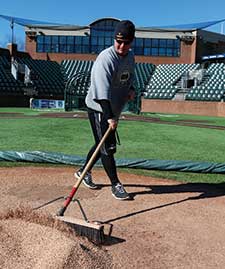
Then you still have the clay bullpens and the game mound, which are the same as on a natural field. And now instead of just fixing the mound all the time, you also have to maintain the cleanliness of the turf area around the mounds and around the bullpens. So I’m brushing the dirt out of that lip about a foot wide in front of the mound. When I do that, it pushes some crumb rubber onto the dirt, and because of that I take all the old dirt off and put new dirt on almost every weekend.
Nation: What are the positives and negatives about the new field?
 Day: It’s different. I miss the smell of the grass. I’m not on a mower anymore making patterns. I miss that the most. Putting in different designs would take some time, but there’s some peace of mind that would come with creating a new field. It got to the point mentally where if we had a bad weekend, I couldn’t wait to mow the field with a different pattern because I felt like it would get rid of all those bad vibes. So I would do a completely different field the next day.
I don’t miss the dirt. Not at all. I don’t miss trying to maintain the proper moisture level within the infield to have a ball play true. I don’t miss looking at the weather report and fretting about whether we should put the tarp on. That’s the biggest thing with this artificial field is that you don’t have to worry about the tarp.
But I used to really love doing the designs on the field. Now I’m driving that four-wheel Toro, dragging the brush behind it. You can’t get it as fine. At least I haven’t been able to yet.
Nation: Was there a learning curve with figuring out the turf?
Day: I talked to different grounds crews at [places like] Wichita State, Wake Forest. And I obviously had the people from Astroturf who installed the field give me some guidelines. It was a much easier learning curve for the artificial field than it was for the natural surface. When I came here in the summer of 2008, I had no experience maintaining a field. I owe a ton of credit to the Vanderbilt Plant Operations people: Bill Randles, Patrick Walk and Lee Langley, specifically. Patrick and Lee are two guys that work under Plant Ops, but they have a personal investment in Vanderbilt baseball that has nothing to do with their jobs. The learning curve would have been tough without those guys.
Nation: How has turf been from a baseball standpoint?
Day: You think about competitive advantages and disadvantages. We play more than half of our games at home, so they’ll be some competitive advantages. But then you look at the SEC schedule, and you’re going to play half of your competition on natural fields. It comes down to the fact that everyone is playing on the same field. The kids on our roster have all grown up playing on natural fields, but it’s not a hard transition. The ball stays true. From an infielder’s standpoint, you can really trust the field. In terms of their form when they’re fielding ground balls, they can always get their face down, get their butt down and get their hands out. Now on a hot day you don’t have, “bad hop, bad hop, bad hop” in the back of their mind. And when we’ve been back on a natural field like at Auburn, we played great ground ball defense because they’re so used to getting in that great form.
Then the practicality of it, in terms of weather in this area. Coach Corbin calculated that the weekend that we played Illinois-Chicago, we would have put the tarp on like 15 times–putting it on and taking it off–and that just messes with the rhythm of the game. It takes the players’ energy from the game to the weather. In terms of the flow of the game, it’s just been great.
Nation: Does the turf give you extra time for your coaching duties?
Day: I’m still busy with the maintenance of it, but I feel like I have had more time to put toward trying to coach. I’ve had more of a chance this year to take part in the coaching meetings, whether it’s discussing that night’s opponent or what we’re going to do for practice on a daily basis. Being able to be more involved with practice planning and with preparation for games, with coaching the catchers and hitters, it has been good from that standpoint, for sure.
Nation: As a baseball guy, is that your favorite part of the job?
Day: My favorite part about my job is the people that I get to interact with. From Coach Corbin, sharing an office with Travis [Jewett], our whole staff, it’s like a family. They are my family down here. And the players, not just being able to work with great baseball players in terms of the skill set, but having intelligent, caring baseball players. It’s one thing to have a player that can hit a ball 400 feet or can throw a ball 93 miles per hour, but it’s another thing to have the type of players that are also invested in each other, in the team, in the program, and not just in themselves.