
May 18, 2011
Commodore History Corner Archive
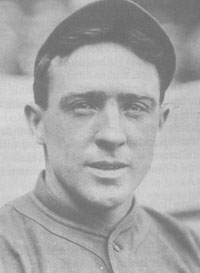 |
| Joe Tinker |
When the old Sulphur Dell ballpark grounds were too wet for play, Vanderbilt’s original Dudley Field could be used as a substitute. Such was the case on March 27, 1912 when the Chicago Cubs of the National League were in Nashville.
The scheduled game with the Nashville Vols of the Southern Association was cancelled due to wet grounds. So the Cubs, managed by Frank Chance, decided to get in some work on the Vanderbilt campus. Chance was part of the famous double play combination as the first baseman of the historic Tinker to Evers to Chance, Hall of Fame trio.
The Tennessean reported:
Although Nashville worked in the Dell the Cubs preferred Vanderbilt on account of the dry grounds. At 1 o’clock the Cubs went to Dudley Field and remained until about 3:30, when the Commodores began to show up on the field.
The weather was fine yesterday and the Cubs had a long and thorough siege of work. Chance began by putting them through a warming-up process then switched to batting practice, which continued most of the time the men were on the field. All of the pitchers, after having been torridized, took turns in the box, while the other hit the pill around with varying degrees of success.
Schulte’s work with the bat was most spectacular, possibly because he is left-handed and hits a lot of his drives into the fight field bleachers, and secondly he is noticed more than the rest of the hitters because of his great record of hitting home runs last season in the National League.
Frank Schulte was the Cubs right fielder and led the National League in home runs in 1911 with 21 round trippers. He also led the league in slugging percentage (.534), RBIs (121) and total bases (308). Schulte, whose nickname was “Wildfire,” had a long career with Chicago (1904-16) and played his last season in Washington (1918).
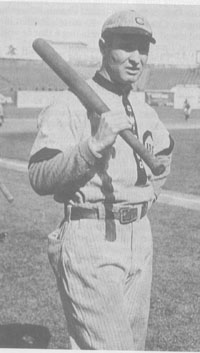 |
| Frank Chance |
Chance was nearing the end of his career. He had been playing baseball for the Cubs since 1898 and was the manager beginning midway of the 1905 season. Chance only recorded five plate appearances while playing in two games in 1912.
The Tennessean reported on Chance:
Chance hit the ball with considerable regularity and ran the bases in old-time form. Although he does not look like a fast man, he is, as the base stealing records will show. Chance has a very easy movement and consequently does not seem to be covering much territory, but he is, just the same.
The same thing is true of Hans Wagner of Pittsburgh, who runs with such ease that he would be thought slow if there were no other way of judging him than by squinting with the naked lamp.
Of course, everybody knows that the reason Chance had to quit was because of the injury he received from a pitched ball. He was hit in the head and almost killed. He has probably been hit more than any other living ballplayer and has been seriously hurt by pitched balls far more than any other man in the game.
Yesterday he was nearly pursued by his evil fate again when Artie Hoffman was batting. Chance was walking behind the plate when Artie fouled off one of Toney’s offerings, the ball went wide, Needham barely touching it. However, that saved the day, for the ball’s course was diverted and hit Chance on his left pin.
In 17 seasons, Chance appeared in 1,286 games, batting .296 with a career .984 fielding percentage. He also led the National League in stolen bases with 67 in 1903. Chance’s managing percentage of .667 (768-389) is ranked as the best in Chicago Cubs history.
As the practice day worn on, Vanderbilt students grew a crowd to witness the professional baseball players on their campus. The original Dudley Field was located on the present site of the law school. They might not have realized that they were watching the most celebrated double play combination in the history of major league baseball.
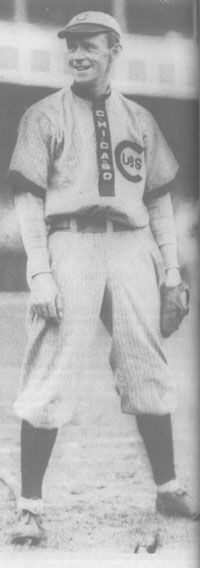 |
| Johnny Evers |
Chance was all but retired as a player, but practiced and worked himself into shape. Johnny Evers was the Cubs second baseman and The Tennessean reported:
While Evers did not hit up to form in batting practice yesterday, he will probably be ripe before the season opens. It is now the intention of Chance to put the former star back at his old stand at second, with Heine Zimmerman at third.
That combination, with Vic Saier on first would not be half bad, and it is the belief of the Cub followers that the club this season, with its present prospects, is a one, two, three array.
Evers played 18 seasons in the major leagues with three teams Cubs (1902-13), Boston Braves (1914-17) and Phillies (1917). He played in 1,783 games, batting .270 with 70 career triples. Evers enjoyed his best season in 1912 with a career-high .341 batting average.
Joe Tinker, the shortstop, had a long career with the Cubs (1902-1916). In the 1912 season, Tinker played in 142 games batting .282 with 550 at-bats. In 1,805 big league games, Tinker batted .263 with a career fielding average of .938.
Tinker was the Cubs regular shortstop for 11 years, leading the National League in fielding percentage in four years and total chances in three seasons. On July 8, 1910, Tinker tied a league record when he stole home twice in the same game.
Chance’s Chicago Cubs finished that 1912 season in second place (91-59) behind the New York Giants and John McGraw. Tinker, Evers and Chance were each selected to the 1946 class of the Baseball Hall of Fame.
New York newspaper columnist, Franklin Pierce Adams, immortalized the diamond trio with this poem:
These are the saddest of possible words:
Tinker to Evers to Chance.
Trio of bear cubs, and fleeter than birds,
Tinker to Evers to Chance.
Ruthlessly pricking our gonfalon bubble,
Making a Giant hit into a double–
Words that are heavy with nothing but trouble:
Tinker to Evers to Chance.
Gonfalon is a word that refers to a pennant or flag and the phrase “pricking our gonfalon bubble,” describes the Cubs success against the National League and Adams’ favorite team– the New York Giants.
This will be the final Commodore History Corner story for this school year. I want to thank website coordinators Brandon Barca and Chris Weinman for their work in preparing my stories for vucommodores.com.
If you have any story suggestions pertaining to Vanderbilt sports history for next year, please e-mail me at WLTraughber@aol.com.
Good luck to Tim Corbin and the Vanderbilt baseball team in attempting to reach their goal of making it to Omaha and the College World Series.