
April 21, 2010
View Archived Issues/Subscribe
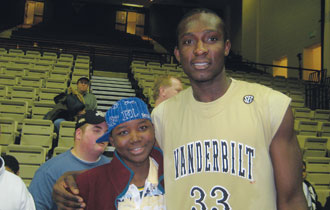 When Steve Tchiengang and Phinias Nyabenda were together, everything seemed perfect. Their smiles were contagious to those around them, and their laughter always filled the room. Neither wanted the moment to end. They didn’t have to worry about not having a supply of water or food like they did when they lived in Africa, they didn’t have to worry about getting acclimated to a new country, and most importantly cancer wasn’t on their minds.
In August of 2008 at only 19 years old, Nyabenda (pictured with Steve), an African immigrant, was diagnosed with aggressive osteosarcoma â€â€ a form of cancer that starts in the bones. That same summer Tchiengang, a native of Cameroon and now a sophomore forward on Vanderbilt’s men’s basketball team, arrived at Vanderbilt as a freshman. Tchiengang didn’t know it at the time, but he was about to begin a friendship that would affect him forever.
It’s a friendship that would not have happened without a high school student at Montgomery Bell Academy named Rob Higham. It was Higham, now a senior at MBA, who reached out to Tchiengang through a simple e-mail almost two years ago to see if he would be interested in helping African refugees in Nashville through outreach organizations called African Leadership and Nation’s Ministry. Both organizations provide assistance to African refugees in Nashville, and Higham is actively involved in both.
The e-mail sparked an interest, and Tchiengang agreed to help any way he could. Along with Higham, Tchiengang began visiting a group of African refugees living in Nashville and befriended them.
“I just felt like it was a call from God to help others,” Tchiengang said. “I know the difficulties and struggles they face.”
It was through Higham that Tchiengang was introduced to Nyabenda.
“The day after I told him (about Nyabenda’s condition), Steve visited him in the hospital after running all over campus that morning, getting personal notes of encouragement from his coaches and autographs from his teammates,” Higham said. “They met that day in the hospital and had an instant connection.”
The friendship Tchiengang and Nyabenda shared grew quickly. Tchiengang invited him and other refugees to a basketball game during the 2008-09 season, he visited Nyabenda at his apartment. When he didn’t visit him in person, they talked on the phone.
“There was one day in May when Phinias was really not doing well, and Steve called him from his home in Houston,” Higham said. “I will never forget the smile I saw on Phinias’ face that day when I handed him the phone and said, ‘It’s Steve.’ In such a short time, they became so close. Their relationship was incredibly special.”
When Tchiengang and Nyabenda were together, everything seemed perfect on the surface, but deep down it was not. Nyabenda’s condition continued to worsen, and sadly, on July 1, 2009, just one week after his 20th birthday, he lost his fight with cancer.
“Phinias is a guy that impacted me,” Tchiengang said. “He suffered, but every time I saw him, he smiled. He reminded me how good of a situation I have.”
Although Nyabenda is gone, Tchiengang has continued to touch the lives of other African refugees, while helping them become acclimated to living in the U.S. Nashville is home to many African refugees from multiple African countries that have been ravaged by violence and civil war for many years. Among the children Tchiengang speaks to are refugees from Burundi, a small country in south central Africa, who arrived in Nashville almost three years ago.
“I’m going to try to help out while I am here and try to support as much as I can,” Tchiengang said. “I just try to help them as much as I can with the transition and help them maximize their opportunities and chances to succeed over here.”
There is no one more suited for the job than Tchiengang. He spent the first 15 years of his life in Cameroon before moving to the U.S. in 2004 to live with his adopted parents, David and Kathy Ambrose.
Tchiengang plays basketball now, but as a child in Cameroon, the sport was far from his mind. Instead of basketball, Tchiengang played soccer, a sport he believes he could have gone professional in if he had stuck with it. Tchiengang didn’t pick up a basketball until six months before coming to the U.S. when he was introduced to the sport because of his height.
When he arrived in the U.S., Tchiengang spoke French and Spanish. The only knowledge of the English language he had were of common phrases such as “thank you” and “hello.”
Over time, Tchiengang was able to learn English thanks to the help of his adopted little brother, Michael Ambrose. Just six years removed from living in Cameroon, Tchiengang still has a strong French accent, but he now speaks English fluently and is continually getting more comfortable with the language.
Like when Tchiengang arrived in the U.S, the African refugees he works with did not know English when they came to the U.S. One of the primary goals of Nation’s Ministry and African Leadership is to teach African refugees the English language. Tchiengang understands just how important it is to learn English, which is why he stresses it when he speaks to the children.
“The biggest problem we face is that most of these kids’ parents were born in refugee camps, as well, and don’t have an education, so they don’t understand the importance of their children’s education,” Higham said. “The parents haven’t put forth enough effort to learn English themselves, so when the children go home from school and the tutoring program, they go back to speaking their native languages.
“Steve’s belief, and my belief as well, is that they need to be speaking English all the time if they are going to become proficient, graduate from high school and pursue college, which is our hope.”
Having gone through the same immigration process, and still doing so, Tchiengang can relate to the children he speaks to.
“The transition is different because people live differently in the U.S.,” Tchiengang said. “You’ve got to get used to having a full supply of water and a full supply of food. People around you are always nice. It is a totally different world. The transition was very difficult at the time for me. With the help of my family I got used to it, and now I’m pretty integrated into it.”
Just as Tchiengang can relate to the children, they can relate to him.
“Steve can speak to these kids in a way that I can’t,” Higham said. “That’s what has made what he is doing so meaningful and important as it is. These kids see themselves in Steve. He came here and didn’t know how to speak English, so they had a similar immigration process.”
In addition to speaking to the children, Tchiengang has been able to have a group of children come to watch him and his teammates play a couple times a year. Even though a lot of the children don’t understand the game, Higham can tell that it motivates them when they watch Tchiengang succeeding at a sport he didn’t start playing until six months before moving to the U.S.
“Being able to watch him play and see how successful he has become really motivates them,” Higham said. “Seeing how much he cares for them is also really motivating to them.”
Tchiengang also has helped bring the refugees to a football game and a women’s basketball game. On both occasions, Tchiengang has met the group and connected members of the team with the refugees.
Tchiengang has treated the children like family. This past December, he took his generosity to another level. After seeing the shoes the refugees were wearing at the Vanderbilt game they attended, he purchased new shoes on his own dime for the kids at the game.
“Whenever I can touch someone else’s life, I will try my best to do so,” Tchiengang said. “I would literally put together a campaign to get some shoes, but if I can provide it myself, I will just go out and do it myself. I know how important it is to have a pair of shoes for a person from Africa. To donate shoes to those kids, it is something that touches their hearts so much. It is just a feeling that I can’t really explain.”
Tchiengang also donates shoes and clothing he has to friends and family in Cameroon, who are not as fortunate.
“They have shoes, but the quality is terrible,” Tchiengang said. “I wore the same shoes to play soccer that I wore to go to school. You didn’t have options. It is my way of showing people I care, and I will help them out as much as I can.”
Tchiengang’s work with the refugees has made him a role model to many, but to Tchiengang, the real role model is the person who opened the door for his work.
“To me, Rob is a role model,” Tchiengang said. “He just does it out of the bottom of his heart, and I just want to be a part of it because it is something special. I just want to make them feel part of the community and make sure they know they haven’t been forgotten and someone is out there thinking about them.”