
Oct. 28, 2009
 View Commodore History Corner Archive
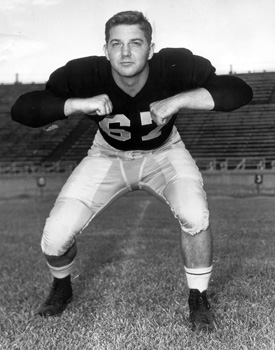
Not too many former Vanderbilt football players can boast these days about beating Alabama three years in a row. But, former Commodore lineman Dick Philpot can. Philpot was born in Birmingham and grew up in Cedartown, GA., where football was king.
“Most people in the South were involved with football especially in the small towns,” Philpot said recently from his Nashville home. “The small towns all played each other and the rival’s games were big. Everybody wanted to be on the football team. If you wanted to know what was going on at the high school, you would go to the barbershop. All the old guys were talking about the teams and the players. Baseball wasn’t very big and basketball hadn’t come along.
“Football was the kingpin. I played four years and went out when I was in junior high school. I started in some football games on the varsity when I was 15 years old. Everybody who was physically able did it. So it was a great part of my life; it was so much fun. By the time I was a junior, a lot of prep schools in the South and would try to get you to come to their schools and they had post graduate courses. The Mid-South Conference was big with Chattanooga Baylor, McCallie, Riverside, Castle Heights, TMI and Darlington, which was right down the road from where I lived.”
Several colleges recruited Philpot for his services as a football player. Georgia Tech was in the state he was raised and a Southern power in the Southeastern Conference. But Vanderbilt was also appealing to the young high school graduate.
“I made a commitment to go to Georgia Tech,” Philpot said. “Georgia Tech was the big deal in those days. They were very glamorous and Bobby Dodd was their famous coach. They went to bowls every year. Red Sanders was the coach at Vanderbilt and he came down and asked me to come to Vanderbilt. I didn’t want to go there, but I did make a trip to Nashville. I was so impressed that I decided to come to Vanderbilt.
“Football has changed so much today. Back in those days Southern athletes were from the rural areas of a city. They came from smaller towns. Of course, Vanderbilt had a few guys from the North. They started to recruit in the North when Bill Edwards came in the following year. He began to recruit more and more Northerners. Traditionally most Southern schools had good families, maybe not much money, and you had a good chemistry with Vanderbilt in particularly.”
In this era of college athletics freshmen were ineligible to participate with the varsity, but played a schedule of freshmen-only games. The much heralded Bill Wade from Nashville’s MBA was the quarterback on that Commodore freshman team.
During the 1948 season, Sanders Vanderbilt squad was 8-2-1. After an 0-2-1 start, the Commodores rolled off eight straight victories. Their last eight opponents were outscored by the Commodores, 307-26. The Associated Press ranked Vanderbilt as the 12th best team at season’s end.
Sanders would bolt for the sunny weather and better times at UCLA. Edwards was named as Sanders replacement.
“It was pretty scary,” Philpot said about the coaching change. “Vanderbilt had a great football team in 1948 and one of the best teams in the nation. They struggled their first two games, but won the rest. As freshmen, we had to scrimmage against the varsity everyday. We did pretty well because Wade had a good arm. I hated to see Sanders leave because I came to Vanderbilt because of him. He was tough. Some people couldn’t stand or like him. He could be tough on people who didn’t like his style. He was unbending. If a guy made a mistake in a game, sometimes he might not play again.”
In 1949, Philpot’s first as a varsity player, Vanderbilt was 5-5 (SEC, 4-4) with conference wins over Alabama, Mississippi, Florida and Auburn. They opened the season with a tough 12-7 loss to Georgia Tech in Atlanta.
“I played a lot in the first game against Georgia Tech as it was a big deal,” said Philpot. “We went to Atlanta where I saw my old friends and family members. Wade struggled that day because he had been on the cover of Look magazine and was picked as a top future quarterback. In that first game the pressure on Bill was terrible. When he’d get the ball the Tech players would call him `Cover Boy’ and all the threatening things they said they were going to do to him. It was comical because I knew a lot of those guys making those threats.”
Philpot did not start during this sophomore season, but played extensively in every game as an offensive guard and linebacker on defense.
“That was the big win for us against Alabama as they were supposed to beat us,” said Philpot. “Everybody had a good day down there. We spent so much time moving down the field to line up for the next play because we were making big gains with Bill throwing to Bucky Curtis. About the third quarter an Alabama tackle named Tom Selman walked over to me and said, `Hey Philpot, when are they going to throw one to you. They have hit every other SOB on that team.'”
It was customary in those days that the better players would play both ways, as did Philpot.
“You played everything back then.” Philpot said. “It is a great way to go because in athletics you rarely have a good day both ways. So if you are having difficulty on defense, you can make up your frustrations on offense when you blocked. I always liked to hit. If you like to hit people, football is fun. I got to play a lot in all the games and started my last two seasons. Vanderbilt was a fun place to play football. Our facilities were horrible, but we did our best.”
In the 1950 season the Commodores were 7-4 (SEC, 3-4) with conference wins over Auburn, Alabama (ranked No. 12) and Mississippi (ranked No. 19). The Ole Miss and Bama victories were most memorable to Philpot that season.
“Those were two great games,” said Philpot. “At Ole Miss I knew a lot of their players. One of their players that I knew I knocked down pretty good during a play. I walked over to him after the play and helped him off the ground. One of my teammates asked, `What the hell was I doing?’ He couldn’t understand why I would help an opposing player. I couldn’t tell him he was a friend that I knew in Georgia.
“Those are the little things you remember that made playing football fun. But it was a rough game. If someone said something to me in a negative way, I’d remember him and look for him later in the game. If you really wanted to zero in on a player it was easy to do like coming down the field on a kick. You could blindside them to get even. I had a bad temper in way, but you had to learn to control it. You have to have a little fire about you.”
Philpot, 79, liked Edwards and thought he was an exceptional football coach. He said Edwards would coach with emotion and enthusiasm, but believed his assistants were not as strong.
The 1951 Commodores were 6-5 (SEC, 3-5) with another win over Alabama, Mississippi and at LSU.
“I have often kidded with my Alabama friends that I never went on a field against Alabama where I didn’t think we could beat them and never thought about losing,” said Philpot. “I thought the same thing about Ole Miss. Ole Miss had more depth than we did, but we could beat them. We had a chance to beat Tennessee. I had my best day against them offensively and defensively.
“I’ve got a DVD that someone sent me of that game (Tennessee). In those days you usually didn’t have a professional camera crew to film a game. You just sent down a volunteer from someone to photograph the games. They weren’t welcomed in a foreign stadium either. They wouldn’t let you in the press box. You had to find a high spot in the stadium to film the game independently.”
Wade was a teammate of Philpot for three varsity seasons that became one of Vanderbilt’s great quarterbacks. He also had a distinguished career in the NFL and scored the only two touchdowns in the Chicago Bears 14-10 win over the Giants in 1963 NFL championship game. So how special was Wade?
“He had a heck of an arm on him,” said Philpot. “You never went into a game where you knew he not could win. We lost some games by flukes. In 1950 we had a win streak going and every time we would get down in scoring position something would go awry. I couldn’t understand that. I’ve got a picture on my wall where we turned the ball over the last time, and the guy is pointing down the field indicating Florida’s ball. We were going for the winning touchdown.
“Years later I was in a meeting out of town and I met a guy from Florida that we played against. He was a tackle and said while looking at game film on us, they noticed that one of our players on every pass play would put his foot in an unusual position to tip off that a pass was coming. He did that on every pass play.”
In his three varsity seasons Philpot’s Commodores never defeated Tennessee, but he came close to scoring his only collegiate touchdown. Philpot caught the Vols’ All-American running back Hank Lauricella in the backfield, knocked the ball out of his possession and recovered the ball. He said for the rest of his life he has envisioned picking up that football and running the 30 yards for a TD, which is a lineman’s dream.
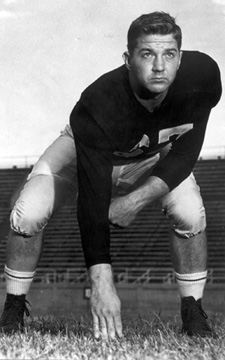 Philpot told about his experiences as a guard on the offensive line and a certain offensive blocking scheme.
“We went down to Tulane (also an SEC member) that had good football teams in those days,” Philpot said. “We put in a new formation. Edwards had heard about this thing that SMU was using called `The SMU Spread.’ The guard would line up two paces outside the center. You had a slot there. The tackle might line up three paces and the end was out even further. The idea was to confuse the defense, supposedly. You had guys spread all over the field. This way you could hopefully get your receivers out and in the open. The key to it was who blocks whom.
“In this system the defensive man usually lined straight up. Then our tackle would call a check off. If you were to block man-on-man the tackle would call `Exit’ If the guys got out in the slot at an angle the tackle or guard would have little difficulty going man-on-man. So we say `Mix it,’ which meant he got my man and I’d get his man. It was a crisscross. Back in those days we did a lot of talking. We thought we had this All-American from Tulane named Paul Lea on our side of the line. When we broke the huddle he is not there. He was on the other side. Bucky yelled over at (Bob) Werckle who was the tackle on the other side of our line. He said laughingly, `Hey Werckle,’ look at what you’ve got.’ Lea had moved to Werckle’s side.
“What we didn’t know was that this burly kid who replaced Lea was now on our side. He looked so young and didn’t have a whisker on his face. He lined up man-on-man so we yelled `Exit.’ The tackle on my side was Russ Faulkinberry and was against this kid. You never heard such an explosion. Faulkinberry came back to the huddle with his helmet twisted across his face. That kid had done him in. We went back and lined up the same way and he said `Mix it’ and I had to block that guy. He called `Mix it’ the rest of the day. That guy just killed me. The guy turned out to be a great pro football player with Baltimore named Don Joyce. We used to laugh about that calling `Mix it’ on me.”
In those days Vanderbilt and it’s opponents would dress for games in the stone constructed Palmer Field House, which is located today beside the Dudley Field scoreboard. Philpot said the opponents were located on the other side with a wall separating the two locker rooms. Players would lie on the floor in their uniforms since the place was so cramped.
Earlier this year Vanderbilt traveled to Baton Rouge for a night game against LSU where the Tigers defeated the Commodores, 23-9. The last time Vanderbilt had won at LSU was during Philpot’s senior season. Vanderbilt won, 20-13.
“LSU is always a tough place to play,” said Philpot. “That was the only school that played night football. It messed up your entire system to go down there. We stayed in the Heidelberg Hotel; the only hotel downtown. You didn’t have television so you’d be in the room and hear all kinds of racket outdoors. The LSU people would bring a real tiger in a cage outside the hotel and a guy would get on top of the cage with a trumpet.
“He’d play that trumpet loud and poked the tiger and that tiger would roar. The crowd outside would just go crazy. That would go on all afternoon. That was your welcome to Baton Rouge and LSU. Playing at night also meant we had to hang around the hotel room before a game. That was a big distraction. You go into the stadium where in those days there were 68,000 fans. You had the feeling that all 68,000 hated you personally. It was that uncomfortable.”
After graduating from Vanderbilt, Philpot went into the Marines where he served in Japan and Korea. He became an executive in Nashville in the paper business and has been active on athletic committees at Vanderbilt and other local organizations. Philpot is a longtime Vanderbilt football season ticket holder.
“In my time I think most people who played sports came to Vanderbilt to get an education,” said Philpot. “You got both here. You didn’t take basket weaving and you weren’t looking for an NFL contract. When people left Vanderbilt they got a good job. If you wanted to go to Med School, you could.
“I’ve had friends that came to Vanderbilt without a dime in their pockets, but they were able to go to Med School. I met my wife at Vanderbilt and she was Vanderbilt’s homecoming queen the year after I graduated. Vanderbilt has been a special place for me and I enjoy talking Vanderbilt football with my old teammates.”
Traughber’s Tidbit: The greatest football player to attend Vanderbilt, but never played was arguably Kyle Rote. Rote earned All-American honors at SMU, starred for the New York Giants of the NFL and was selected to the National College Football Hall of Fame in 1964. In the summer of 1947, Rote attended classes at Vanderbilt for two weeks. One night he mysteriously disappeared from campus.
Vanderbilt teammates reported taking a series of long distant telephone calls for Rote on the one pay telephone located in Kissam Hall, the men’s dormitory. One call was from the Texas Governor’s office. Rote asked to borrow head football Coach Red Sanders’ automobile assuming for a date into town. The next day, Rote called from his home state of Texas to say he was homesick and was playing football for SMU. Rote also said Sanders’ car could be located at Union Station.
If you have any comments or suggestions you can contact Bill Traughber via email WLTraughber@aol.com.