
June 24, 2008
Subscribe to Commodore Nation magazine / View Archived Issues
 |
|
By Ryan Schulz, Commodore Nation Magazine
What was once a baseball field at the intersection of 17th Avenue North and Herman Street in Nashville is now overrun by weeds, which conceal where the infield used to be. Fences are nonexistent, and only a backstop identifies that this once was a baseball field.
Unfortunately, this image can be seen in almost every large metropolitan area in the country. Football and basketball are king among inner-city youth, and baseball has fallen farther and farther off the radar.
To see the decline in interest in the sport among African-Americans, you need not look further than Major League Baseballitself, where the Associated Press reported that African-Americans made up just 8.2 percent of major leaguers in 2007, the lowest level in at least two decades.
With the need to reestablish baseball among inner-city youth at an all-time high, Vanderbilt baseball Coach Tim Corbin and former Vanderbilt pitcher David Price of the Tampa Bay Rays are doing their part to increase the interest in baseball among Nashville’s inner-city youth.
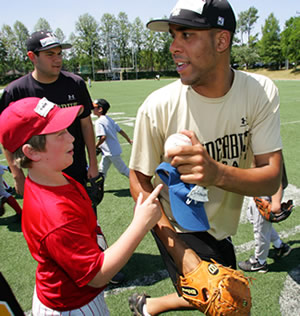
The two teamed up to split the cost of purchasing 100 tickets for members of Nashville RBI to attend every Vanderbilt Sunday home SEC game throughout the 2008 season. The children also receive a David Price shirt, a free hot dog and an opportunity to take the field with Vanderbilt’s team for the national anthem.
Corbin was initially approached with the idea by Vanderbilt’s marketing department, and it didn’t take any persuading to get him started.
“It didn’t really take too much thinking to get involved in something like this because it is for the city, and it’s for kids to get them involved in baseball,” Corbin said. “In this program, we’ve got some role models like a David Price or a Pedro Alvarez or an (Alex) Feinberg or (Ryan) Flaherty. I think they are personalities that kids can attach themselves to, and they are good players, so I thought this was as good a time as any.”
Like Corbin, Price is happy to be able to provide the children in RBI with an opportunity to attend a Vanderbilt game, and he hopes the initiative helps keep children interested in the game.
“It is fun to see kids wanting to learn about baseball, and RBI gives them that chance,” Price said. “I hope the kids are able to enjoy the Sundays at Hawkins Field and stay interested in the game.”
RBI, which stands for Reviving Baseball in Inner Cities, was started in 1989 and encompasses more than 200 cities in the United States. Thanks in part to an $8,000 grant from Major League Baseball, Nashville’s RBI program was founded in 1996 by Reggie Whittemore, who played at McGavock High School and Lipscomb University before playing seven years of minor league baseball in the Boston Red Sox organization.
Since its inception, Whittemore has seen the number of participants rise from 60 to more than 1,300 boys and girls ages 6 to 14. Helping sustain and grow the program are opportunities such as the agreement between Nashville RBI and Corbin and Price.
“We have an opportunity to bring kids to see a college baseball game and have kids on a college campus, and they wouldn’t have an opportunity like this if it wasn’t available to them,” Whittemore said.
Going to a Vanderbilt game not only exposes the children to a high level of baseball, it also gives them an opportunity to experience something most of the participants, 90 percent of whom are underprivileged according to Whittemore, wouldn’t be able to afford.
“They get to see enough violence and enough hatred going on in their neighborhoods,” Whittemore said. “This is an outlet for them to be a part of something positive.”
Corbin believes that donating tickets to Nashville RBI is a small, but necessary step toward increasing interest in baseball among inner-city youth.
“When you impact kids, you impact the community more than anything,” Corbin said. “I think where it starts is that people have to reach out into the inner city to grab those kids and pull them into an environment in which they can see kids they identify with.”
One of those individuals Corbin thinks kids identify with is Price.
“He came from a situation like that, albeit it was Murfreesboro (Tenn.), but still, he was given the opportunity to play, and look what he’s done with it,” Corbin said. “I think there are a lot of David Prices out there.”
It may be hard to judge how much of an impact the program will immediately have, but one thing that is for sure is that Corbin and Price leading the charge is a winning combination.