

Making Her Mark
by Graham HaysShot putter Sarah Marvin’s mark on Vanderbilt track and field will outlast any divot in the dirt
NASHVILLE, Tenn. — At nine pounds, or slightly heavier than a gallon of milk in the palm of the hand, the metal ball that shot putter Sarah Marvin launches into the air leaves an impression wherever it strikes the ground. Throw the shot after the clouds open, as they often do during Nashville springs, and archaeologists may one day find the indentation.
In shot put, the mark you make is everything. Years of training come down to seconds in the throwing ring and wherever the shot first strikes ground. At Vanderbilt, Marvin is among the best to ever do it. A Double Dore approaching the final throws of her career in the SEC Outdoor Championships—and hopefully NCAA regionals beyond—she has thrown the shot farther, indoors and outdoors, than all but four women in program history.
Still, meters and centimeters aren’t the measure of a person. In life, what matters is the mark you make on the people you encounter and the places you inhabit. Marvin has thrived in the SEC while embarking on a path to medical school. Mastering an individual discipline, she found community and left it stronger than she found it. As the last holdover from cross country and track and field director Althea Thomas’ first year, she embodies a program that has mentored SEC and NCAA champions and Olympians while helping runners, throwers and jumpers become much more.
Throwing the shot taught Marvin the importance of leaving a mark. At Vanderbilt, hers will last longer than any divot in the dirt.
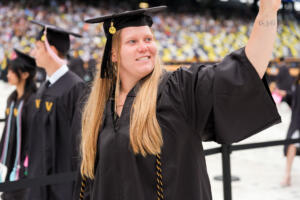
Shaped by Shot Put
Shot put might seem a solitary endeavor. It’s rarely the center of attention amid the swirl of races and other field events. Competitors meet only in passing, otherwise lost in their own thoughts before stepping into the circle alone. Then again, most of us didn’t grow up on the Marvin homestead in Gaines, Michigan, where map apps suggest the tractor equipment store and the summer rodeo as prominent landmarks. Other Midwestern families came together around cornhole boards. The Marvins had the family shot put circle.
Perhaps the only real surprise would have been if one ring was enough (constructed by her dad, there was also an indoor set-up in the barn for when the weather turned cold). Both of Marvin’s parents are former throwers, including her mom’s days throwing shot and discus at the University of Michigan. In a family of six kids, just about everyone threw—several collegiately. From Marvin’s earliest days, throwing always had a collaborative dynamic. It was competitive, yes, as all things are between siblings, but also shared.
Shared spaces always mattered. They made her better. She played football into high school. She adored basketball, which she played alongside her twin sister, Becky, on a Byron High School team coached by their mother. To her mind, she wouldn’t be where she is without those sports, without the camaraderie of teams or changes in routine that prevented burnout. But growing up with throwing stitched into the family DNA, she connected with a sport that hides complexity—the physics of a throwing motion, the dance steps in the ring—beneath the veneer of simplicity that comes from throwing something as far as you can. She was compelled to find out how good she could be at this particular craft.
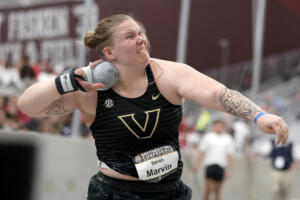 “There’s no distance you can’t throw, no ceiling on what you can do,” Marvin said of shot put. “It is about winning and losing in certain meets, but track is also more big picture at times. You can really get into the nitty gritty of technique. As a perfectionist, and most athletes are, that’s sometimes the bane of my existence. But I also think it’s cool that there’s always something you can improve on—improvement you need to make. I mean, hardly anyone ever has a perfect throw. Maybe a handful of people, and they’re Olympic champions and record holders.”
The better she got, winning multiple state titles in high school in shot and discus and an age-level national title in shot put, the more the pursuit of excellence humbled her. She was bright, her high school’s valedictorian. But she couldn’t outsmart the shot. No one can. Former Vanderbilt associate head coach Ashley Kovacs, who coached world champions, used to tell her, in no uncertain terms, ‘I can see you thinking. I need you to stop thinking.’
She had to learn to trust her preparation—and the hard work that made the preparation trustworthy. All these years later, stepping into the ring, she tries to limit herself to a couple of deep breaths, one or two short cues and then go, letting her body take over. In one recent meet, the cues were nothing more complicated than “go fast and smash the finish.”
Maybe you wouldn’t want to hear your surgeon repeating those words just before your anesthesia takes hold, but the principle is more transferrable than it might appear.
Marvin still remembers the general chemistry exam from her freshman year, still winces at the memory. There might, she allows now, have been a few tears shed at practice that day. Kovacs, as she recalled, took it in stride. The exam didn’t go well? So what? They would work with the Ingram Center to find a good tutor and build the mechanism for success, the same way they did every day with her throws. A three-time member of the SEC Academic Honor Roll and USTFCCCA All-Academic honoree as an undergrad, she did just fine.
“Sports give you resilience,” Marvin said. “We’ve all had bad meets, bad competitions. And you learn not to get discouraged. It’s just back to the drawing board. This could just be me, but I don’t tend to get test anxiety because I think your confidence comes from your preparation. That gets talked a lot about in sports. And so just like I’ve learned to not think too much before my throw, I don’t obsess over the little things right before taking my exam. Take a couple of minutes, take a couple deep breaths, and then what I know, I know. Just execute. Sports prepare you to like work under pressure and perform when you need to.”
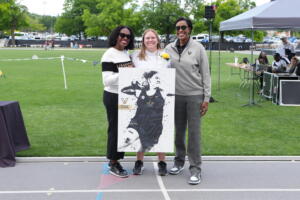
From left, Althea Thomas, Sarah Marvin and Candice Storey Lee (Vanderbilt Athletics)
A Quintessential Commodore
We celebrate that sports equip a person with the skills to navigate a given path. But they can also help reveal the path itself. Marvin didn’t grow up dreaming up about being a doctor. Breaking state and national records, sure. The more distant future and career paths, no.
Most subjects came naturally to her in school (the whole valedictorian thing, again), and she realized early that STEM subjects interested her most. But it was sports that showed her that what she wanted more than anything was the opportunity to be around and serve people. In a small community, you do a bit everything, so even while she played high school basketball, she also coached a team of younger kids. And before she was one of most successful high school athletes her school ever produced, she had the time of her life as a student-manager for varsity teams. Medicine, in turn, was more a byproduct than a goal. She loved STEM and wanted to serve people. Medicine brought that together.
It also helped bring her to Vanderbilt. After navigating her way through a confusing COVID-era recruiting scene, she transferred to Vanderbilt in the fall of her freshman year. She loved the idea of being part of an athletic department led by women, not just her coaches but Candice Storey Lee, vice chancellor for athletics and university affairs and athletic director. What better example that she could follow whatever path she wanted?
“I didn’t want to go somewhere where I could just coast academically—and I have not coasted,” Marvin laughed. “Maybe sometimes, when I’m finishing an assignment at midnight, I’ve wondered what 18-year-old me was thinking. But jokes aside, academics are really important, especially for what I want to do in the future. I didn’t want to sacrifice that for the athletic cost. And similarly, I didn’t want my academics to overshadow my athletics. It truly felt like home and like the place that I could succeed in anything I wanted to do.”
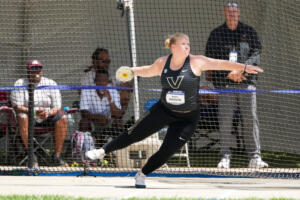 She benefitted from the community she found. Grueling as the practices were, she looks back fondly on the throwers who trained together early in her time in Nashville, a large group that included the likes of All-American Divine Oladipo and Joe Kovacs, Ashley’s husband and a world champion. Used to being the best up to that point, from her backyard to high school nationals, she had to challenge her own limits to keep up.
And she, in turn, strengthened the community, whether founding an Athlete Ally chapter on campus in 2022, welcoming graduate transfer and javelin standout Elizabeth Bailey into the fold this season after a season as the team’s lone thrower or simply in those small, shared moments sitting at airport gates or on a bus.
“One of my favorite things this year has been just being around the whole team,” Marvin said. “Sure, we might not all see each other every day because we train at different times, but traveling has been so fun. We all get along really well. It’s really awesome to get to be in community and share spaces with the other event groups. It looks different than your typical team sport. Finding that group looks different when you’re on a basketball team because it’s forced proximity, so of course it’s going to happen. In track, you’ve got to seek it out a little more. It is easy to default and just train in a small group or by yourself.
“But I absolutely found it here, and that’s going to be one of my biggest takeaways when I leave, the people I’ve been around, trained with and all the connections that I’ve made.”
After all, the people make the place.
And what Marvin has helped make Vanderbilt track and field can be summed up succinctly enough to fit in those brief seconds before she lets the shot fly.
Trust yourself. And live life as an ensemble.
About Anchored for Her
Through Anchored for Her, a comprehensive fundraising campaign, Vanderbilt is positioning women’s track and field and its broader women’s athletics programs as national leaders in advancing women’s sports. Anchored for Her’s initial $50 million goal will fuel investment in sustainable success for a new era of collegiate athletics through facility enhancements, endowed scholarships, coaching and staff positions, capital support and naming opportunities, team-specific Excellence Funds, the Women’s Athletics General Fund and the Competitive Excellence Fund.