

History in the Making
by Graham HaysWith track and field at the forefront, a new generation of leaders builds on the work of Commodores who founded the Vanderbilt Black Student-Athlete Group
NASHVILLE, Tenn. — When not occupied with her own training as a professional runner, Taiya Shelby helps coach high school track and field in Baltimore, where she now resides. Not so long ago, a coaching colleague wanted to pick her brain about her alma mater. One of this coach’s student-athletes was on Vanderbilt’s radar for football. He was eager for Shelby’s perspective on what a young person from an economically disadvantaged and predominantly Black community in Baltimore would find on the Nashville campus.
One of the co-founders of Vanderbilt’s Black Student-Athlete Group, Shelby didn’t hesitate to offer her endorsement of a Vanderbilt experience that welcomes everyone.
“You’ve got a community because I’m going to make sure Vandy BSAG is there for you,” Shelby said of the message she relayed. “It makes me feel good to be able to talk about my experience, but also that I can confirm that someone is going to have a good experience because I know they are continuing to build that group and that safe space. That just makes me happy whenever I’m speaking to athletes thinking about joining the university.”
Shelby doesn’t feel like history. She’s not the past. The former All-American is more focused on her future, specifically her path to running the 800 meters in the 2028 Olympics in Los Angeles. Yet with each passing year, her place in Vanderbilt’s story grows. Not because of the records she set. Those will one day fall. Maybe. But because in the hands of current co-presidents and track and field student-athletes Lena Gooden and Madyson Wilson, the Black Student-Athlete Group makes the university community ever stronger.
All history, after all, starts somewhere.
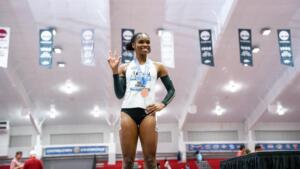
Taiya Shelby holds eight school records, earned three All-America accolades and qualified for four NCAA Indoor or Outdoor Championships (Vanderbilt Athletics).
An Idea and a Foundation
Arriving at Vanderbilt in 2018, Shelby soon seized the opportunity to attend the national Black Student-Athlete Summit. An annual event focused on leadership mentoring, career development and education, attendance is a regular part of the Ingram Center for Student-Athlete Success programming. She and her peers were inspired by the event’s sense of shared experience. It occurred to them that it would be good to have something similar at Vanderbilt, a community nesting within the larger university and athletics communities.
Teaming with football’s Elijah McAllister and Cameron Robinson and soccer’s Olivia Simmons, Shelby acted on the idea behind the Black Student-Athlete Group in fall 2020. Amid the uncertainty of a global pandemic that upended the daily rhythms of university life and the backdrop of a summer of social justice protests across the country, they took their idea to Katelen Watkins, then an assistant director of student development for the university.
“We were definitely frustrated,” Shelby recalled of the state of the world, “And we also definitely had hope.”
Social events were a relatively simple and necessary starting point, giving student-athletes space to come together while simultaneously allowing the founders to figure out how they could have the greatest influence. Building on that, their first cornerstone project centered on community outreach, partnering with Vandy Votes for a voter registration drive at FirstBank Stadium ahead of that fall’s elections. From little more than the idea for a group weeks earlier, they successfully organized an event that registered hundreds of voters.
For Shelby, naturally sure of herself but also inclined to lead by example, that experience and her leadership role in general honed the same skills she uses today as a mentor with younger athletes in Baltimore and her hometown of Kansas City.
“When I’m with a group of people who are like-minded, I guess it comes naturally for me to be like ‘All right, we’re all thinking this, so let’s do this and do it to the best of our abilities,’” Shelby said. “I definitely learned a lot. And I take a lot of that experience leading and organizing with me now.”
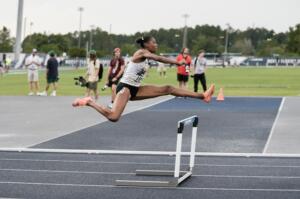
In addition to her Black Student-Athlete role, Madyson Wilson is Student-Athlete Advisory Council Career Development Chair (Pilar Ballough/Vanderbilt Athletics).
Growing the Vision
Arriving as a freshman when Shelby was a graduate student, Wilson was among those teammates the latter mentored at Vanderbilt. Growing up in Atlanta, she had never been to a school that wasn’t predominantly Black in the makeup of its students or staff. Vanderbilt was a very different experience. For someone who has not only earned athletic and academic honors but serves her peers on the Student-Athlete Advisory Council, the Black Student-Athlete Group played a significant role in making her feel part of a campus.
“Coming here was a culture shock for me,” Wilson said. “So having something like this in place made me feel more comfortable, because when I first got here, I’m not going to lie, I hated it. I didn’t feel comfortable here — just because it was so different from what I was used to. But having a space like this made me feel like I actually belonged here. It helped me grow in different spaces because I was able to open up, be who I am and see that I can relate to different people. You see you’re not alone in this college journey.”
Last spring, as her junior year ended, she started talking with Gooden, a year behind her, about taking on a leadership role with BSAG. Neither was sure she had the time or bandwidth for the responsibilities of president on her own, but what if they collaborated? At its best, power sharing in any setting produces exponential growth. The delicate balance can also be a recipe for stagnation and recrimination. But if ever you needed proof that college track and field is very much a team sport, they provided it. Gooden is, by her own admission, a Type-A personality who wants every detail planned and every box checked in advance. Wilson is more willing to go with the flow, well suited to adapting on the fly when even the best laid plans go awry. Close friends, they are ideally suited to supporting and challenging each other.
Together, they set out to help BSAG take the next step in its development. Through its early years, it found its surest footing as a place for camaraderie, the safe space that Shelby described. Gatherings like a recent game night, with Gooden researching Vanderbilt-related questions for a Jeopardy-style Black History Month trivia contest followed by a round of Taboo, are important relief from the stress of school and athletic seasons. But in continuing those traditions, Gooden and Wilson also wanted to bolster the more future-focused and outward-facing initiatives.
“What was important for us going to this year was having a diversity of events,” Gooden said. “So not only just the social but the community and the career events that really move us forward as a group. The social events are fun, but you want to also educate and help people out. I think even being on the board itself gives people leadership opportunities that they probably wouldn’t have had or had time to do just on campus regularly.”
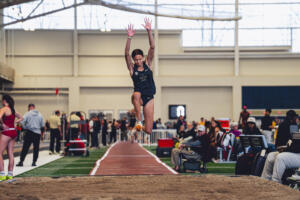
A 2024 second-team All-American and USTFCCCA All-Academic selection, Lena Gooden holds school records in outdoor long jump and the 4×100 relay (Vanderbilt Athletics).
A year ago, for example, the idea for hosting a leadership summit fell through. So, from early in the fall semester, Gooden, Wilson and the group’s board planned and organized the summit that was held the second week of February. From paying attention to small details, like working with a local Black-owned bakery for catering, to assembling a panel, they took on a lot in addition to their academic and athletic responsibilities. It came together with McAllister, cross country and track and field director Althea Thomas and Norris “EJ” Edney III, Vanderbilt’s associate dean of students for belonging and communities, addressing students from across the university, athletes and non-athletes alike.
“We wanted to make sure that we had a space where we can have people from different backgrounds,” Wilson said, “And people who can share different knowledge with us on different topics.”
Next up on the agenda is organizing a BSAG community service event for the spring, as well as collaborating with the Ingram Center’s student development staff on some career development initiatives.
View this post on Instagram
Passing the Baton
Like Shelby, who was a three-time qualifier for the NCAA Outdoor Track and Field Championships and either holds or is part of eight school records, Gooden and Wilson do have other things on their plates, in addition to executive duties. After earning All-America honors in long jump in 2024, Gooden will try to return to the NCAA Outdoor Championships for a second time, while Wilson has come close to a number of school relay records and was already part of the winning 4×400 team in this season’s Rod McCravey Memorial meet.
Indeed, the same goes for all of the members of BSAG, including board members Taylor McKinnon (marketing and communication chair), Anya Carey (treasurer), Kenyah Conner (programming/events and community outreach co-chair) and Joy Moorer (secretary) from track and field, Kennadie Marchand (programming/events and community outreach co-chair) from soccer and Ted Gregoire (team relations) from football. Taking on extra responsibilities isn’t something any Division I student-athlete can do lightly. But leaving a place better than you found it is a familiar refrain in athletics, the sort of thing that helps a football team win 10 games for the first time, a soccer team go to the Elite Eight for the first time or a track and field team send a crowded traveling party to the NCAA Championships. Gooden and Wilson know what the Black Student-Athlete Group has meant to their Vanderbilt experience. And they want to leave it better than they found it for the next leaders.
“Being upperclassmen, we will not be here forever,” Gooden said. “I think it’s important that BSAG keeps progressing and building every year. We definitely have some passionate Black student-athletes on our board and also just in athletics in general. So any questions that they have, we’ll try to answer — just so that they feel safe enough to ask us, the same way we asked other people questions. We’d like to see the legacy maintained.”
It’s how an idea becomes part of the story of a place. Part of Vanderbilt’s story.
“Taiya was a no BS type of person,” Wilson said. “She’s very serious about her stuff. But seeing her outside of the track space was very different because it showed me that she’s very passionate and driven about everything that she does. She was a great role model for me with how good she was overall — she was succeeding in academics, obviously succeeding in track and leading a great organization. She was inspiration for young Black student-athletes who were coming up and through Vanderbilt the same way she did.”
As they will be one day.