

Nov. 18, 2014
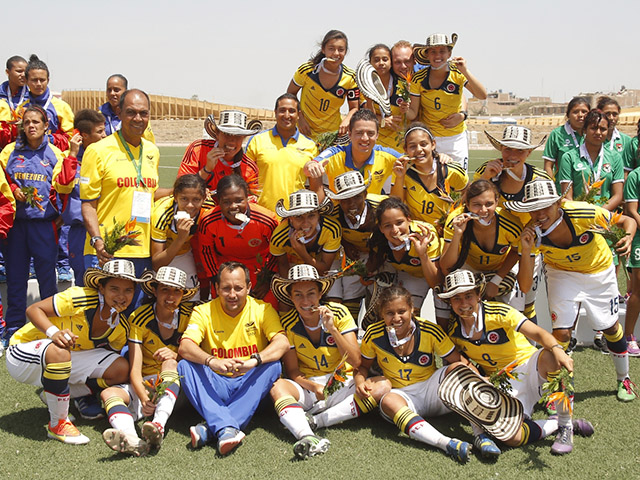
Vanderbilt sophomore Lina Granados, bottom row, second from left, won the gold medal with her native country of Colombia at the Bolivian Games in Peru last November.
By Jerome Boettcher | Subscribe to Commodore Nation
Fresh off winning a national championship, Walker Buehler, Carson Fulmer, Bryan Reynolds and Dansby Swanson instantly became world travelers.
That is one of the perks of representing your country.
And they weren’t alone. Along with the baseball quartet, who played on USA Baseball’s Collegiate National Team, four other Vanderbilt student-athletes represented their countries and played in international competition.
Eight current Commodores represented three countries (Canada, Colombia and United States), traveled to five countries (Cuba, Netherlands, Peru, Taiwan and Uruguay) and won four gold medals.
In addition to the baseball foursome, Paris Kea, a freshman on the women’s basketball team, also played for Team USA. Her fellow freshman teammates, Khaléann and Audrey-Ann Caron-Goudreau, represented their native Canada on the hardwood. And Lina Granados, a sophomore forward on the soccer team, played in two tournaments for Colombia.
“It was one of those things you knew it was a great honor going into it but you weren’t exactly sure what it entailed,” Swanson said. “But when you started playing for them, you realized the importance of being able to play for your country against other countries.”
While Fulmer had played on the 18U Team USA squad in 2011, playing for their country was a new experience for Buehler, Reynolds and Swanson. And so was traveling out of the country for Reynolds and Swanson.
Along with 15 games throughout South and North Carolina, Team USA also played eight games in the Netherlands and five in Cuba. For Reynolds, who is from nearby Brentwood, Tenn., just getting there was the daunting part.
“The plane ride was scary because I don’t like flying to begin with,” he said. “The seven-hour flight across was rough.”
When they got to Amsterdam, where they went 7-1 to win the Honkbal Week tournament title, Swanson and Reynolds experienced a different pace and culture than they were used to do.
Swanson enjoyed the stress-free nature of Haarlem. Reynolds couldn’t help but notice the compact size of the cars and the difference in architecture.
“The city was like a city you see in Harry Potter,” Reynolds said. “You walk down a back alley but there are shops on every corner and people packed in there. Definitely different.”
The team also played a five-game series in Cuba. A late addition to the team, Buehler joined the squad for the first time in Cuba. Vanderbilt became just the fifth school since 1980 to have four players on the Collegiate National Team.
Though they failed to defeat Cuba, it didn’t take away from the experience. In fact, Swanson said having more than 10,000 fans in the stands just added to the atmosphere.
“Nicest people ever,” he said. “They love baseball. It is like a religion for them down there. Very, very passionate about it.”
Team USA finished the summer 18-8-2. Of the eight losses, five were to Cuba and two were to Japan. In all, Team USA played four countries (Chinese Tapei, Cuba, Japan and the Netherlands) and seven teams from collegiate summer leagues.
One of the biggest highlights, though, for Swanson, came stateside when his parents were in the stands on Fourth of July to watch him play Chinese Tapei in Durham, N.C.
“One of the coolest things, other than the national championship, was on July 4, getting to play for USA on Independence Day,” Swanson said. “Getting a win, packed house over in Durham, 10,000 people and fireworks afterwards. It was one of those things that you didn’t realize was a dream but it was a dream come true at the end. So that was definitely an honor. Having the USA on the front and have your own name and number on the back, it was special.”
Basketball trio snags gold
Currently, Paris Kea isn’t in possession of her Team USA jersey.
Another family member has called dibs.
“My little brother wears it to school,” Kea said, laughing, thinking about her 10-year-old brother Jermani. “I have everything but my jersey.”
That No. 4 red, white and blue jersey is a prized possession. Kea donned the American colors while helping the USA squad win the gold medal at the FIBA Americas U-18 Championship in August in Colorado.
Weeks before she would begin her fall semester as a freshman at Vanderbilt, Kea stood on a podium with her USA teammates, a gold medal draped around her neck and the Star Spangled Banner playingâ€â€signifying how real this moment was.
“It was really amazing,” Kea said. “The whole time I was looking at my parents and my little brother. I didn’t cry. I just held my head down and prayed and thanked God for this amazing opportunity to be around some great players, great coaches, great people. It was all around an amazing experience.”
Kea wasn’t the only Commodore freshman to live a dream and win gold for her country. In fact, Kea and twin sisters Khaléann Caron-Goudreau and Audrey-Ann Caron-Goudreau all won gold medals on the basketball court this summer. While Kea was representing America, the Caron-Goudreau sisters were representing their province of Quebec in helping the Canadian Senior B national team win gold at the William Jones Cup International Tournament in Taiwan.
“We’re the only French province so I’m really proud to represent my French province,” Khaléann Caron-Goudreau said. It is an honor for me to be on the Canadian team and represent my family and my friends. It was just great. I was just proud.”
Kea stayed in the states as the FIBA Americas U18 Championship was held at the U.S. Olympic Training Center in Colorado Springs. She made the 12-member team back in May after an intense week of tryouts.
Kea, a 5-foot-8 point guard from Greensboro, N.C., couldn’t believe what she was hearing when it was announced on the last day of tryouts that she made the team. Kea is the first Commodore to make a USA team since Christina Wirth helped the U-19 team win the gold medal at the World Championship in 2005.
“It felt amazing,” Kea said. “At first I was surprised. I had to get them to repeat my name. I was like, ‘You said me?’ Everybody was like, ‘Yeah, Paris. They said you.’ Oh, snap. That was really amazing.”
Kea returned to Colorado later that summer to begin training. In the process, she received great lessons from USA head coach Dawn Staley (South Carolina) and assistants Kim Barnes Arico (Michigan) and Jeff Walz (Louisville). Kea said learning from Staley, a three-time Olympic gold medalist, was especially helpful.
In August, Team USA swept through the tournament to the crown. The U-18 team won its seventh straight gold medal by defeating Canada and Kea scored 19 points, grabbed 11 rebounds and dished out 17 assists in five games.
“It was a rush of energy (to make Team USA),” Kea said. “I was really excited. I knew it was my first really, really big breakthrough. To have my little brother there, he looks up to me. So it felt really good that he would be able to see me succeed and play for the USA team.”
The Caron-Goudreau sisters also kept busy in August, making the Canadian Development National Team. After 10 days of training camp, they then flew over to Taiwan for nine days.
This wasn’t the first national team for the sisters. The pair played for Team Canada Cadette Women National Team in 2012, helping their country to a third-place finish at the World Championship in Amsterdam.
But playing for Team Canada a second timeâ€â€before their college careers have startedâ€â€wasn’t any less special.
“It is everything,” Audrey-Ann said. “Some people care more about the numbers on their chest, I always cared more about the country I represented. Because I was from a French province, I’m really honored to play for my French province and represent the French people of Canada.”
Just like Kea and Team USA, Canada won all five games at the tournament. The Canadians defeated the USA squad in the gold medal game of the World Cup.
“It was really amazing to win a gold medal,” Audrey-Ann said. “It was my first gold medal with national team. It was a great experience. We got to meet awesome people. And the people from Taiwan were just amazing. They’re so nice.”
On the island country of Taiwan, where there are more than 23 million people and the average female height is 5-foot-2, the 6-foot-3 Canadian sisters stood out. Add to it there were two of them that looked near identical and they were basketball players, fans in Taipei, Taiwan treated them like celebrities.
“It was crazy. I would go to the bathroom and they would literally run after us,” Khaléann said. “They wanted my picture and my autograph. It was a really great experience. They were so into it. They freaked out when they saw there were two of us.”
Getting to share the experience together was that much more rewarding for the twin sisters, who have climbed up the basketball ladder at similar paces since they jumped into the sport when they were 10.
“We’re always together in everything,” Khaléann said. “It is good to have someone in my family with me on the team. She understands me and I understand her.”
Added Audrey-Ann: “It was amazing. She is half of me. I don’t feel complete if she is not there.”
The Vanderbilt freshman trio hopes this isn’t the last time they’ll represent their countries. Kea wants to play on the U-19 team next year. Khaleann and Audrey-Ann already have their sights on playing for Canada in the 2020 Olympics.
“It does motivate me,” Kea said. “I played for the USA U-18 team. I know they have a college team. Of course that motivates me to want to play again, prove myself again.”
Year away one to remember for Granados
Vanderbilt redshirt sophomore Lina Granados will never forget the first time she put on that yellow Colombian jersey.
She was 17, ready to take the soccer field to represent her native country of Colombia in the 2012 South American U-20 Women’s Championship in Brazil. The Colombian national anthem, ¡Oh Gloria inmarcesible!â€â€translated O Unfading Gloryâ€â€blasted through the speakers. Born in Columbia but having lived most of her childhood in the United States, Granados had just learned the words two weeks before.
It didn’t matter. Tears rolled down her face as the national anthem played. Less than two years later, again representing Columbia in international competition, Granados beamed with pride and a gold medal around her neck as ¡Oh Gloria inmarcesible! rang through the stadium.
“When it started playing, it is a wave of emotions,” she said. “Colombians are very passionate people. They’re very proud of where they come from. Just being able to wear that jersey and being able to say I’m one of the 18 out of 48 million Colombians in a sport they love so much is just a crazy experience. It still gives me goose bumps.”
Two weeks before preseason practice at Vanderbilt began last summer, Granados received a call-up she couldn’t turn down. She had been chosen to play on the Colombian U-20 national team in the Bolivarian Gamesâ€â€a regional multi-sport event held in South America between the countries of Bolivia, Colombia, Ecuador, Panama, Peru and Venezuela.
In addition, Colombia also had a chance to qualify for the FIFA U-20 Women’s World Cup in January. Thus, Granados, a 5-foot-6 forward, spent a year away from school to fulfill a dream.
“It is one of those things where you can’t give up an opportunity like that. Totally worth it,” Granados said. “In the long run, what’s graduating a year early or a year late? 21, 22, it is not going to make a huge difference. But these experiences… They say you learn more from traveling than you do sitting in the classroom.”
Though Granados was born in Colombia, her family moved to Costa Rica when she was 2 years old for her father’s job with Exxon Mobil. Three years later, they moved to Ashburn, Va., where she has lived since. At the age of 15, while visiting family in Colombia she was informally invited to play with players three or four years older than her. The U-20 coach was on hand and invited her to try out.
Though she didn’t make the U-20 team, the experience fueled her fire to represent her country. Two years later, she played for the U-20 team in the South American Women’s World Championship.
“When you have that jersey on they say you don’t just represent your country, you represent your family, you represent where you’re from and everything you believe in,” she said.
Last fall, she put that jersey back on for the Bolivarian Games in Peru in November. For the first time in the history of the games, which dates back to 1938, Colombia was the top medaling nation. The U-20 women’s soccer team did its part, capturing the gold medal by defeating Venezuela in penalty kicks.
As exhilarating as winning the gold medal was, Granados enjoyed the entire experience. When stepping off the bus to enter the stadium, the Colombian team would announce its arrival by breaking into song and dance.
“In Peru, the Peruvian team got (eliminated) in the first round,” she said. “Somehow we won the hearts of all the Peruvians over there. We sing and dance. It is kind of Colombia. You sing and dance and you’re always happy… It was mind-blowing to be a part of that. We would go out and people want to take pictures and ask for autographs. It was just really cool.”
And the journey continued into 2014.
In January, she joined the U-20 team in Uruguay for the South American qualifier for the FIFA U-20 Women’s World Cup. Unfortunately, Colombia finished third, missing out on qualifying by one point as only the top two teams qualify.
Her run with the U-20s might be over, but her chance to represent her country is not.
This summer, she was called up to be a practice player for the full Colombian national team. Within a few days, one of the players on the team tore her ACL and Granados was added to the official training roster.
Though she didn’t join the squad in international competition in Septemberâ€â€not wanting to miss more schoolâ€â€she’ll get a chance to tryout again next May for the team that plays in the 2015 Women’s World Cup. That same squad will also try to qualify for the 2016 Olympics in Rio de Janeiro. The opportunity this past summer to practice with the national team was another dream come true for Granados. She can recall icing a torn meniscus in her knee and watching the 2012 Olympics. Those same players she idolized then, she was now sharing a field.
“I’ve seen these girls walk out. I’ve seen them stop by and train. They were just these idols to me,” she said. “These girls who have had so much experience. I was afraid to make a mistake. But they were so supportive and so caring and nice. They just legitimately want the best player on the field and want the best for you.”
Granados admits when she first started playing for her home country nearly five years ago, she was hesitant to mention she lived in the United States. She was afraid her American accent when she spoke Spanish would give her away.
There was a belief by some that the Colombian Football Federation should only recruit players who were born and raised in Colombia. But Granados said she always felt support from her U-20 coach. She remarked that last year in Peru, the team grew as a family, spending all their time together. In January, Granados counted six players on the team who either lived in the U.S. or Canada but had Colombian connections.
For Granados, she has been fortunate to have the best of both worldsâ€â€and wear that vibrant yellow Colombian jersey in the process.
“I’m just really proud of being able to say I came to the states but I still am so proud of where I came from,” Granados said. “I think one of the first things that anybody knows about me when they meet me is that I’m Colombian. It is my life. It is part of me. It’s who I am. I’m really proud of that. I guess I was young and afraid that it would mean I wouldn’t fit in. But it is like when I’m here I say I’m Colombian and when I’m there I say I’m from the states. I grew up in the states. It is something to be proud of, where you come from.”ï€Â