

May 30, 2013
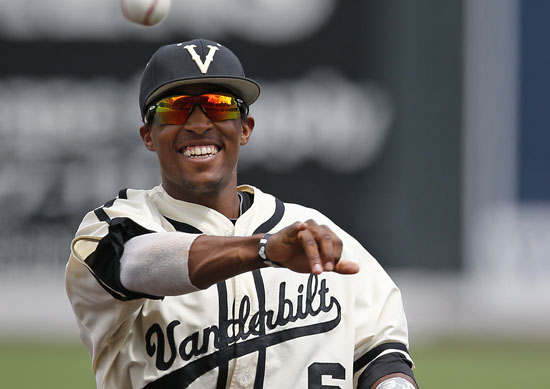
It didn’t matter if the game started at 3 p.m. or 6 p.m. because by 8 a.m. Tony Kemp was ready to go. Tony wasn’t old enough to tell time, but he knew what days his baseball games were. So every morning before a game, the first thing he would do is put on his baseball jersey, socks, pants and hat. Every passing minute leading up to the start of the game seemed like an eternity for Tony and every anxious and highly-excitable bone in his body.
“The kid woke up excited,” said Tony’s brother, Corey, who is six years older. “Every hour he would be asking if it was time to go to the game yet. I would always tell him to chill out.”
Tony Kemp doesn’t get dressed in his Vanderbilt uniform when he gets out of bed each morning, but the excitement the Commodore second baseman had for the sport as a child remains today and is apparent in everything he does from the relentless motor with which he plays to his signature grin that is always plastered on his face.
Since arriving on campus in the fall of 2010, Tony, now a junior, has made a profound impact on Vanderbilt’s program through his on-field production and heroics, as well as his infectious personality. He is Mr. Excitement for the Commodores and nobody else is quite like him.
His plays wow fans and border the line of ridiculous and unfathomable. He is a human highlight reel and every play he is involved with seems just as likely to be spectacular rather than routine.
Defensively, Tony flashes his leather with the best of them, throwing his 5-foot-6, 160-pound frame around with a reckless abandon, diving for ground balls, turning acrobatic double plays and making circus-like catches.
On offense, he is a menace that leaves opposing teams shaking in their cleats. Each time he steps in the batter’s box he can completely alter the course of a game. He has as many triples as any player in SEC history and is just as likely to burn an outfielder with a line drive as he is to lay down a perfectly placed bunt that leaves the defense without a play at first base. Once on base, he can swipe a bag with ease and causes opponents fits with his aggressive base running that leaves pitchers thinking more about him than the batter at the plate.
He is a thorn in a pitcher’s side that won’t go away and a spark plug that can ignite Vanderbilt’s entire team.
“When I get on and use my speed, I know that pitchers are probably going to leave a pitch in a spot that they don’t want to leave it and someone is going to punish it,” Tony said. “You can just see where the pitcher’s concentration kind of gets aimed towards me and that is when they make mistakes.”
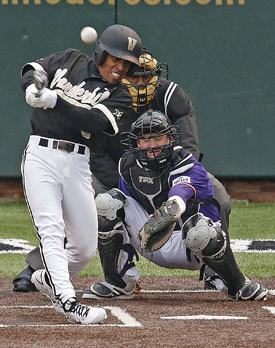 Tony’s ability to impact a game stretches well beyond his play on the field. He is a natural leader who exudes confidence, but does not come across as cocky. He’s constantly smiling and laughing and lights up a room with his fun and upbeat personality that people gravitate towards. His energy level helps inspire the team and his fun-loving demeanor keeps his teammates loose.
“Tony is full of energy,” Vanderbilt junior first baseman Conrad Gregor said. “I’ve never seen the kid down or without a smile on his face. When you are looking for a positive light, Tony is the person that comes to mind. He just brightens everyone’s day. He gets everyone going.”
Tony is the rare total package that succeeds in virtually every phase of the game his physical size will allow him to and, yet, can still positively impact a game just as much with his leadership and personality even when he has a poor game.
“You look at his offense, you look at his defense, you look at his base running, what people in the stands don’t see is what he does in the locker room, what he does off the field,” Vanderbilt Head Coach Tim Corbin said. “They see the smile, they see the exuberance and they see the positive life force that he is and what he creates for our team, and I would say that, just as much as his physical abilities, are just as important to our success because he infuses energy into the guys.”
Tony has always been full of energy from a young age, growing up as the youngest of three children to Rick and Catherine Kemp in Franklin, Tenn. Tony spent almost all of his life in Franklin, with the exception of a year and half when his father’s job with Caterpillar caused the family to relocate to Baltimore, Md.
 |
“He has always been like the Energizer Bunny from sun up to sun down. When Tony would eat his dinner, he would take a couple of bites and then go run outside and play, come back in and take another bite and go run out and play.” – Rick Kemp |
“He has always been like the Energizer Bunny from sun up to sun down,” Rick said. “When Tony would eat his dinner, he would take a couple of bites and then go run outside and play, come back in and take another bite and go run out and play. So he was always back and forth, always full of energy, always moving. Always on the move.
“That extended smile you see on his face on the field is genuine. Tony genuinely loves the game. He is out there having a good time and it is just who he is and he just has a love for the game. Even when he was little he had that crazy laugh and always had that stupid grin on his face.”
For Tony, baseball is fun and it always has been. His love for the game is exemplified by the way he wears his emotions on his sleeve with his constant laughter and chatter, and, of course, his big grin.
“I think the whole energy thing is just my personality,” Tony remarked. “I think it is something fun. You are out here with 30 other guys playing baseball and you have all these people at your games, I think it is the best.
“It is just one of those things where you want to have fun with your teammates and that’s what it is and I wouldn’t trade these guys for anything.”
– – – – – – – – – – – – – – – – – – –
Tony Kemp is used to the doubters. His whole life he has been told that he is too short and too small to play sports at a high level. But all he has done is prove the naysayers wrong.
Coming out of high school, he received very little interest from college programs. He doesn’t know exactly why that was, but his height – or lack there of – likely had a lot to do with it.
“I think it was because of my height,” Tony said. “I think people would come and see me play and say, ‘he’s good, but he is too small.’ I think a big thing is that they saw my height and they saw it as a disadvantage. Thank God, Coach (Tim) Corbin saw it as an advantage.”
One school that did recruit Tony hard was East Carolina, where his brother Corey had played his final two collegiate seasons and earned Conference USA Player of the Year honors in 2008. Corey had a great experience at ECU and he wanted Tony to follow in his footsteps.
“I wanted him to go (to East Carolina),” Corey said. “Coach (Billy) Godwin and Coach (Link) Jarrett, who is at UNC Greensboro now, are just great people. They always took care of me being a kid from out of state. I played with a lot of guys in high school who went to Vanderbilt and I knew other players there and they talked about how good of a guy Coach Corbin was, so when my brother said he wanted to go to Vanderbilt, I never tried to pull him to East Carolina because I knew Coach Corbin would develop him and give him a fair shot at getting to play.”
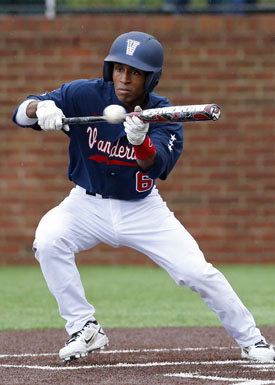 A fair shot he has. Kemp burst onto the scene as a freshman and hasn’t looked back. He started in left field and batted leadoff in the Commodores’ first game during a freshman season that ended with Vanderbilt making its first trip to the College World Series. That same year he garnered SEC Freshman of the Year accolades and became a household name for college baseball fans everywhere after his outstanding play in the College World Series that earned him All-Tournament team honors.
Much of what helped Tony make an immediate impact as a freshman was his speed. No one else on the team was as quick as Tony and could do so much damage with their legs. For Corbin, Tony was the perfect player to execute the bunt game he relies so heavily on.
But there was a problem: Tony couldn’t bunt and really had no interest in learning how to. “In four years of high school, I probably bunted three times in my entire high school career,” Tony said.
Corbin knew Tony could become an invaluable weapon if he mastered the craft and he sold Tony on bunting by explaining how he could hit .400 if he learned how to bunt. “I started laughing and thinking no way,” Tony recalled.
Shortly thereafter, Tony began working closely with teammate Mike Yastrzemski on the fundamentals of bunting, but he still didn’t enjoy it.
“It just wasn’t comfortable,” Tony said. “I just didn’t have good rhythm. I didn’t have good timing. If I moved my hand up and down the barrel, I didn’t want my finger to get hurt when I bunted so I was really uncomfortable at first when bunting.”
Eventually after much practice, bunting became comfortable to Tony and it quickly became a valuable piece to Vanderbilt’s offensive attack.
Mike Yastrzemski taught me all the inns and outs for things to look for,” Tony remarked. “I thank him so much for that because I wouldn’t be the player that I am without him. He had the wherewithal to see that I had potential to be a better player if I got better at the bunt game.”
Throughout his freshman season, Tony utilized the bunt to keep defenses off balance, and it worked. If defenders played him deep, he would lay down a bunt and use his blazing speed to easily make it to first. If defenders cheated in, he would slap a ball past them.
The addition of a bunt game was just another factor in helping him find success much quicker than he could have expected as a freshman.
“Coming into my freshman year, I just wanted to do the best that I could,” Tony said. “Coach Corbin always said that you win a position, so I just took that opportunity and said I am going to do whatever I can to get on the field. In February, we went out to San Diego and he was announcing the starting lineups and that I was going to be in left field with Connor Harrell and Mike Yastrzemski. It kind of shocked me for sure. I was making phone calls to my dad, my (high school) coach and my brother saying, ‘Hey, I’m starting in left field; I’m really nervous and I don’t know what is going on.'”
|
“It is great having him on our team and not having to play against him because he can beat you every way and you want to keep him off the bases, which is a hard thing to do.” – Conrad Gregor |
After his sophomore season, Tony had superstar written all over him. He was tabbed a Louisville Slugger Preseason All-American, and the table was set for him to have an even better season. But instead of taking a step forward, Tony went backwards. He hit just .261 and saw his strikeouts increase and his on-base percentage decrease.
“Just being on that 2011 team and going to Omaha, I think it was that there was no pressure,” Tony said. “You had Aaron Westlake, you had Sonny Gray, you had Grayson Garvin, Taylor Hill, you had all these big name guys and I was the little freshman and got swallowed by a lot of those names.
“As a sophomore, it kind of felt like I needed to be that guy. That spark plug. That energy guy. That led to some pressure. I’d swing at pitches that weren’t necessarily in the strike zone. At times I wasn’t comfortable at the plate because I was trying to do too much for the team.”
Tony was asked to do more at the plate, but also in the field. A little past the midway point of the season, starting second baseman Riley Reynolds went down with an injury. The injury threw a wrench in Vanderbilt’s routine. In need of a replacement, Corbin turned to Tony.
He had played shortstop up until eighth grade, but he spent his entire high school career in the outfield. Suddenly, Tony was having to learn an infield position in the middle of the season.
“We had a meeting and Coach Corbin asked if I could play second base,” Tony recalled. “I said, ‘I haven’t played infield since eighth grade, but I will do whatever you want. I will try my best.'”
To learn the position, Tony turned to Reynolds and shortstop Anthony Gomez for help. Reynolds would be out in his boot helping with fielding mechanics and Gomez would assist with his range and first step. The position change did not come without a few early struggles, but overall it came naturally to Tony, who started 24 games at the position last season and has started every game there in 2013.
Following his sophomore season, Tony was still transitioning to second base, but he knew another change he had to make to his game was on the offensive end. His sophomore numbers were not where he wanted them to be, so he worked on changing his approach in the batter’s box.
 “Coach Corbin helped me change my stance and I changed my stance going to the Cape (Cod League),” Tony said. “I worked on a two-hand finish with (summer league coach) Mike Roberts up in the Cape and that led to some success up there and I brought it here.”
To say the least, the changes he instituted in the offseason made a dramatic impact this season. After a disappointing sophomore year, he has rebounded in 2013 with one of the most remarkable seasons in SEC history, helping him become only the second Vanderbilt player to be named SEC Player of the Year, joining Hunter Bledsoe.
Throughout the year, Tony has been doing things that you are not supposed to be able to do in Division I college baseball. He is swiping bases with ease, forcing defensive mistakes with his base-running ability, regularly bunting for base hits, making circus catches and doing virtually what he wants whenever he wants on the diamond. All of which have led to Kemp putting up numbers that are video game-silly.
“It is great having him on our team and not having to play against him because he can beat you every way and you want to keep him off the bases, which is a hard thing to do,” Gregor said.
He finished the regular season leading the league in hitting (.408), on-base percentage (.490), runs (58) and stolen bases (27). He is shooting to become the first player in school history to bat .400 in a season since Warner Jones hit .414 in 2004 and is just 15 hits shy of tying Jones’ school record from that same year for most hits in a single season.
“For me to see him do not just well, but be exceptional this year … we are just so happy for Tony,” Rick said. “It’s been good for me because I saw him last year and to see him bat .269 and struggle with the transition from left field to second base was tough. As a parent, you live through every strike out, through every 0-for-4 game and you live those struggles with them. I’m just very happy for him that he has been able to have a banner season.”
For as happy as Tony’s family is for what he has accomplished on the field, they are even more thrilled with what he has done academically.
Last December for his father’s birthday, Tony surprised him with an academic honor roll plaque he had received for making the SEC Academic Honor Roll as a sophomore studying interdisciplinary studies with an emphasis on communication and society.
“I was just so overwhelmed with all that because all of the baseball stuff is great, succeeding academically at Vanderbilt is something else,” Rick said. “I love all the praises, but as a parent, the best thing I can hear is when people tell me Tony is a good kid and that Tony is a nice guy. I love the baseball stuff, believe me, but when somebody tells me that as a parent it absolutely moves me.”
– – – – – – – – – – – – – – – – – – –
There was a time when Tony Kemp didn’t appear to have the slightest of hand-eye coordination that was needed to hit a baseball. Tony would get in a batting stance in the backyard of his family’s Franklin, Tenn., home and Corey would toss the ball, but Tony, who was four at the time, would swing and miss. Corey would then set the ball on the tee and Tony would drive his hands forward and smack the bat into the tee. Determined not to stop trying until he succeeded, Tony would try again and again, but each attempt ended with the same result.
“It was awful,” Corey recalled. “I told my dad, ‘I don’t know how this kid is ever going to have hand-eye coordination. I personally got frustrated because I would keep putting balls on the tee and he would crush the tee all the time. I would pitch to him and he would swing and miss all the time.”
|
“I told my dad, ‘I don’t know how this kid is ever going to have hand-eye coordination. I personally got frustrated because I would keep putting balls on the tee and he would crush the tee all the time. I would pitch to him and he would swing and miss all the time.” – Corey Kemp |
Disappointed that Tony did not appear to have the same ability as he did, Corey made a suggestion to his kid brother that would impact Tony’s future in the sport as much as anything else he has ever done.
“When he first started, he wanted to hit right-handed because of me,” Corey said. “I told him to just turnaround because he couldn’t be any worse from the left side. I was talking to him and the first ball I threw, he crushed it. I was like, ‘oh my gosh, this is unbelievable,’ so I literally probably threw balls to him for another two or three hours and he didn’t miss one. He was hitting balls the other way and he didn’t even know what the other way meant. He was having the greatest time because he had never made contact like that. All he wanted to do was keep hitting.
“I kind of stumbled upon it. No one in the family knew he was left-handed. He writes right-handed, throws right-handed and my dad and I just figured he was right-handed. One day in the backyard my frustration turned him around left-handed an he’s never looked back.”
Once Tony learned how to hit, he and Corey would spend hours in the backyard playing baseball. Even after they had finished their own games, the two brothers would return to the backyard to play more. Tony was interested in other sports such as basketball and football, but baseball was Corey’s favorite sport, and Tony wanted to be just like his big brother.
“Just because he played, I wanted to be like my big brother,” Tony said. “He was my biggest inspiration and Corey always said baseball was the best for him and I wanted it to be the best for me.”
Everywhere Corey would go, Tony would tag along. But having his kid brother in tow was not necessarily a bad thing.
“Tony became such a good athlete at a young age that I always wanted him with me so I could show him off,” Corey recalled. “I would brag to all my friends about how good my little brother was. That is kind of where our relationship started.”
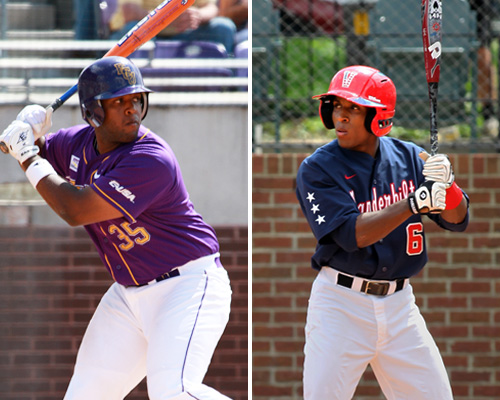
Corey was the 2008 C-USA Player of the Year at East Carolina and Tony was the 2013 SEC Player of the Year.
Tony didn’t know how impressed Corey was with him, so Tony was always trying to prove to his brother that he belonged.
“Even though there is six years difference, they have always been extremely close,” Rick said. “Tony obviously has always idolized Corey. At one time Tony was playing basketball when he was in middle school and whenever he would play basketball and make a shot, I remember him looking in the audience and he wasn’t looking at me or my wife, he was looking at Corey, seeking Corey’s approval. He just put a lot into impressing Corey and he still does that today.
“I think he was very fortunate that Corey was the kind of big brother that didn’t just blow him off, but really took an interest in trying to help him and to try to mold him to a player.”
For as similar interests they share, Tony and Corey are the polar opposites when it comes to stature. Tony is 5-foot-6, 160 pounds and Corey is 6-foot-1, 250 pounds. Because of their differences in size, they never played the same positions. Corey was a catcher and played third base, while Tony was always an outfielder or shortstop when he was younger.
“It is funny if you see the two together you wouldn’t see them as brothers because they are vastly different in stature and they bring something different to the game,” said Rick, who is more similar in size to Tony.
Outside of a few games of H-O-R-S-E, the two tried to avoid athletic competition against one another. Instead, the competitions between them were often held in the form of card or board games.
“He was always so much smaller than me that it was always tough to compete one-on-one,” Corey said. “Our competitiveness came in the form of board games. Tony and I would have legendary Monopoly games and people would hate playing with us because we would get so competitive. Gin Rummy was another card game that we would go back and forth for hours.”
More often then not, Tony would come out on top in all games.
“He would kill me in everything,” reluctantly admitted Corey. “The kid is a ruthless trader of properties and he will make deals with everybody but me and it would tick me off. We will play for five or six hours and he will not quit. He whips me in that pretty regularly and I hate to admit it.”
– – – – – – – – – – – – – – – – – – –
Because of his own baseball schedule, Corey was not able to see as many of Tony’s games as he would have liked to. He knew Tony was good at baseball, but Corey remained significantly better given his advanced age.
Corey’s perspective completely changed one summer day.
When Tony was 10, he played on a travel team in Franklin. He was primarily a shortstop, but because of his ability, the coaching staff occasionally moved him to center field when the middle of the opposing team’s lineup came up to bat.
“The other team had a couple of runners on base, the coach puts my brother in center field in the middle of the inning and I was thinking what the heck is this guy doing,” Corey recalled. “Sure enough, the kid hits the ball over the wall and Tony goes and robs it. That was probably the first lightbulb moment so to speak. It is a moment in time when I always speak to; it just sticks out.
“Being an athlete myself, anytime you go from an infield position to an outfield position, it is just instincts at that point. It is instincts and competing and whenever you have that – and there is God-given ability obviously – but when you have that instinct and competitive drive, you can play the game for a long time. And he’s always had that.”
It was around that same age where Tony’s flair for the dramatic began to become a recurring trend on the baseball diamond. In one game he went 5-for-5 with six stolen bases. In a tournament in Cooperstown, N.Y., Tony made a splash by doing a backflip during team introductions.
Tony got the idea from watching video of Hall of Fame shortstop Ozzie Smith. Tony’s parents grew up in St. Louis as Cardinals fans and passed that along to their children.
“The first time I saw Tony’s backflip was in Cooperstown,” Rick said. “The funny thing is that they introduce all the teams as they come walking out and Tony comes out first and he does this backflip. Well the guy working the camera missed it so they had the whole team back up and he did it all over again so that he could capture it on camera.”
 “My brother would work on that tirelessly in the backyard just because he is a freak athlete and could do it,” Corey said.
Just as Tony continued to advance in the sport, so to did Corey. In high school Corey set records and earned All-District and All-Region honors at Centennial High School, where Tony also attended and lettered four years in baseball and football.
Through each accomplishment, Corey’s shoes got larger and larger for Tony to fill. Corey was well aware of the added pressure Tony could feel and he went out of his way to make sure Tony didn’t worry about trying to live up to his brother’s accomplishments.
“It was never pressure for me because we would always have talks and he would always say, ‘I don’t want you to be as good as me, I want you to be better than me,'” Tony said.
Corey would go on to start his college career at Tennessee Tech before transferring to a junior college in Georgia for a year and then on to East Carolina. Former Vanderbilt assistant Erik Bakich recruited Corey late in his senior year after he had already made his commitment. Coming out of junior college, Corey again received interest from Vanderbilt, but decided East Carolina would be his best choice.
Corey was drafted in the 14th round by the Milwaukee Brewers in 2008 and played two seasons of minor league baseball before retiring from the game. He now works for Courier Express in Georgia.
Tony has no idea how far baseball will take him, but he has every desire to continue playing as long as we wants. His size will again be an obstacle to overcome at the professional level whenever he decides to make that leap, but his height has led to skepticism his entire life and each time he has done more than enough to win over even his harshest critics.
Since Tony and Corey were young, their parents always told them to play the game as long as they were having fun. For Tony, every gameday remains just as fun and exciting as it was years ago when he would put on his uniform as soon as he got out of bed.
“We were a baseball family and they both were driven to play,” Rick said. “We had a philosophy with Corey and Tony that we were going to keep playing baseball as long as we were having fun because it has always been a fun game and we are going to have a good time playing it. When it gets to the point where it’s not fun anymore, then it is time to quit.
“Corey played a couple of years in the minors and he got to the point where it just wasn’t fun anymore and he told me that and I think the next day, he quit.”
|
“Little kids who watch him play could pick up on so much, and the one key thing is he has fun. His mother and dad have just let him go, and boy what a great example for parents. What a great example for a kid that this is a game that should be played as a game and when you play it as a game, you create a lot of positive effects for yourself and the team that you are with.” – Tim Corbin |
Take one look at Tony Kemp on the field and it is clear he is having fun. He wears the same smile on the field today he did when he played little league baseball and he can’t stop laughing and chatting it up with his teammates.
“It is nice to see Tony still having fun because sometimes the higher you get and more success you have, sometimes it takes the fun out of it,” Corey said. “Things become more serious and pressurized and it is fun for me to see him have fun. I love watching him play because I know how much he enjoys it.”
By just observing how hard Tony plays the game and how outwardly he expresses his love for the game, Corbin believes Tony is someone others could learn a lot from.
“Little kids who watch him play could pick up on so much, and the one key thing is he has fun,” Corbin said. “His mother and dad have just let him go, and boy what a great example for parents. What a great example for a kid that this is a game that should be played as a game and when you play it as a game, you create a lot of positive effects for yourself and the team that you are with.”
Years from now when people reflect on Vanderbilt’s all-time great players, Kemp’s name will be mentioned and his eye-popping plays will become folklore.
Sure, Tony’s name will be sprinkled throughout the record book, but statistics alone will never tell the full story of how much of an impact Tony Kemp made on Vanderbilt’s program.
There’s never been a player or person quite like him and maybe never will be again.