

April 6, 2011
Commodore History Corner Archive
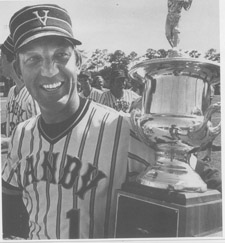 Roy Mewbourne retired as Vanderbilt’s baseball coach at the end of the 2002 season as the all-time winningest coach at Vanderbilt (655-608-9 in 24 seasons on the diamond). Under his guidance, the Commodores captured the 1980 SEC championship as Mewbourne was named the SEC Coach of the Year.
Mewbourne was born and raised in Birmingham, Ala., playing Little League Baseball at age 10. He graduated from Ensley High School. Mewbourne would play his college baseball at traditional power Florida State where he was a senior captain. After graduating from FSU in 1967 with a degree in business management, Mewbourne used his ROTC training at FSU to enter the Army as a lieutenant for two years.
Returning to FSU for two years as a graduate assistant, Mewbourne next taught Physical Education at Birmingham’s C.W. Hayes High School. He moved to Birmingham Southern College where he eventually became the head baseball coach. Six years at Birmingham Southern (267-74) would precede the next 24 years in Nashville as the new Commodore skipper.
At the start of his final season, Mewbourne would witness the unveiling of Hawkins Field. He played a vital role in the fundraising, construction, planning and oversight for the $5.8 million facility. Mewbourne left Vanderbilt as the 35th college head baseball coach to reach the 900-career-win plateau.
His fundraising ability led him to the MTSU Athletic Association where today Mewbourne raises money for Blue Raider athletic scholarships, facilities and other sports needs. Recently Vanderbilt sports history researcher and writer Bill Traughber spoke with Mewbourne about his life in baseball. This is their conversation:
Bill Traughber: Tell me about Roy Mewbourne the high school baseball player?
Roy Mewbourne: I was the leadoff hitter and I was kind of a scrappy guy that did whatever I had to do to help our team win. I wasn’t a power hitter or anything like that. I just tried to get on base with a walk, bunt or anything to get on. I could run pretty well. I would not say I was outstanding. I could steal a few bases. I was a left-handed throwing outfielder.
BT: You played your college baseball at Florida State. Did you have other college options?
Roy Mewbourne: I had been accepted at Auburn, had a roommate and a room reserved for me. I played ball at Ensley and in the American Legion. There was a guy locally that had some contacts at Florida State. I had been to Florida State on a spring baseball trip. I received an offer with some scholarship money to play baseball at Florida State. When that came up, I decided to go to Florida State. There was not a freshman team since freshmen were not eligible for the varsity, but after that first season it changed. Freshmen were allowed on the varsity.
BT: What were your highlights at FSU?
Roy Mewbourne: I was just happy to play. Each year that I was there we played in the NCAA Regional Tournament. In my senior year, I was the team captain. When I was a senior captain we lost in the regions. I had seven straight hits, which was probably the biggest thing that happened to me. I went 7-for-10 in that series.
BT: You served in the Army as a lieutenant from August 1967 until September 1969. This was during the Vietnam era. Were you drafted?
Roy Mewbourne: When I arrived at Florida State, ROTC was mandatory. You were required to take two years of it. At the start of my junior year, it changed so you could get out. You didn’t have to take it any longer. When I came back to school for my junior year, I got out. Vietnam was going on at that time. I remember being over at the ballpark during the fall and thinking to myself. You are 5-foot-9, you don’t run, you are not the fastest guy or the greatest hitter; you are not going to play any professional baseball. I knew I was going to get drafted since I was a walking specimen. There was nothing wrong with me. I was in good health. I decided if I’m going, I’m going as an officer. I went back that spring into the ROTC program. I finished my senior year and went right to ROTC summer camp and to officers’ basic camp at Ft. Sill, Oka. Thinking that I was going to Vietnam, I was trained to be a forward observer for the artillery. They had the highest mortality rate for anybody going over there. When I received my orders, I went to Ft. Bragg, N.C. I didn’t have to go to Vietnam.
BT: What were your duties in the Army?
Roy Mewbourne: When I reported to the personnel officer he looked at me and said, `We don’t need another artillery officer at all. We have more than we need.’ Here I was a 22-year-old kid. I told him the only thing I knew was sports. That’s all I’d done in high school and college. He said, `Okay, Monday morning you see this Major since we have a need on the post for a sports officer.’ I ended up being the sports officer at Ft. Bragg. I ran the intramural programs and organized the various teams that represented the post in competitions. It really gave me an opportunity to put a baseball team together. I got uniforms, purchased the equipment, made the schedule and coached. I was really lucky because it gave me a chance to decide what I wanted to do when I was out of the service. This was when I decided to go into coaching.
BT: When you left the military after your two-year commitment, you returned to Florida State as a graduate assistant baseball coach on the GI Bill for two years. You followed that by returning to your hometown, which led you to your first head baseball coaching position at Birmingham Southern of the NAIA.
Roy Mewbourne: I went back to Birmingham and took a job at a high school (C.W. Hayes) as a Physical Education teacher. I was also an assistant football coach and in the spring an assistant baseball coach. Then I met a guy at Birmingham Southern College who coached the baseball team and he let me be the assistant for one year. The next summer the coach, who was in his early 30s, told me he wasn’t making enough money at Birmingham Southern for his family’s sake. He left, and I applied for the job and got it. I was in the right place at the right time.
 BT: You developed a baseball powerhouse at Birmingham Southern winning at least 41 games in each of the six years you coached there, and were in the Top 10 in the NAIA each year. You guided Birmingham Southern to the Area 27 Tournament four times (1972, 1975-77). Your 1975 club compiled a 49-9 record capturing both the district and Area 5 crowns while finishing fifth in the national tournament. Your overall record was 267-74. Tell me about your Birmingham Southern experience.
Roy Mewbourne: We did pretty well. We had some great teams. I spent a lot of time recruiting. You don’t realize how much is involved in that that type of a job when you want to be good at it and successful. You can’t do it without players. When I was on the staff as an assistant it was the first time the school had made it to the district. We were able to take some junior college kids that helped us right away. I had some connections with some junior college guys. We got some kids that could not go to Division I schools and were overlooked. I knew enough people in baseball that helped me find them. David Lipscomb College with coach Ken Dugan was a war. We played against them while I was at Birmingham Southern and Vanderbilt. When I came to Vanderbilt that rivalry was already there. That game was probably tougher when I was at Vanderbilt. Sometimes it was difficult to match my pitching with their pitching. I had conference games on the weekend in a high-powered conference. You couldn’t waste a pitcher in the middle of the week.
BT: Vanderbilt Athletics Director Roy Kramer scoured over 60 applicants to find a replacement for the Commodores head baseball coach Larry Schmittou who resigned to concentrate on his involvement with the Nashville Sounds. Did you apply for the position?
Roy Mewbourne: I did apply for it. I knew it was coming open. I talked to Larry about it at the coaches’ convention. There had been a guy working in Birmingham that was once on the Vanderbilt athletics staff. He knew some people and helped me. He knew of me and what I was doing in Birmingham Southern. I got an interview with Kramer and he hired me. When I arrived we were not a very deep team. At that time Larry was spending so much time getting the Sounds started and I believe he just drew away from his focus at Vanderbilt. Larry had been the head recruiter at Vanderbilt including football. He was recruiting guys that were duo sports guys. He had football players that also played baseball. Larry built some outstanding teams, but they were guys in both sports.
BT: What was the situation with the baseball program when you arrived?
Roy Mewbourne: When Larry got out of that head recruiter role and involved with the Sounds, it slipped a little bit that year. Some guys graduated and the team was thinner when I got there, but there were some quality guys on that team. I added to it that year. I didn’t get there until about February 14th and they didn’t do anything in the preseason. And in two weeks we were going to Hawaii to open the season. In Hawaii we lost all six games and I was a miserable human. I told my wife there is something really appealing about this job offer at Vanderbilt. She said, `what is it?’ I told her the first six games were in Hawaii. She said, `Oh my, take the job!’ We had a couple of pitchers that were very good. We had a few hitters that were very good. We were not deep enough, and going to Hawaii to play those guys with just two weeks work was miserable. Everybody else on the trip was having a good time.
BT: In 1980, just your second season at Vanderbilt you won the SEC Tournament, which at that time were proclaimed SEC champions. You appeared in the NCAA National Tournament, but lost both games. How special was that team?
Roy Mewbourne: We had some guys that were held over that Schmittou brought in who were good players. I added some guys to it and deepened the pitching staff and team. Offensively and defensively we were really good. We could run, steal bases, had power; and pitching-wise, our guys did a really good job for us. At the end of the year we got into the SEC Tournament and got on a roll. When hitters get on a roll it is contagious. We lost the first game of the tournament and then we just went ballistic. We were hotter than a firecracker. I don’t think we made an error in the tournament. I remember one day we had to play a doubleheader during the tournament. If we lost one of them we were done since we lost our first tournament game. We had a big lead in the first game. I was subbing guys with pitchers hoping they would make an out so the game would get over. We could rest a little bit and come back and play the second game. The pitchers were even hitting. Once we got it going we just blew through that tournament. We blitzed everybody when we got started.
 BT: Vanderbilt did not have impressive baseball facilities as an SEC member. Did that make it more difficult for you to recruit SEC type players?
Roy Mewbourne: As the league escalated that became a definite factor. There was no doubt about it. We had done some work on the surface and the surroundings. That ballpark was so far behind the others it had an effect on your ability to recruit. We were the only team for a long time without lights. I didn’t want to get into the stuff of fundraising, but if it was going to get done I felt like I had to do it. In athletic departments there are always priorities of needs for the programs. Every time I felt that our needs were getting to the top of the run something happened like a football change. A new guy would come in and they had to upgrade the football facilities. The sports that were bringing in the revenue at Vanderbilt were supporting our baseball program. It was difficult for me to say anything. They are paying our way. I decided I was going to have to raise the money to get the new lights and other improvements. It was becoming a more prevalent thing that college coaches were getting involved with marketing their programs and raising money to help make their program more successful by bringing in revenue.
BT: Mark Prior was from the West Coast. How did you get him to Vanderbilt?
Roy Mewbourne: There was a good tie here. Both his mother and father went to Vanderbilt. They were on the West Coast traveling around going to places. They had been to Florida and came through Nashville to look around. I was not here. I had plans to be out of town. I had one of my assistants meet with them. I knew very little about him, but I did get a telephone call from someone telling me he was a prospect. I did talk to his dad so we knew he was coming. After the meeting my assistant coach said, `He is the real deal, coach.’ We made him an offer for a full ride at Vanderbilt and we got him.
BT: Prior left Vanderbilt after one year. Was he not happy at Vanderbilt?
Roy Mewbourne: We had a pitching coach. I would say that is not an area of my expertise. I know pitching, but I was not with them all the time. The head coach has to be here, there and everywhere else. In his freshman year, he pitched in our rotation. It wasn’t like he was a guy we sat on the bench and nursed him. We used him. We put him out there and he worked as much as we let him. I think he and my pitching coach had some rub. I never had a problem with him. I thought he did everything we asked of him. He could also hit. I think there was friction with the pitching coach. He was also a long way from home. It is tough being an 18- or 19-year-old and being that far away from home. He didn’t make a final decision to transfer to Southern Cal until June or July. I tried my best to keep him. I hired a new pitching coach to come in. It just didn’t happen.
BT: You would lose key players to the June major league draft that could ruin the next season for you. How difficult was that for you?
Roy Mewbourne: One year two guys on our starting pitching staff and a couple of good high school recruits, who had signed with us, signed major league contracts. They were all really good students and figured into the starting rotation. Some of the high school guys we signed might sign a contract when they were not a high draft pick. For Vanderbilt to lose guys in June or July is like, where are you going to find a guy academically to get into Vanderbilt and pitch at the level I’m trying to meet? When those things happened it was very difficult. We had to scramble and figure out how to find replacements. Do I hold on to the scholarship money or sign a guy just to fill in? At Vanderbilt you are there to get an education. There were schools in our league that would sign a guy and if he didn’t perform they would cut him loose. Vanderbilt didn’t like for you to do that. They wanted kids to come in, go through school and get their degrees, which is what it is all about. In my last few years at Vanderbilt the hardest thing for me was handling scholarships. You only had so much and the cost of that place was so high.
BT: You coached 19 All-Americans, some went into the major leagues. You had great players like Scotti Madison, Hunter Bledsoe, Joey Cora, Greg Thomas, Greg Smith and Josh Paul. Tell me about a few of those players.
Roy Mewbourne: The thing I remember about Scotti Madison was when we would do our workouts inside when it was cold, rainy, snowy and whatever. We had some batting cages inside the old McGugin gym set up to hit inside. When Scotti was in there hitting, the sound coming off the bat was different than anything you heard. He could hit the ball so hard. He had a great desire to win. He was one of those guys that was a holdover from Schmittou who was determined to succeed and wanting to be a winner. Those are valuable guys.
Here is the great thing about Joey Cora. He was 5-foot-7 and played like he was 6-foot-3. I lost a shortstop that was selected in the major league draft. Here I am in July trying to find a new infielder. I called a couple of scouts to see if they had seen anybody. This one guy said to me, `This is your lucky day.’ He told me he had seen a player that was from Puerto Rico. I thought to myself, ‘Sure, that guy is coming to Vanderbilt.’ The guy told me he was a good student with a 3.5 GPA taking the right courses in math and the sciences in a private school in Puerto Rico. But I was told that he would be in Ohio for just one day. I got on a plane the next day to see this guy. I got there and watched three innings and the game was rained out. I spent the rest of the day with Joey’s dad who could speak some broken English. I told them I needed to see his transcripts before I can make an offer. Since he would be a foreign student he was required to take a certain test from the admissions office. He did well enough in that test for Vanderbilt to accept. So I signed him to play baseball at Vanderbilt.
BT: When did you decide to retire?
Roy Mewbourne: It was my choice. We had a series late in the season. Friday night we won and beat them pretty good. We came back on Saturday and started a guy that had pitched a lot for us that season and in the past couple of years. He was a quality starter for us. The guy goes out and gives up 10 runs in the first inning. Because we did not have enough depth on the pitching staff we had to let some starters pitch in games for an inning or two. When he gave up those 10 runs I remember sitting on the bench thinking to myself, `What in the world am I doing here?’ I went home that night and sat out on the deck in the backyard with my wife. I was drinking a beer and I said, `Honey, I think I’m done.’
Then on Monday I told the team that I was retiring.
BT: When Roy Mewbourne looks back on his 24 years as the Vanderbilt head baseball coach, what does he think about with pride and accomplishment?
Roy Mewbourne: I survived 24 years in the Southeastern Conference [laughing]. There are not too many people that can say that. It is such a high-profile league that escalated during all those 24 years. I would also say putting that new ballpark (Hawkins Field) in place meant a whole lot to me. In my mind it was probably the last goal that I had. It was without a doubt a great feeling for me when I left. And what [Tim] Corbin has done with that program now, was my vision of where I wanted to take Vanderbilt. He has done it. In my honest opinion he will eventually get into the national tournament and win it. I’m real happy to see what’s taking place there. Vanderbilt was good to me. It was a great time and a great career.
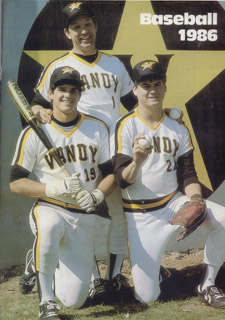
The photographs accompanying this interview are Roy Mewbourne with the 1980 SEC champiohsip trophy; 1979 Vanderbilt Baseball Cover (left to right), Scotti Madison, Roy Mewbourne and Jack Nuismer; 1986 Cover; (left to right), Bill Shiverick, Roy Mewbourne and John Parke.
If you have any comments or suggestions you can contact Bill Traughber via email WLTraughber@aol.com.