
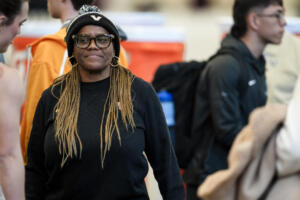
 NASHVILLE, Tenn. — Like many in Commodore Nation, Vanderbilt track and field assistant coach Lisa Morgan packed a bag and hit the road in March. But this wasn’t a spring break excursion. And there were no beaches in sight. From Nashville to Nanjing, China, by way of San Francisco and Beijing, Morgan trekked more than 30 hours each way to coach Team USA’s distance runners in the World Athletics Indoor Championships.
Counting the return leg, she spent about as many hours on planes and waiting out layovers as were allotted to the entire three days of competition in China.
The trip produced tangible results. Americans in her charge won medals and set personal bests. Still, Morgan’s life and travels in track and field are evidence that the clock and medal stand rarely tell the whole story. Returning to Nashville and her Vanderbilt student-athletes, she can spin tales about Americans sweeping the men’s and women’s 4×400 relays and other glories. But stories about lost luggage, sightseeing mishaps and the small moments of camaraderie that make long days memorable offer insight of their own.
 Not all lessons come from the medal stand. They come instead in how you get there.
“To be on that level, the training is different, the commitment is different,” Morgan said. “The athletes that make it at that level, they train, they’re committed and they sacrifice. That’s what I share with our student-athletes, that to achieve your goals you’ve got to sacrifice and want it, mentally, spiritually, emotionally and physically. It’s about really putting together the whole package and going for it.”
In other words, the lessons come from a life spent giving yourself over to the journey.
She’ll point to Team USA athletes as examples. They aren’t the only ones.

Julia Rosenberg, Audrey Allman and Lisa Morgan celebrate during the Music City Challenge (Alondra Munoz Sandoval/Vanderbilt Athletics).
Her Own Amazing Race
Growing up, Morgan dreamed about what happened on the track. Where that track was located didn’t matter. She dreamed about being an Olympian, not traveling the world to get there. A standout collegiate middle-distance runner at Kentucky, she got closer than many, but it was coaching that turned out to be a ticket to the world.
A celebrated prep and collegiate coach in New Jersey, where she’s enshrined in the New Jersey State Coaches and Armory Coaches Halls of Fame, among others, she has been on the USA Track and Field coaching radar for nearly two decades.
Track took her to Cali, Colombia, for the 2015 World Youth Championships. More than the travel advisories that cautioned against going out at night, she remembers the warmth and hospitality of the people she met—and the mouthwatering local food.
Yes, she remembers adding Noah Lyles to her relay pool in the 2013 World Junior Championships in Donetsk, Ukraine, after the then-teenager failed to qualify in the 200 meters. He helped win a medal in the medley relay. But she also remembers stumbling across a wedding party while out for a walk in a park. War engulfed the city a year later, long before Russia’s full-scale invasion in 2022. On that perfect summer day before the world changed, the newlyweds cajoled her to join them in their wedding photos.
There are trips when the time zone and even the continent are all but meaningless. She could be anywhere, one hotel and one stadium the same as any others. These are work trips, after all. But she tries to get something out of the experiences.
 It’s why, with perhaps a four-hour window one day in Nanjing, she and a few others in the traveling party hailed a ride-share to take them to the City Wall, constructed in the 14th century when the city was the capital of the Ming Dynasty.
With a four-hour window and a drive of almost an hour each way, there wasn’t much margin for error. At one point, with traffic at a standstill, their driver suggested they would be better off walking and pointed them in the general direction of the wall.
“You’re walking through a neighborhood and then it just opens up into this like beautiful park with beautiful cherry blossoms and the wall and people,” Morgan said. “We’re right there, it’s just us and the locals and all these Chinese tourists.”
After catching a break with a guide who let them skip the long line, they wandered the streets while wearing out the translation apps on their phones to communicate with the ride-share driver for the return trip.
They made it to the stadium with at least four or five minutes to spare.

 An early riser, she would go for a run along the Qinhuai River before breakfast—the meal an international affair with runners from all over the world sharing the same hotel. She’d then organize the day’s schedule—which runners needed to be where at what time for training or heats to massage and treatment sessions. Indeed, rather than delivering stirring speeches, much of the national team coaching staff’s life during these events is endless logistics.
 “I’m a fun coach, and that’s what it is for me. I think the more relaxed you are, the faster you will run and the better you will be. That’s just always been my philosophy.”
 “I was right there on the turn and I’m yelling to ‘get up, get up,’” Morgan recalled. “I just tried to coach her through that whole thing. She just missed qualifying. They take the top three and she just was out-leaned. But she had caught up. If that race doesn’t teach you anything, nothing can. That’s a character building race and I told her ‘You should know, one, how fit you are, and two, how good you are.’ Because to come back on that group of girls and just miss making the final? To me, hands down, she would have won the final.”