Leading the way on and off the field
Entering the master’s program next fall will allow Gross to play one more season with her Commodores teammates in 2023, making use of the additional eligibility that the NCAA granted spring sport student-athletes affected by the onset of the pandemic in 2020.
More immediately this spring, with a strong core that includes fifth-year all-conference selections Gabby Forina and Melissa Hawkins and senior captains Emily Brooks, Maddie Souza and Callie Sundin, Vanderbilt aspires to build off last season’s NCAA Tournament appearance. An early victory against nationally ranked Notre Dame highlighted the potential to do just that, Gross contributing two assists. But having Gross around for an additional season will be crucial to maintaining momentum, and not just for the goals and assists she provides out of midfield.
“I know she’s a leader, and she feels like she’s a leader,” Hewitt said. “But all of her teammates need to hear from her for them to buy in to what she’s doing and where she wants to take us. She’s really started to grow in that area. That’s the next step. I look at her as someone who should be captain next year and holding us to a super high standard—getting to a conference championship and winning a conference championship and getting to the NCAA Tournament and progressing through the NCAA Tournament.
“When you have players who have played at an elite international level like she has, she has that experience, so we need to hear from her on an every day basis.”
Not for the first time, lacrosse offers a lesson that will serve her throughout her life. It already showed her she could excel in the face of expectations. What remains is to see if she can lead.
At Vanderbilt, Gross is part of a diverse environment—her master’s program is almost evenly split between women and men. That isn’t always true in the wider worlds of engineering and technology.
According to U.S. Census Bureau data, the percentage of STEM jobs held by women increased from 8 percent in 1970 to 27 percent in 2019, although engineering lagged other fields. A recent Deloitte Global report, meanwhile, projected that women will represent 32.9 percent of the overall workforce in large technology companies in 2022 and 25 percent of the technical roles in those companies. Both are examples of progress—and of how much work remains.
“I am encouraged that she’s going on for her master’s,” Johnson said, “Because I would say probably one of the areas where she could make a big contribution, and where there is still work to do, is in the leadership in the tech sector. There are still opportunities to have more women in those roles.”
Gross isn’t sure which path she will ultimately follow, perhaps aerospace or perhaps working with medical devices—a field she is increasingly drawn toward through Johnson’s mentorship and experience in that area. Perhaps she will find a way to do both. Inevitably, whichever path she chooses, it will be one previously traveled by few women.
After her time at Vanderbilt, on and off the field, she will be ready nonetheless.
“When you are part of a team for so long, you learn how to work with different personalities and how to motivate people in different ways,” Gross said. “No two people are motivated by the same thing. No two people react to criticism or new ideas in the same way. With lacrosse, it gives me an advantage when working with other people.”
Gross still stops by her old high school team’s practices when she goes back to California, where the student-athletes are always eager to learn a new drill the local lacrosse legend picked up at Vanderbilt or with Team USA. Truth be told, Hendel recalled, she had the effect even when she was still in high school and young girls would line up along the fence by the field for autographs.
For Gross, supposedly the one doing the inspiring, their looks and words are no less meaningful.
“She is from here, and she can do it—so I can do it.”
And so times change. Because people change them.
“It makes it all seem not so far removed to them,” Gross said.

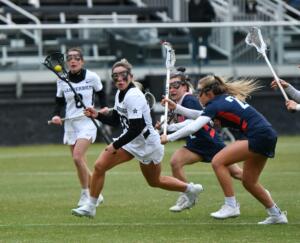 “She was rare in the sense of how athletic and gifted she was in the game,” Hendel said. “We hadn’t seen too many players at that level, especially when she got to high school. Very few players in the area got recruited to go play at a D1, top-25, top-40 school.”