

March 7, 2016
By Eric Jones | Subscribe to Commodore Nation
Much of the attention garnered by theVanderbilt Baseball team these dayscenters around the Vandy Boys whotypically appear in the box scores.
You may have seen some of the recentheadlines. From David Price’s $217 million,record-breaking contract with the Boston RedSox to Dansby Swanson’s selection as the firstoverall pick in the 2015 amateur draft, it’s hardto ignore the impact of former Commodores inthe major leagues.
In actuality, the Commodore connection iseven deeper than that.
There are at least 13 former members of theCommodore program working at various jobswithin Major League Baseball. Inside your favoriteteam is an organizational chart made up of a bigleague staff, a scouting department and a playerdevelopment department with various offshoots.
From David Schnabel who is working in filmand video for the New York Yankees to DerekJohnson as the newly named pitching coachof the Milwaukee Brewers, there is an emergingtrend of Vanderbilt’s black and gold colorsworking at all levels of professional baseball.
“When I first was looking for an internship,the VU name had a ton of weight,” remembersCarter Hawkins, who is the Director of PlayerDevelopment for the Cleveland Indians. “Everyonesees the GM (general manager) track as theultimate goal, but the thing that attracted mewas the (baseball) culture. Anyone that looksat my stats will say that I didn’t play a lot, but Idid get to see a ton of good baseball. I learnedabout good leadership and improving day in,day out. That was part of the culture that Corbs(Tim Corbin), DJ (former pitching coach DerekJohnson) and Bakich (former assistant coachErik Bakich) created and it still is with me today.And it resonates with major league teams.”
 Hawkins (pictured) continues to pay forward what helearned while recruiting other talented peoplewith Vanderbilt baseball ties to Cleveland. TheIndians now have a total of five including MikeCalitri (scout), Larry Day (minor league hittingcoach), Tony Mansolino (minor league hittingcoach) and David Wallace (minor league manager)along with Hawkins.
“Maybe we should call ourselves theCleveland Commodores,” joked Mike Calitri, aformer Vanderbilt Director of Operations andnow a major league scout for the Indians. “It isreally interesting to see all of the talent that hascome to Cleveland with Vanderbilt ties. That isCarter’s influence and why he is so good at sucha young age. He was one of the smartest guyson Vanderbilt’s team and is a key to what theIndians are doing with all the young talent.”
Calitri played for Clemson where he was signedby Corbin, who was the Tigers’ recruiting coordinatorat the time before coming to Nashville.
“He recruited me at age 17 to go to Clemson,then recruited me again to work for him atVanderbilt, and he made it very easy to meetpeople in major league baseball,” Calitri said.”In 2007, I got to know the people in Tampa(Rays) as they wanted (David) Price with thattop overall pick. I guess they saw me work, likedhow Corbs had created a culture at Vanderbiltthat I worked well in and offered me that firstbig league job.”
Besides Calitri, there are five other Vanderbiltties among the scouting community where akeen eye and perhaps clairvoyance help thepipeline of top talent project the next DavidPrice from a skinny 17-year old kid with an85-mph fastball.
Alex Levitt, a former Vanderbilt media relations intern-turned-team manager, was the latestto be hired as an amateur scout by the ChicagoCubs this past season. Charlie Sullivan (1991) continuesto be a long-time trusted amateur scoutfor the Brewers and former Vandy team managerAnthony Aloisi is now an area scout for theOakland A’s. The Vanderbilt connection alreadyhas two top level scouting leaders in Greg Smith(Director of Scoutingâ€â€Pittsburgh Pirates) whowas a standout for the Commodores on the diamondfrom 1985-88 and Gil Kim (Director of Player Development â€â€Toronto Blue Jays), whosuited up for the Dores from 2003-05.
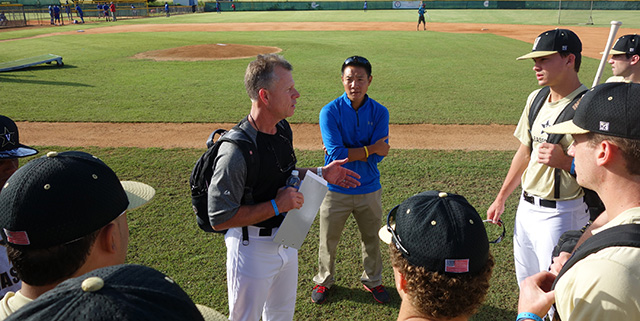
Kim was recently hired by the Blue Jays after serving as senior director of international scouting for the Rangers
“I played on Tim Corbin’s first team back in2003,” remembers Kim. “We weren’t as talentedas the most recent teams, but we bondedtogether and were very close-knit because weworked every day to get better. It wasn’t justabout baseball, it became a way to live life.Corbin, Derek Johnson, Erik Bakich, and (assistantcoach) Mike Holder were mentors to us all andtaught us about chemistry, teamwork and buildingsomething based on our individual talents toachieve a common goal. Those are all things thateveryone is looking for in baseball.”
The Seattle Mariners came looking for DavidMacias this past fall after hearing about his workas the Commodores volunteer assistant coach.Macias served as the Commodores startingcenterfielder and leadoff hitter from 2006-2008,before getting drafted by the Chicago Cubs.He gained the reputation of doing whatevertask was required, which came in handy onthe Commodores’ 2014 exhibition trip to theDominican Republic. Macias’ fluency in Spanishallowed him to serve as the team’s interpreter throughout the trip and paved the way for hisnew job with the Mariners as Coordinator ofInternational Player Programs.
The most interesting example of how Vanderbiltbaseball continues as a training ground for allaspects of MLB operations almost didn’t happenat all. David Schnabel arrived on campus as afreshman enrolled in the Blair School of Music in2007 as a diehard Yankees fan. He answered anemail to be a manager for the men’s basketballteam, but found that the schedule overlappedtoo much with his commitment to the VanderbiltSpirit of Gold Marching Band where he playedtrombone. It turned out to be a lucky breakfor Vanderbilt baseball and opened a door for”Schnabs” that has led him to a spot as a videographerfor the New York Yankees.
“I was in the right place, at the right time,”says Schnabel who works on special digitalprojects used by the team’s baseball operations.”Mike Calitri answered an email from me whenbasketball didn’t work out and hired me to runa brand-new, state-of-the-art video system thatwas putting six camera angles in at Hawkins Field.I didn’t know much about anything as video wasmore of a hobby, but I learned by working in theVanderbilt Athletics video production departmentand started to get more confident. I helped thecoaches with scouting other teams and breakingdown video to help our own players. Eventually,I was asked by Erik Bakich to create a highlightvideo that would motivate the team down thestretch in 2010 and it took me a long time to get itright. Actually, the whole season. I showed it to theteam for the first game of the 2010 SEC Tournamentand it went over really well. I applied for asummer internship with the Yankees, one I hadn’tgotten a year before and finally got it. CoachCorbin helped me get an interview by talking toESPN’s Buster Olney (another Vanderbilt alumni).It’s funny to look back now, but it all started withthat one returned email from Mike Calitri.”
With so many layers within most major leaguefranchises, the thousands of people who workto put a team on the field are largely anonymousto fans. Unless you wear a uniform, sit in thedugout dodging a myriad of flavored sunflowerseeds and occasionally watch him make a pitchingchange, you won’t hear much from DerekJohnson. DJ (as he is known to Vanderbilt fans)was hired this past November after serving fortwo years as the Chicago Cubs minor leaguepitching instructor. Considered a guru as Vanderbilt’spitching coach from 2003-2012, DJ will be amentor to some of the promising talent in hopesof teaching the next David Price or Sonny Gray.The question now becomes who will be the firstformer Commodore to be a big league manageror general manager as the CEO of a MLB teamnear you? Head coach Tim Corbin believes that itmay not be too far away at all.

Derek Johnson is now the pitching coach for the Brewers
“Absolutely. I believe that you have to look atthe experience those kids have had with baseballprevious to their professional employment. Typically,if a person has been exposed to a positiveenvironment while doing something they love,it inspires their passion for that skill to a greaterextent. I’m proud that these individuals havetaken on a leadership role in baseball beyond theplaying field. Every single one of them is passionateabout the game and sees it as a lifestyle… I amglad that Vanderbilt provided that foundation forthem and helps to influence their career path.”