

Sept. 24, 2014
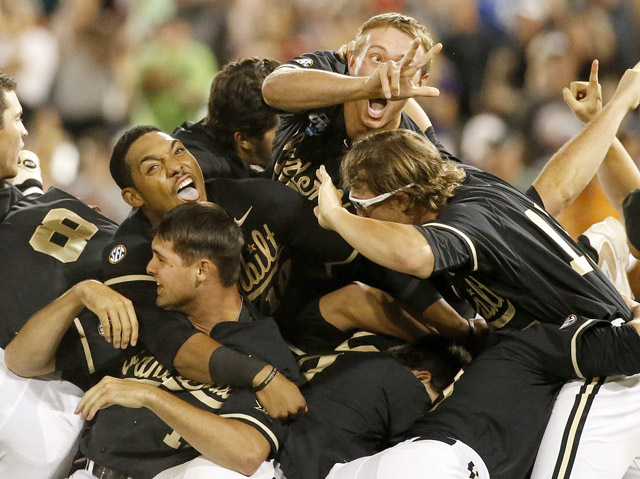
In the Summer issue of Commodore Nation, we celebrated the Vanderbilt baseball team’s first national championship. Below is a collaboration of the articles in that issue, including the postseason’s top moments and a Q&A with coach Tim Corbin as part of our monthly coach’s handbook.
Black & Gold crown: Commodores gel at right time
By Jerome Boettcher
In 1886, Vanderbilt University’s first baseball team took the field.
One hundred and twenty-eight years later, the Commodores finally captured a prize that had been eluding them since the dawn of the program  a national championship.
On June 25, 2014, Adam Ravenelle struck out Virginia’s Daniel Pinero for the final out of the College World Series, setting off a frenzy in Omaha, Nashville and throughout the Black & Gold universe.
The next day, at a celebration gathering in front of 4,000 jubilant Commodore fans who squeezed into the multipurpose indoor facility, VU head coach Tim Corbin said that he didn’t get much sleep because he didn’t want to wake up and find out it was a cruel dream.
It was very real.
The Commodores are national champions.
For the first time in a men’s sport in school history, Vanderbilt can stake this claim. The 2007 national champion women’s bowling team has company.
“I don’t want anyone to stop the dream,” Corbin said. “I’m just happy for the kids and the university. There is a toughness team character trait that grew within this team. It took a while to grow, but I think they realized if it did they could be in a situation like this.”
Two months before, the Commodores were a team at a crossroads. After winning 23 straight regular-season series, including 15 in the SEC, in a streak that dated back to the 2012 season, Vanderbilt lost two games to Mississippi State. Then the Commodores dropped three straight series to Tennessee, Texas A&M and Arkansas.
On April 20, they sat at 8-10 in the SEC, struggling with channeling consistency and scrounging up runs.
So what happened?
“A group of personalities grew together, and maturation was reached at the right time,” Corbin said. “That’s exactly what happened.”
Looking back, a series of turning points boosted the Commodores.
Though they lost the Arkansas series, Corbin and the coaching staff came away optimistic thanks to Carson Fulmer, who threw six scoreless innings in his first career start.
“Even though we lost it, we found another pitcher who could stabilize our staff  that was Carson Fulmer,” Corbin said. “I do think it was a turning point. I can remember vividly on that Monday after coming back from that series, using Mississippi State as an example of a team that was at exactly the same point we were. They left our facility a year ago limping with the same record, and they ended up getting to the College World Series (championship series).”
Moving the fiery right-hander out of the bullpen proved to ignite a spark as he followed up his starting debut with nine scoreless innings and just four hits allowed in a victory over Florida the next week. The next day, the Commodores unloaded offensively for 16 runs to take the series from the eventual SEC regular-season champs.
The second turning point didn’t look like much of a good thing at the time. After losing their final series to South Carolina, the Commodores made an atypical early exit from the SEC Tournament (as the sixth seed), knocked out by Friday afternoon. For a team so accustomed to reaching the SEC championship game (four times in the previous five years) a short stay appeared to be a bad omen.
Instead, Corbin said having two extra days to rest and decompress might have been a blessing in disguise heading into the NCAA Tournament.
“It gave us a mental relief,” Corbin said. “It was a chance to rejuvenate ourselves.”
And what a month it was.
The Nashville Regional started with Tyler Beede taking the mound and setting the tone for 25 dominant innings by Vanderbilt starting pitching that weekend with a career-high 14 strikeouts against Xavier. The three-game sweep of the regional championship ended with Ro Coleman’s dramatic walk-off single that capped a rally against Oregon.
Relief pitching took the baton in the Super Regional with stellar performances by Tyler Ferguson, Brian Miller and Hayden Stone. That series against Stanford also highlighted the Commodores’ resilience. After losing on a walk-off homer the night before, Vanderbilt won its first of three elimination games during the postseason. Two innings of offensive outbursts and six innings of baffling pitching by Stone pushed the Commodores into their second College World Series.
Then Omaha provided enough storylines for its own season.
Fulmer’s three gutsy starts. Tyler Campbell’s emergence. The bullpen stepping into dicey situations and providing unflappable relief. Staving off elimination against Texas. Campbell’s walk-off infield single to clinch a spot in the finals. Bryan Reynolds not playing like a freshman. Dansby Swanson stepping up as the tournament’s Most Outstanding Player. Rhett Wiseman’s catch against Texas  and then again against Virginia. Adam Ravenelle’s three saves. And, of course, John Norwood’s game-winning, national-championship-sealing home run.
“It was a team that at some point during the season you didn’t even know if they would be able to catch themselves,” Corbin said. “As the season progressed you could see this maturity take over and say, ‘This team is finally feeling it. It’s not too late.'”
Better late than never.
In 2013, the Commodores tied a school record with 54 wins, set a new mark with 26 SEC wins and earned the No. 2 national seed. It was a team with six draft picks  all taken in the first 14 rounds  that many believed was Vanderbilt’s best shot at winning a national championship.
The 2014 squad, by contrast, was still talented, but young. This was a team with only two players who had been on the 2011 squad that reached the program’s first College World Series. And neither had made the trip to Omaha that season.
Vanderbilt was replacing five position players and its Friday night starting pitcher. Contending for a national championship seemed possible eventually with this bunch, but not this quickly.
When the pieces came together, however, the ‘Dores wouldn’t be denied.
It started with Beede, a kid who turned down $2.5 million out of high school because he wanted the Vanderbilt experience and education and he wanted to win a national championship. Fulmer’s competitiveness forced him into the starting rotation and stoked the flames. Walker Buehler and Tyler Ferguson blossomed during their sophomore campaigns and fired first-round caliber stuff on the mound. Hayden Stone, a freshman, stayed calm and collected in relief, while Miller used his experience out of the pen.
Reynolds belted out a Freshman All-American season. Swanson, also an All-American, developed into a leader by setting the tone at the plate and displaying tremendous range at second base. Wiseman brought a consistent bat and reliable glove to right field. A committee of catchers grew up. Vince Conde, another All-American, was a vacuum at shortstop, earning a Rawlings/ABCA Gold Glove. Campbell rose to the occasion. And Norwood matured into a power hitter who came up with the year’s biggest hit.
Guided by Corbin and his staff, this team conjured up a “perfect storm” at the absolute best time. After 128 years, the Commodores finally have their crown.
“I look back last year, my first day here I knew that I got into something very, very, very special,” Fulmer said. “I look at all my teammates as my brothers. I look at coach (Corbin), our pitching coach (Scott Brown) as father figures. Words can’t describe this experience. It is something we’ve always dreamed about doing as a team, and we finally accomplished it.”
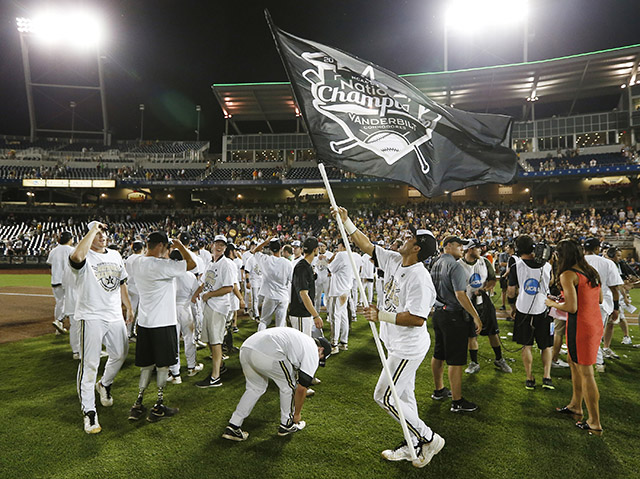
The Postseason’s Golden Moments
RUNNING WILD
The Commodores wreaked havoc on the base paths. In 13 postseason games, they stole 29 bases. Seventeen came in Omaha, tying a College World Series record. Base running forced the issue throughout. Vanderbilt scored their first run of the final game against Virginia thanks to a double steal that forced an errant throw. In contrast, Vanderbilt’s opponents stole just one base against the ‘Dores all postseason.
WISEMAN’S CATCH
Rhett Wiseman turned on the jets to chase down a definite extra-base hit for a huge first out in the top of the 10th in the decisive game against Texas. C.J. Hinojosa sent a gapper to deep right field, but Wiseman raced toward the wall, losing his hat in the process, extended his glove and made the snag before falling on the warning track. The catch snuffed out any Texas momentum. Wiseman then stoked the Commodores’ rally in the bottom half with a two-out single and then scored the game-winning run on Tyler Campbell’s walk-off infield single.
Tyler Campbell STEPS UP
Thrust into a starting role on the biggest stage, Tyler Campbell provided one of the best storylines of the CWS. With just 15 prior at-bats during the season, Campbell collected five of his season’s seven hits in Omaha. Coach Tim Corbin called Campbell’s bases-loaded, walk-off infield single in the 10th inning against Texas the defining moment of the CWS for the Commodores. He then set the tone in the first game against Virginia with a three-run double in a nine-run third inning.
STARTERS, RELIEVERS SHARE THE LOAD
Starting pitching and relief pitching took their turns in lifting the Commodores. In the Regional, Tyler Beede, Carson Fulmer and Walker Buehler combined for 25 dominant innings, 27 strikeouts and only four runs allowed. The bullpen snagged the baton, starting in the Super Regional with Tyler Ferguson, Jared Miller Brian Miller and Hayden Stone throwing 12 innings of one-run ball against Stanford. The relievers again were the story in the CWS. Buehler and Brian Miller threw crucial extending innings while John Kilichowski helped thwart a Virginia rally in game one. In the final game, Stone took over for Carson Fulmer before Adam Ravenelle, pictured above, closed out the national championship with a six-out save. It was his third save of the season, with all three coming in the CWS.
FULMER’S PRESENCE
With his rec specs, his locks flowing, his workman-like approach and arsenal of nasty pitches to foil batters, Carson Fulmer provided a fiery, yet calming presence for the Commodores. The hard-throwing right-hander did not lose any of his five starts in the postseason. On only three days rest the sophomore took the mound against Virginia with a title on the line. He threw 103 pitches, struck out five and allowed only three hits and one earned run in 5 1/3 innings.
WINNING FOR CORBS
Tim Corbin watched from afar as his team celebrated a national championship. But his players wanted him in the party. Tyler Beede raced over to hand him the national championship trophy, and the team eventually lifted him on their shoulders. Adamant to win this one for coach, Dansby Swanson referred to him as a second dad. It was a fitting tribute to a man who has turned the Commodores into a national power.
RO WALKS OFF
Diminutive Ro Coleman delivered one of the biggest hits of the tournament. His bases-loaded, walk-off single through the left side of the field in the ninth against Oregon sent the Commodores on to the Super Regional in dramatic fashion. The freshman received a warm celebration from his teammates and was mobbed in right field.
NORWOOD’S BLAST
A Major League swing on a 97-mph fastball up and in cemented John Norwood’s place in Vanderbilt history. The junior broke up a tie ballgame in the eighth, rocketing a 1-0 pitch from first-round pick Nick Howard into the bullpen over left field. His solo shot  Vandy’s first homer since May 16  sealed the Commodores to their first national championship.
DANSBY’S LEADERSHIP
As the postseason wore on, Dansby Swanson revved up. The second baseman grew into a leader and guided the Commodores as a sparkplug in the leadoff spot and a vacuum in the field, sucking up would-be hits. The rising star, who missed most of 2013 with an injury, capped off his All-American season with a tremendous effort in Omaha. He cranked out 10 hits (which tied for the CWS lead) three doubles, stole four bases and scored five runs as he was named the tournament’s Most Outstanding Player.
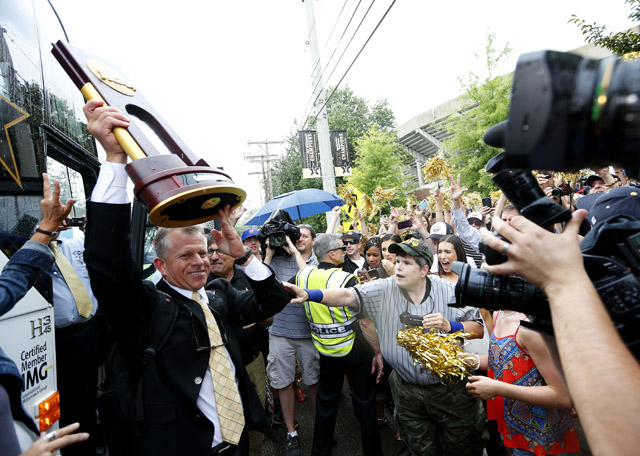
Coach’s Handbook: Head baseball coach Tim Corbin
In 2003, Tim Corbin, after spending nine years as an assistant at Clemson, took over the reins at Vanderbilt. A native of Wolfeboro, N.H., Corbin quickly began to build the Commodores into a national power. In his 12th season, they transformed into national champions.
Do you allow yourself time to realize how far you’ve come, how far the program has come?
I remember when we first started playing regular-season games here in 2003. I remember the moments at the end of the season, the Tennessee series and Worth (Scott’s) home run and the progressions that happened after that. In 2004, we get to a Super Regional. We’re two games away from going to Omaha. We may have moved too fast. 2005 was a little bit lean. And then after that it is progressions of getting good players and momentum of the program surging forward to the point where in 2007 we started to captivate the community a little bit in terms of, “OK, Vanderbilt might be a little bit real here in baseball.” We get (David) Price, (Pedro) Alvarez, (Sonny) Gray, (Casey) Weathers and (Mike) Minor and so on. Now look at this point, having gone to Omaha, winning a national championship, I think some times it is a little bit hard to believe. When our team was greeted inside of the fieldhouse I felt like, “OK, we’ve finally done something. This is not a joke anymore. People are actually showing up to meet these kids.” That’s when I knew we had done something special.
When did you get to that point where you thought winning a national championship was possible?
When we were inside of it. I don’t think you think national championship game until you’re actually in it. I think it is too big of a sports monster. As a basketball coach, getting to the Final Four, and then when you finally win it to get to the final one. I think then and only then do you know that we can win a national championship.
I think that’s how we felt after we won game one  that this is attainable. It is only nine innings away. Although we didn’t speak in those terms right there, everyone is realizing that is a possibility.
Omaha… At the midpoint of the season did you still think that was a possibility?
I think you always have to. Because you’re in a conference that can sometimes dilute your feelings of your team. That’s the toughest part of coaching in the SEC, keeping your own ego. Even though you may be losing games, knowing that you still have a good team in front of you, I think all the kids knew that. We kept telling them that, “Hey this is a good team. Don’t fool yourselves.” Even though we dropped some games here we felt like we were capable of making a run. Now did we feel like we could play this out the way it played out? I don’t know if anyone could do that. But I felt like we could play deep into the season.
After Adam Ravenelle struck out the last batter, what do you remember?
After he threw the pitch, I never saw anything. It felt like you got hit with a punch  a good punch. After that, everything is a blur. It is celebrating with the coaches and staff right inside the dugout. Then it is gaining your bearings and walking out on the field and shaking hands with Brian O’Connor and the (Virginia) coaches. Then it is finally turning your attention to the kids and watching what they’re doing. When he threw that strikeout pitch, the next time I saw the kids they all had white T-shirts on. So it was a different visual for me. I’m watching the last pitch, I never see them again and then the next time I look I go, “Holy cow, they’ve already got championship T-shirts on and hats.”
What was the defining moment of the College World Series?
The defining moment had to be the last inning against Texas, I think for us. Just to realize that we beat Texas after they beat us and that game putting us in the national championship series. That, to me, was the defining moment of our group. It felt like a young kid (Tyler Campbell), who was asked to step in and play. For him to get that hit, to celebrate the hit, game-winning RBI. I felt like things were moving in the right direction. I felt like at that point we had some good mojo.
What was that moment like to have your wife, Maggie, and stepdaughters (Molly and Hannah), celebrating with you?
It was great that your girls would be that interested in what their stepdad does to follow him and be there. They walked away from their jobs, and that wasn’t easy. To celebrate with your family. I don’t think anything is really worthy if you don’t have your family there to celebrate there with you. It only gets heightened because they share your emotions, and then your emotions together become heightened because everyone feels good for one another. I feel good for Maggie. The girls feel good for me. I feel good for the girls. All the emotions come together. It is certainly a great moment for the family to be there.
Was this a culmination of the past 12 years?
We don’t get to this point unless several progressions have happened before us. We could have been at this point with other teams, it just didn’t happen. This is a program that has continued to build and get stronger and stronger, and there is more consistency that has been built inside of it. You talk about all the coaches and all the players that have been at Vanderbilt at least in the last 12 years since I’ve been here. I think the thing I’m proudest about is how consistent we’ve been. We haven’t had many years where we’ve just slipped. We’ve been within that 35, 40, 45-win plateau. We’ve been able to get to a Regional. I think that before this year, Maggie says every year ends in a heartbreak. But every year ends in a heartbreak because we get to the final game. We get to the final moment. That in itself is a strength of where our program is to this point. Just being able to play deep into the season and get to the final game. Win, lose, draw  just being there. It is so difficult to finish off and win. That’s why I consider ourselves very, very fortunate to be able to do that.
What intangibles contributed to this team winning a national championship?
There was a mental toughness component of their team that certainly grew. It was not there at the beginning of the year, I can assure you of that. We lost too many of those kids last year. They were older kids. This team had to grow into it. It wasn’t in their skill package. It was something they had to attain. They had to attain it growing through experiences  losing, winning, investment. When they gained that, the team became more confident. You could see better things starting to happen. The energy was all directed in that way. It was a perfect storm. It was a storm that came together, and it grew. I felt at the end of the year they weren’t going to let this moment go.
How much did seeing 4,000 fans at the celebration mean to you?
It was great to see their eyes and great to see their emotion. They could jump onto this moment and share it with the kids and know there is a gold lining. There is something good that can happen after all. We got off the bus, and there are people who are greeting you and they’re actually crying and shaking your hand. That is fulfilling. To be a part of something that other people feel so emotional about is great, and it’s great they can share it. I am happy. I am happy for (the Voice of the Commodores) Joe Fisher. I’m happy for everyone who has worked here for years. A girl like (administrative assistant) Beverly Brothers  people who have given their heart and soul to Vanderbilt and, at the same time, may never have been able to celebrate something from an athletic standpoint. There has been many celebrations. That is not to minimize the strength of any other program here. Just the ability to finish something off and have a national championship title associated with it is good for a lot of people. It stimulates a fan base. It stimulates a university. I’m not saying athletics is everything to an university, but it is a part. And it certainly makes people feel good.