

April 12, 2007
Read the Kentucky Series Preview Plus Video and Audio – Click Here
By Will Matthews
 |
|
NASHVILLE – When Belmont catcher Ben Petsch drilled a two-run home run to left field Wednesday night to put Vanderbilt in a 6-4 seventh inning hole, one could have understood had the Hawkins Field faithful stirred uneasily.
But if the crowd’s almost nonchalant reaction to the homer is any indication, the 1,523 fans in attendance knew their Commodores better than to get overly worked up about the late-inning deficit.
After all, they had seen this plenty of times before.
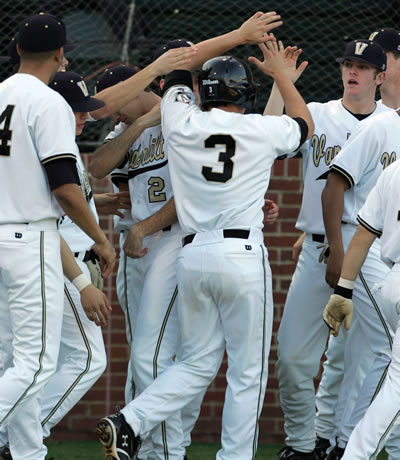
More than half of Vanderbilt’s 29 victories entering the night had been of the come-from-behind variety, and right on cue Wednesday the Commodores scored twice in the eighth and once in the ninth to beat Belmont 7-6 and improve their record to 30-5 overall, including an astounding 23-0 against non-conference foes.
“They have confidence, they absolutely think they can do it,” Head Coach Tim Corbin said. “The game was getting to a point where you’re thinking, `Well, I don’t know, can they do it tonight or not?’ That was big. That was clutch for us again.”
Clutch, maybe, but certainly not unexpected. Including Wednesday’s game against Belmont, Vanderbilt has now trailed at some point in 18 of their 30 victories. Six times the Commodores have faced a deficit in the sixth inning or later, and Vanderbilt has erased deficits of three runs or more four times.
“We are confident every time and we feel like we are going to win every time,” said centerfielder David Macias, who raced home to score the winning run on a wild pitch Wednesday. “That confidence helps us to play well.”
It is a confidence that bodes well as Vanderbilt continues to navigate the tough Southeastern Conference schedule. The Commodores travel this weekend to Lexington for a key three-game series against defending SEC East champion Kentucky.
Corbin attributes much of his team’s success at overcoming deficits to the way in which he forces his team to go full speed during every minute of every practice.
“We never have a practice in which there is any low energy. I just have high expectations for them in that regard,” Corbin said. “I have always told them that you don’t just turn on the switch for a game. Practice is essentially a game. If you make practice an everyday activity, one in which you put a lot of effort into, I which you are very alert, it will carry right into the game.”
And in games like Wednesday’s where Vanderbilt was certainly not playing its best baseball, Corbin said maintaining a high level of intensity can prove the difference between winning and losing.
“You can still come up with a win even while not playing your best baseball if you are alert mentally and if you have got that focus,” Corbin said. “That’s the difference with our team. They expect to win, but they have practiced to win.”
Vanderbilt also relies on a cadre of veteran players who have amassed a wide range of experience that translates into their not being intimidated by being down in a game, no matter the inning, Corbin said. Senior pitcher Casey Weathers, junior pitcher David Price and sophomore third baseman Pedro Alvarez all played for the U.S. national team in Cuba this past summer, while junior Dominic de la Osa played in the highly competitive Cape Cod League.
“Guys like that have played at a high level for a long time,” Corbin said. “They are not awed by much of anything right now.”
Corbin said he hasn’t been a part of a club with as uncanny a knack to come from behind in games since he was an assistant on the 1994 Clemson team that won 57 games and the Atlantic Coast Conference championship. And while that Clemson squad ultimately fell short of the College World Series, Corbin said he learned that being able to overcome deficits is a key ingredient to a championship-caliber team.
“You can’t play every game that close to the vest, certainly,” Corbin said, “but you need to be able to do that in order to become a complete team. It is just another way of trying to win ballgames.”
Will Matthews spent three years as an investigative reporter with the Los Angeles Newspaper Group in Southern California. He is currently in his third year at Vanderbilt Divinity School.