

May 7, 2008
 Blooper Man Has Vanderbilt Connection (pdf) | History Corner Archive
 |
|
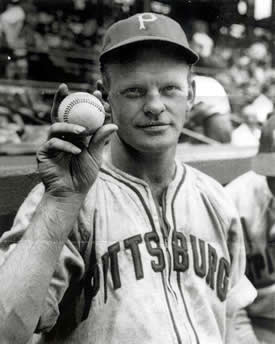
Truett “Rip” Sewell became a well-known major league baseball pitcher when he developed his “blooper” or “eephus” pitch. Though he was born in Decatur, Ala., Sewell has a Nashville and Vanderbilt University connection.
Sewell was born on May 11, 1907. His father had been a farmer, nurseryman, store clerk and a streetcar conductor. Times were tough and jobs were scare. Decatur had a semi-pro baseball team in the Alabama-Tennessee League. Sewell was more interested in going to ball games than school.
Sewell’s athletic ability would gain him a scholarship at the Alabama Military Institute in Anniston, Ala., for high school. He won a medal for being the school’s best all-around athlete playing football, basketball and baseball. Sewell surprised himself, as others, and became an excellent student. He would earn 14 letters as a high school athlete.
With his successes in athletics, several leading universities approached Sewell in the spring of 1929 offering scholarships. Sewell considered full football scholarships to Georgia Tech, Auburn and Alabama. Another visitor trying to secure the athleticism of Sewell for his football program was Vanderbilt football coach Dan McGugin.
McGugin offered Sewell expense money to visit Nashville and the university campus. Sewell recounted his visit to Nashville in the book, “The Blooper Man” by Elson Smith:
“A fellow named Parker met me at the train station. He drove me to the Vanderbilt campus in a big Packard convertible. We pulled up in front of the SAE Fraternity House where Parker lived. It was rush season. At the time, I didn’t know what rush season meant. They introduced me to some debutantes. We went on several dates with them. I had never smelled anything so nice.”
Also from “The Blooper Man:”
“One day while Truett was sitting on the front steps of the fraternity house, a Ford pulled up in front, and out stepped a big, blond, bear-like man. He introduced himself as Lynn Bomar, and said, `Truett, you’re supposed to go with me.’
“Bomar drove Sewell to the Kappa Sigma house. They were met at the door by three or four fellows who led him upstairs to a room. He went inside and someone said to him, `Stay here, we’re going to feed you.’ He waited patiently, but after a while he heard quite a commotion going on downstairs.
“I crept down a flight of stairs and took a look into the living room. There were Parker and some of the SAE boys. They were arguing with the Kappa Sigs. Bomar had lifted a rather large living room couch straight over his head and was threatening the intruders. That was the last I ever saw of the SAE’s.'”
Bomar was an All-American football player at Vandy. Sewell was offered a full scholarship to play football at Vanderbilt with some spending money earned by taking a payroll to the bank each Saturday for a local company at $65.00 a month. He accepted the Vanderbilt offer and was now a Commodore.
Sewell did not fit in as a college student. He dropped out of Vanderbilt in 1930 after playing football on the freshman team. Sewell never played for the baseball team. One of his fraternity brothers, and Nashville Banner sports writer Fred Russell, said about Sewell: “Truett was struck out on a fast ball by math, a curve ball by chemistry, and a change of pace by his drawing class.”
Now out of school and needing a job, Sewell found work at the Dupont Company in nearby Old Hickory, Tenn. Part of the deal to work at Dupont was for Sewell to play for the company’s semi-pro baseball team where he pitched and playing in the outfield.
Sewell later told his friend Russell, that he wanted to play professorial baseball. So Russell introduced Sewell to Bob Allen, an owner of the Nashville Vols of the Southern Association. Allen had seen Sewell play with Dupont and signed him to a contract worth $250.00 a month.
The 1931 season with the Vols gained a memorable start for young Sewell. The New York Yankees were playing an exhibition game with the Vols at Nashville’s Sulphur Dell ballpark in April. The Tennessean described Ruth’s first plate appearance against the rookie Sewell:
“While Mr. Ruth did not whale the leather out of sight, he slammed one of Sewell’s slants against the right field wall in the seventh with such violence he sprung a board. Sprung a board what? We are glad you asked that question. He sprang a board on the fence. That’s what Irving Porter says and he was out there on the dump when the wallop hit the plank.
“Sewell, in spite of the lacing he received, still has all the earmarks of a hurler who can be developed into a sterling slabber. He needs tutoring to be sure. But there is plenty of stuff in his wing. He needs instruction as to what to pitch and when it should be pitched.”
Sewell walked Ruth in his next at bat. Sewell rode the bench during the 1931 Nashville season rarely appearing on the mound. As reserve outfielder, Sewell played in 16 games batting .259 (7-for-27). The Vols recognized Sewell’s talents, but being fresh out of college and only semi-professional baseball experience, he was farmed out to Raleigh. The Detroit Tigers eventually purchased Sewell’s contract from the Vols later that year.
Sewell did appear in five games for Detroit in 1932 without recording a decision. His career continued in the minors with Toronto, Beaumont, Seattle, Toledo, Louisville and Buffalo. Sewell caught on as a starting pitcher in 1939 with the Pirates. In a 13-year career with Pittsburgh, Sewell was 143-97 appearing in 390 games and recorded a 3.48 ERA Sewell led the NL in wins (21) in 1943.
Part of Sewell’s foot was shot off in 1940 in a hunting accident. While having difficulty pushing off his foot, Sewell developed his famous blooper pitch, which was a high arching toss that fell onto the strike zone. Ted Williams slugged the blooper pitch out for a home run in the 1946 All-Star game. The only dinger ever hit off the unusual throw.
Sewell passed away in Plant City, Fla. on Sept. 3, 1989.
If you have any comments or suggestions you can contact Bill Traughber via e-mail at WLTraughber@aol.com.