

Jan. 13, 2015
By Jerome Boettcher | Subscribe to Commodore Nation
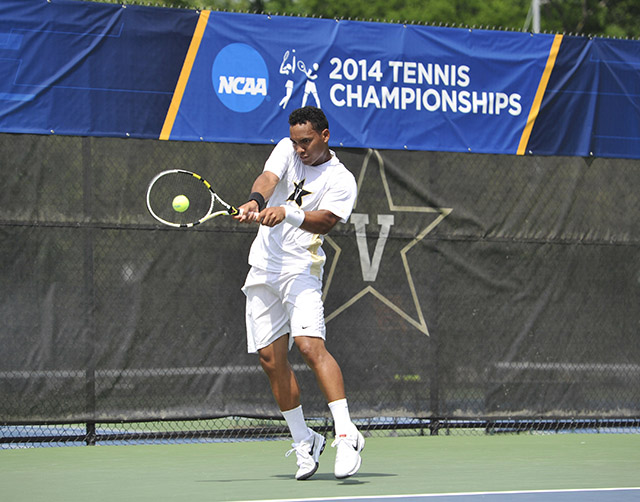
After narrowly missing out on winning the National Indoor Intercollegiate Championships’ individual title in November, Vanderbilt senior Gonzales “A.J.” Austin and his coach Ian Duvenhage met with a representative from the United States Tennis Association (USTA), the sport’s governing body.
In addition to knocking off the No. 1 player in the country – Baylor’s Julian Linz – on his way to reaching the finals, Austin had been awarded the USTA/ITA Sportsmanship Award. The USTA rep praised Austin, who was having hard time believing what he heard.
“He said to A.J., ‘You know, you’re one of the best things I’ve seen in a long time and I’m 100 percent sold on you,'” Duvenhage recalled. “Afterwards A.J. and I were talking and he looked at me and said, ‘Yeah, I’m finding it hard to believe that.’ I think when he learns to completely believe in himself and his abilities he can certainly be extremely successful in professional tennis.”
Just looking at the last year and a half, Duvenhage has strong evidence supporting his theory on Austin. And the recent results have reaffirmed to the Miami native that professional tennis is in his future.
He earned All-American honors twice last year and, along with then-senior Ryan Lipman, he set school records for doubles win in a single season (30) and career (36).
He started playing the sport “as early as anyone could start playing,” and picked up a tennis racquet when he was three years old. His father, Gonzales Austin, Sr., was his coach until he was 15 and his biggest tennis influence. His father moved from Haiti to New York when he was 13 years old and Austin’s mother, Susan, is from the Philippines. Together, they helped send Austin and his older sister Nakita, who played collegiately at St. John’s, to tournaments around the country in order to increase their exposure. Knowing how much his parents spent, Austin said he would feel terrible if he didn’t win the whole tournament.
“Somehow my parents found a way to get me to play enough tournaments to be a top junior player so I could come to a school like Vanderbilt,” he said. “It is real easy to lose sight of that, especially as an 18 year old. Just thinking that all your friends are able to go to tournaments, you feel like you should be able to as well. You get a little older and you get a little more experience and you realize it is really hard to pay for a kid to go travel. That is definitely something I am unbelievably grateful for to my parents.”
Duvenhage saw this intangible quality in Austin. Sure, Austin had pinpoint control with his serves, a strong forehand and a calm demenaor on the court. But his sense of indebtment  even though he didn’t grow up playing at country clubs  appealed to Duvenhage.
“Here is a kid that doesn’t have everything like many tennis kids have,” he said. “That is one of the reasons I wanted him so badly. I thought he would appreciate this and he has.”
As he climbed up the national tennis rankings – he was ranked No. 1 in the country at one point in high school and won the USTA 16s Summer Championship – he’d go back and forth on whether he wanted to be a professional tennis player.
He admits three years ago when he arrived at Vanderbilt, he was burned out from the end of his junior tennis career. But whereas he was on his own as an individual competing in junior tournaments throughout the country, the team and family atmosphere at Vanderbilt rekindled his passion in the sport.
“It is kind of like you rediscover your love for the sport and your love for competing,” he said. “That definitely happened over here and it made it really easy with the team aspect. Because when you’re on your own (in juniors) and you’re traveling it is really easy to get burned out and lose sight of the big picture. When you come here and you’re playing for your best friends and you get to go to school in an awesome place, it makes it a lot easier to refocus yourself and find great joy in playing the game.”
His first year on campus, he made the SEC All-Freshman Team in 2012. Then he had what he called a “pretty average season” as a sophomore, though the results said otherwise – he won 25 matches, was ranked as high as 20th in the ITA, played in the NCAA Singles Championships, helped the Commodores reach the Sweet 16 and was named First Team All-SEC.
Still, Austin said he was “on the fence” of a professional career after his sophomore year. The double major in economics and political science spent the following summer in Washington, D.C., working as intern for Sen. Kirsten Gillibrand (D-NY). He played tennis a couple times a week over the summer with some of friends and thought about his future.
For Duvenhage, he saw in Austin a freshman who clearly wanted to play professionally. But then Duvenhage witnessed an “odd kind of lull” as a sophomore. But the veteran head coach also credited Austin’s intelligence and well-roundedness for creating interest in other areas – reading, politics, art.
From watching Austin’s sophomore year, Duvenhage thought Austin had decided he wasn’t going to play professionally.
“Then, somewhere, during his junior year last year I started noticing he was doing extra weight workouts, he was doing extra conditioning workouts, he started putting in a lot of extra work,” he said. “We talked again and he said, ‘I’ve decided I’m going to commit to giving this go.'”
The proof was in the pudding right from the start of his junior year.
In the fall, he reached the quarterfinals and semifinals of two ITA national indoor tournaments. After the break, the drive and determination carried over. He was named First-Team All-SEC for a second straight year and was tabbed to the SEC All-Tournament Team as the Commodores reached the semifinals.
Then, he advanced to the round of 16 in the NCAA Singles Championships and, pairing up with good friend Ryan Lipman, made the quarterfinals of the NCAA Doubles Championships. It was the farthest a Vanderbilt doubles team had ever advanced. In the process, Austin earned All-American honors in both singles and doubles play.
“Even if I didn’t end up pushing a pro career, I wanted my junior year to be a lot better,” he said. “I ended up having a really good year and that definitely helped me come up with a career path I wanted to follow.”
After graduation, Austin plans to team up with Lipman, now a volunteer assistant coach, and try their luck on the pro circuit as a doubles duo.
Of course, Duvenhage has extreme faith in his humble star.
“I just don’t think he realizes how quite good he is and how good he can be,” he said. “He is not only a great tennis player, he is a great person. He is the total package.”