

Oct. 14, 2009
Commodore History Corner Archive
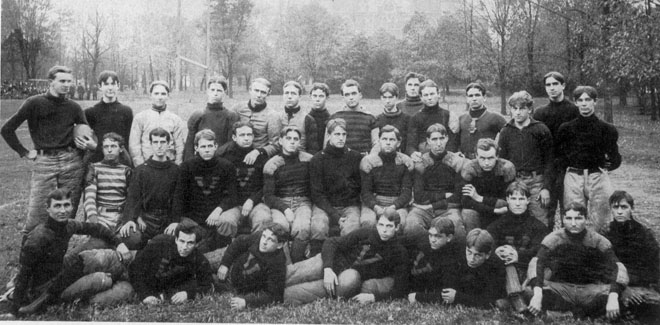
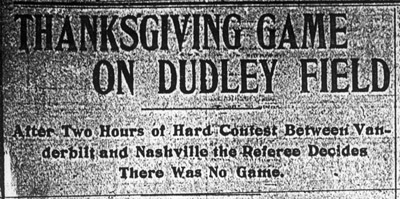
Thanksgiving Day 1899 on Vanderbilt’s Dudley Field ended in controversy and the results might be in doubt in 2009. The Vanderbilt Law School presently stands on the original site of Dudley Field. The contentious game involved cross-town University of Nashville (Peabody).
Vanderbilt had been playing football since a one-game schedule in 1890. The Commodores entered the game with a 6-2 record with wins over Cumberland (32-0); Miami (Ohio) (12-0); Mississippi (11-0); Bethel (22-0); Texas (6-0); Central (Ky) (21-16) and losses to Cincinnati (6-0) and Indiana (20-0). J.L. Crane was in his first of two seasons as the head coach at Vanderbilt.
The Nashville American gave this pregame report:
“The fickle populace yesterday dethroned the military heroes home form the East, and elevated the giants of foot ball to the pinnacle of fame. Vanderbilt and the University of Nashville played a spectacular game before the greatest crowd that ever saw a gridiron contest in this city.
“More than 4,000 people filled the seats, and lined the green terraces, forming a hollow square about beautiful Dudley Field to see the great Thanksgiving game that closed the foot ball season. With the exception of a stiff breeze from the southwest the city was perfect, and in convenience everybody was there. The students of both institutions seemed to lie present en masse.
“Early in the afternoon the delegations from the Normal College began to fill the seats on the eastern side of the field, save a large crowd of feminine sympathizers, who occupied one end of the terrace, and shouted for their heroes. The Vanderbilt rooters spread themselves both literally and metaphorically.
“West Side always unique, paraded the field before the game with a grim-looking coffin draped in the Nashville colors, and singing a colorful hymn to the tune of `John Brown’s Body.’ Tin horns, megaphones and stentorian voices mingled in one deafening blast.”
 The game was scoreless until midway in the fourth quarter when the only score occurred with the strange ending ensuing. The American reported on the scoring play:
“Throughout the first half Vanderbilt had the ball in Nashville territory, but the Nashville line held time and again. Late in the game, Nashville drove to Vanderbilt’s 10-yard line, where quarterback Reeves made a wild pass and Massey broke through, captured the ball and started down a clear field with Godchaux and Cragwall behind him. For 105 yards the plucky center continued his great run, which was a repetition of the play that enabled Poe of Princeton to snatch victory from Yale last year.
“The crowd went wild over the magnificent dash and when Massey crossed the goal a thousand spectators came onto the field. A mighty hubbub of cheers arose as players argued the legitimacy of the play before the referee. Nashville claimed the ball was down when Massey got it. The referee decided it was a touchdown, which brought on redoubled enthusiasm from the rooters. The crowd was never cleared from the field and the game was called on account of darkness.”
In this era of college football the forward pass was not used often and the rules were vague. Nashville’s quarterback Reeves passed the ball (Nashville claimed it was a fumble) and Felix Massey, playing defense for Vanderbilt, picked off the ball and ran 105 yards for the touchdown. The football field was 110 yards at this time and a touchdown worth five points.
Referee Estes gave this explanation on his decision:
“The touchdown was granted and Vanderbilt was directed to try the kick for goal. I decided there was no game, so nether side wins and there is no score. The ground for this decision is: The rules provide that the game shall consist of two halves of thirty-five minutes each. Rule 12, Section 4, provide that the game shall be decided by the final score at the end of two halves. Before the end of the last half the game was broken up by the rush of the crowd on the field, which remained there until the game terminated on account of darkness, so the last half was not played and there was consequently no final score.”
The American gave this report on Crane’s reaction to the game’s unusual conclusion:
“The touchdown was allowed by the referee and the score of 5 to 0 was allowed. He instructed Vanderbilt to kick the goal, and Vanderbilt did so; but the referee made no effort whatsoever to place Nashville’s team on side–that is, back of the goal line. He declared the game off than on account of darkness, which is in direct contradiction to the spirit of the rules as shown in Rule 12 of the official guide. The referee had absolutely no authority, according to the rules, to declare off any score made previously.”
The American reported on the Vanderbilt officials’ comments:
“Members of the Vanderbilt Athletic Association claim that the game was unfinished; that at the time the game closed the score was 5 to 0 in Vanderbilt’s favor, and that it is simply an unfinished game, with five or six minutes to play. They say there is no authority whatsoever in any rule for the referee to decide that there was no score, for he had already declared that there was a score of 5 to 0. His opinion on any point cannot offset the rules. The same should be recorded as unfinished and 5 to 0 in Vanderbilt’s favor. No decision of the referee, or anyone else, can record otherwise.”
Though it was never officially resolved, Vanderbilt has claimed the 1899 game as a 5-0 win in its records and a 7-2 mark.
Traughber’s Tidbit: An editorial in the 1891 Vanderbilt yearbook states that Vanderbilt will never be able to compete in football without better practice facilities.
Tidbit Two: During the game at Louisville in 1894, Vanderbilt’s football captain, Cap Keller, yanked his fellow Commodores off the field late in the first and headed to the locker room. Louisville was winning at the time 10-8. Keller and Coach Henry Thornton said after the game that the poor officiating gave Louisville seven downs to make a first down and a Vandy player was ejected unnecessarily after being attacked by a Louisville player. Also most Vanderbilt gains on offense were called back on disputed penalties.
Tidbit Three: In the early years after a big victory, Vanderbilt students would parade in their nightshirts from campus to downtown Nashville carrying torches and chanting their favorite cheers. Their 1897 cheer–“Hippity huz, hippity huz! What the Hells the matter with us! The chant was so scandalous at the time that Nashville police told Vanderbilt officials that any student continuing the chant would face arrest.
If you have any comments or suggestions you can contact Bill Traughber via email WLTraughber@aol.com.