

Aug. 3, 2009
 Buy 2009 Season Tickets Starting at $109
For most six-year-olds, going from kindergarten to first grade constitutes a “big move.” For Commodore receiver Udom Umoh, it was a slightly more momentous.
Just after his sixth birthday, Umoh’s mother decided to uproot the family from his native Nigeria to Fort Valley in central Georgia, hoping for greater educational opportunities for their children.
For Umoh, leaving Nigeria for an entirely new life was tough. “I remember my dad stressing to me that I needed to learn English, and I didn’t want to. I probably cried until I got on the plane,” he recalls.
“[The transition to life in Georgia] was pretty hard at first. I had a strong accent, so I kept pretty quiet until about third grade. I used to get in trouble because my teachers thought I was saying the wrong words,” he added.
A dozen years later, after Umoh’s stellar high school career at Fort Valley and following his first year on the Vanderbilt campus, Umoh decided to embark on his first trip back to Nigeria.
“I was nervous,” Umoh says, “I remember when we got off the plane – it was so hot.” He laughs and continues, “My uncle met us at the airport, in Legos, and he took us to another airport, where we met up with my dad.” Besides his uncle and father, Umoh also reconnected with three brothers and two sisters who still live in the west Africa country.
For years, Umoh and his dad didn’t talk. “He would try to call, but it was always hard to get through. We really didn’t talk until high school when he got in touch with my sister. From there, I gave him my cell phone number and we talk all the time.”
During his visit to Nigeria, Umoh discovered Uyo University, where his dad, Benedict, serves as the Dean of the Faculty of Agriculture (would be known in the U.S. as the School of Agriculture). His dad, who also attended college in America, has been heavily involved in fundraising for the university, and particularly for the agriculture department.
Umoh witnessed many of his father’s fundraising ventures, including a profitable and educational chicken farm that Benedict started years ago. “They do a lot of research at the farm trying to make sure more people can be fed,” Udom said.
Umoh came away from the month-long trip with a better understanding and significance of his dad’s work. “I remember passing all the older cities and villages, and you would see all these one-room, small houses, made of mud. And there were always lots of people outside, just around.” The stark disparity from his adopted American life and the vast difference-making potential of his father’s research became explicitly evident to the football player.
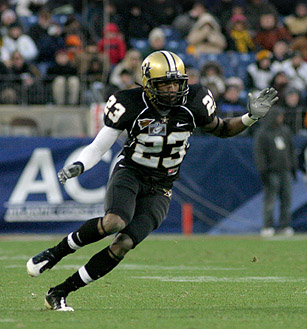
Upon returning from his family reunion, Umoh returned to Vanderbilt eager to improve on the gridiron and in the classroom. As a redshirt freshman in 2008, he played in every game, contributing as a standout on special teams. Then, Umoh broke through offensively in the Gaylord Hotels Music City Bowl, catching three key passes in the big Commodore win.
This season, the explosive Umoh is expected to compete for a starting position at wide receiver for an offense that returns nine starters.
The English major says that “education was always a huge emphasis” in his family. His mother is an academic advisor and his stepfather teaches at Fort Valley State. “My mom always told me that I had to keep my grades up, or I couldn’t play football,” he remembers, “and my dad … when I would talk to him, all he wanted to know was what college I would go to and things like that.”
The dynamics of Umoh’s life bring an extra dimension to both his football career and his education. He’s soft-spoken and thoughtful, and for a college kid in the middle of summer break, refreshingly punctual.
Umoh recently took an introductory poetry class, which counted both toward his degree and the general requirements of the College of Arts & Science. His lecturer, Andrea Hearn, notes that Udom is “certainly not a typical English major.
“In his contributions to class discussion as well as his formal academic essays, Udom consistently offered insights into literary works that went beyond the obvious,” Hearn shares. “As well as being a perceptive reader, Udom is an eloquent writer; I always looked forward to reading what he had to say about the work he had chosen.”
One of Umoh’s favorite poems is William Carlos Williams’ “The Red Wheelbarrow” – a work that he first encountered in Hearn’s class. He was struck by the way form and meaning meld together: the eight-line, 22-syllable poem celebrates what Umoh calls “the realization that it comes down to the simple things in life.
“Something about it just made me sit back and think about my father, and my past.”