

National Championship Summer
by Graham HaysCross country and track and field standout Lily Kriegel enters 2025-26 after winning the USATF U20 national title in the 5,000 meters
NASHVILLE, Tenn. — There is an old sports adage that champions are made in the offseason. For someone inclined toward science and computing, perhaps it was just the left side of her brain ruling the day. But Lily Kriegel took that literally this past summer.
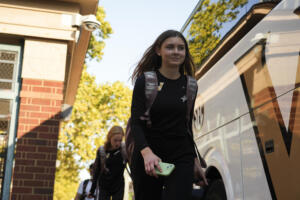 In June, Kriegel beat all challengers to win the national championship in the 5,000 meters at the USATF U20 Outdoor Championships, the elite domestic track and field competition at the under-20 age level that over the years helped propel the likes of Sydney McLaughlin-Levrone and Sanya Richards-Ross on their record-setting ways. Kriegel also brought home a bronze medal in the 1,500 meters in this year’s event at Hayward Field in Eugene, Oregon.
Kriegel’s win didn’t come out of nowhere, although some might argue you could have seen nowhere from where she stood on the starting line. Rather than the culmination of a glorious freshman year, her championship stood in stark contrast to an often frustrating injury-marred first year of collegiate cross country and track and field. Even her highlights had a hint of bittersweet. She hit her stride in the SEC Outdoor Track and Field Championships—only to miss the 1,500 meter final by one position and .25 seconds.
And yet Kriegel’s first season at Vanderbilt was an unqualified success long before she finished first in Eugene. Standing on the podium was indeed the exclamation point on a year likely to shape many more to come. In her first year as a Commodore, she explored an interest in neuroscience and helped organize BrainHack 2025, a Vanderbilt-sponsored event “where data science flirts with neuroscience, all in the name of unlocking the secrets of the brain.” The same desire to find out how fast she can go fueled her to find out why the world around her is as it is. She hit pause for a few months on the track, but she never stopped moving forward.
At the finish line in Eugene, she could see just how far she had come. And how quickly.
“It showed me that maybe progress isn’t always linear,” Kriegel said of the national championship. “You just have to stay dedicated to getting better. To be honest, in high school, there were a lot of times I wasn’t sure if I wanted to run in college. It can be a tough sport, just the nature of it. Winning just showed that if you can stick it out and trust yourself and all the work you’ve been doing, it can lead to something in the end.”
View this post on Instagram
Kriegel’s U20 title might have been a surprise, given the frustrating year of running that preceded it, but she arrived at Vanderbilt with serious credentials after a successful prep career in Wisconsin. She started early. Her mom and dad ran collegiately at Wisconsin-Milwaukee, and while they never steered her toward competitive running, she gravitated to it of her own accord, mimicking the drills when she tagged along with her dad to the club practices he led. As she alluded to, there were times as the years went by that she felt like giving up sports (her mom, a scientist, and dad, a history teacher, didn’t push her toward running, but they never failed to emphasize where education fit on the priority list). But in the end, not only did running and competing provide a chance to blow off steam, she just couldn’t imagine the logistics of a life without their familiar rhythms.
“I’ve always been someone that prioritizes academics and didn’t want to miss out on anything because of running,” Kriegel said. “But I found that running makes me better at those other things—it helps you stay dedicated and gives you a schedule. I feel like I use my time a lot more efficiently because I have to be running all year.”
It didn’t take her long to make a good first impression at Vanderbilt. In her first collegiate cross country meet last fall, before she had even collected all her books for her first semester of classes, she finished third overall—and the top freshman. She was arguably even better the next week, finishing as the 11th-best freshman in a field of runners from nearly 50 schools in the Southern Showcase. But that was also her final race of the fall, a stress reaction sidelining her for the remainder of the cross country season and ultimately leading Althea Thomas, director of cross country and track and field, and her coaching staff to decide that redshirting the indoor track and field season was in Kriegel’s best interests.
“It was definitely the right call at the end of the day,” Kriegel said. “It’s something you probably could run through, but it usually never ends well because a reaction can lead to a fracture. I’m grateful for the coaches and our training staff using caution because I am such a young runner. There’s no reason to push it so early on in my time here.”
For many first-year student-athletes, removing the familiarity of competition can be disorienting. It’s the one part of their new world with which they were already comfortable. It wasn’t Kriegel’s preferred path, either, but rather than feeling lost, she embraced the opportunity to explore everything about her new surroundings.
A northerner still getting used to being a transplant after her family recently moved to Georgia, she enjoyed meeting peers from across the country. She made herself a regular at various professors’ office hours. She checked out the full array of student organizations and clubs. And when a teaching assistant in her introductory neuroscience class mentioned Brainhack, she volunteered as one of 12 undergraduate students who helped organize the event.
Supported by VALIANT, Vanderbilt Lab for Immersive AI Translation, January’s BrainHack brought together more than 100 researchers from 24 departments and institutes. Through in-person and virtual collaboration, the hackathon supported 10 innovative projects—from dynamic neural decoding for adaptive neuroprosthetic control to multi-site fMRI harmonization—and featured renowned speakers from around the world.
Even someone who had previously served as co-president of a Girls Who Code club, she initially thought it sounded a little too into the weeds. It wasn’t, and she had a lot of fun.
“Things like that, trying something new, gave you something to look forward to,” Kriegel said.
She took a lot of computing classes in high school, in addition to Girls Who Code, and even won awards for her work. It was less a calling in its own right than the gateway computing and technology could be to everything else in the modern world. She had some inkling that neuroscience might be one of those pathways, but the class she took at Vanderbilt stoked the kindling. She’s always been interested in how things work, from the mysteries of vending machines when she was a child to the complexities of the human brain now.
Maybe that’s only natural for someone who willingly sets out to try and run mile after mile faster than everyone else.
“I think that was a large part of why I decided to go to Vanderbilt,” Kriegel said of her intellectual curiosity. “It seemed like there was a lot of structure and intention in how we do things. In high school, it sometimes seemed like we did things because that’s the way they had always done them. I’m not really the biggest fan of that reasoning. If I’m going to spend three or four hours a day practicing, I want to have intention behind it.
“And it’s good to be at a place, too, that understands that every athlete is different and different things work for them. I guess I’m always asking ‘why’ in everything I do.”
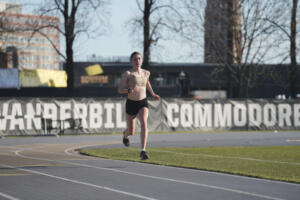 Or sometimes, “why not?” On the track, she was feeling something close to her old self by the time the SEC Outdoor Track and Field Championships rolled around in May. She posted the 13th-best time in the preliminary heats for the 1,500 meters, missing one of 12 spots in the final by the blink of an eye. Afterward, assistant coach Chad Balyo brought up the idea of competing in the U20 event in Oregon. She was initially hesitant. Training with teammates, experiencing the camaraderie of other runners, is part of what she enjoys about the sport. With most of the team done after the SEC Championships, and others on the road for NCAA regionals and nationals, she knew she would be training mostly on her own.
But if trying something new got her through the fall and winter, why not summer? Besides, given the age classification, this would be her one and only opportunity. She went home for a couple of weeks, celebrated her birthday, and then returned to Nashville to train.
Winning has never been her primary motivation for running. Maybe it is for some, but that’s a tough way to live as a collegiate runner. For Kriegel, running a personal best or sticking with a field full of superstars is where the satisfaction comes from. As she puts it rather well, those moments are like getting a glimpse of the future—of what’s possible. Arriving in Eugene, she felt good. She knew running fast was within reach.
When she crossed the finish line first? Well, that was a heck of a bonus.
“It was kind of unexpected through most of the year, which made it almost more exciting,” Kriegel said. “You look up and you’re like, ‘I don’t even know how I got here. But this is awesome.’”
She had all of one night to celebrate. The 1,500 was the next day. Originally, she had only really planned to compete in one or the other. She and the coaches settled on the 5,000 because it would give her a time that would help her enter future races. After the win, Balyo told her to sleep on it and see how she felt in the morning. She woke up ready to run and finished on the podium again.
“My calves have never been more sore in my life,” Kriegel conceded with a smile.
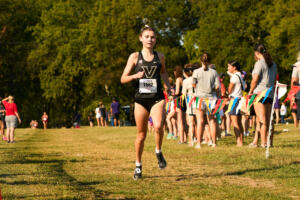
Fortunately, she’s had time to recover in advance of cross country season. Just not so long that the afterglow—and lessons—of Eugene have faded from memory. If that achievement marked a surprising conclusion to her freshman year at Vanderbilt, perhaps it will prove a perfect starting point for her sophomore season. Track has always had the strongest hold on her affections, but, to put it a way she might appreciate, why shouldn’t she do it all?
“I really like the training aspect and long runs with teammates, but cross country can be difficult—especially when it’s hot at the beginning of the year,” Kriegel said. “And being injured during the season last year, I haven’t had a ton of experience with college cross country. So I think winning the title mostly just made me excited. I had success in the 5K, and [the women’s standard distance] 6K is pretty close to that, so it should be all right.”
It’s hard to argue with the logic. After all, it is coming from a national champion.