

Sept. 30, 2015
By Jerome Boettcher | Subscribe to Commodore Nation
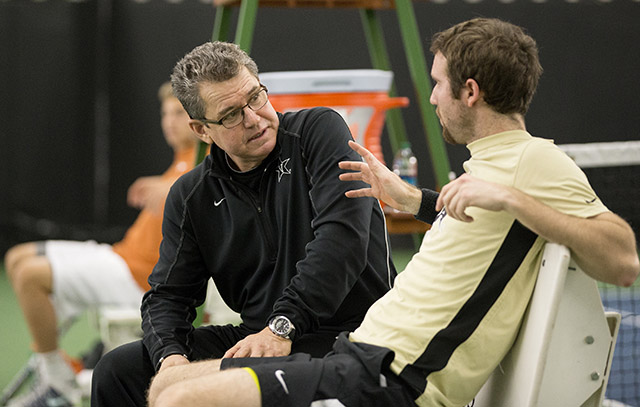
Tennis led Ian Duvenhage to the United States, helped him acclimate to university life, sparked a stint on the professional circuit and then opened the doors to a lengthy career in coaching.
But for as much as the sport has been a part of his life, Vanderbilt’s veteran men’s tennis coach often needs outlets to alleviate stress the rigors of coaching produces. So it is not unusual to find Duvenhage off hiking at Radnor Lake or with his head in the book or turning a blank canvas into a colorful painting.
“As I got older I discovered they’re great antidotes to the stress of being a coach,” he said. “I can paint or I can read or I can go for a hike or I can go work in my garden and two hours later mentally and emotionally I’m in a very different place than I was when I started.”
Duvenhage has spent the last 35 years as a tennis coach, including the last 10 at Vanderbilt. But the 55-year-old doesn’t let tennis define him as he is a man of many hobbies.
Roots formed in his home country of South Africa can be credited for much of his well-roundness as an intellectual, avid reader, enthusiastic outdoorsman and talented artist.
Born in 1959, Duvenhage grew up during apartheid and racial segregation in South Africa. He spent a semester teaching a class on apartheid with athletic director David Williams in the political science department at Vanderbilt.
He touched on his experiences, witnessing segregation from restricting black people from staying in the same hotels, going to the same restaurants or even through the same door as white people.
In 1960, the Sharpeville massacre killed 69 people when South African police fired into a crowd of African protesters, who were demonstrating against segregation laws. Duvenhage, who was just one at the time, says looking back at how it was covered, South African newspapers didn’t report on it at all whereas the shootings were broadcast on televisions around the world.
“My guess is that it was like a lot of places in the world where oppression is rampant,” he said. “The government did a fairly good job at hiding it from their citizens. But you still had to have your head completely in the sand to not know that whatever was going on was not good. You are so brainwashed when you actually live there that things didn’t start to change for me until I had been in the United States.”
When Duvenhage arrived at the University of Miami for his freshman year, he was taken to the athletic director’s office right away. For a split second, Duvenhage was concerned he was going to be told he didn’t have a scholarship anymore.
Instead, the athletic director looked at him worriedly and said his roommate was a black student named Darryl Johnson.
“And I was like, ‘Cool,'” Duvenhage says, laughing remembering the encounter. “The coolest guy. He had a fro this big (extending his arms). He was a music major. He played the oboe… My parents were probably, as Afrikaners of that era, were as probably as enlightened as you could be. But… in the final scheme of things, they were still white South Africans living in South Africa. And if you asked them, they would have defended apartheid. But they taught us, me, my brother and sister, that we had to treat everybody with respect.
“So it wasn’t huge (to have a black roommate). Actually, it was a very cool experience. He was into completely different things for me. He was non-athletic. He was musical. He turned me onto Stevie Wonder. It was a great experience.”
Duvenhage can recall returning one summer to the states from the University of Miami and greeting one of his father’s employees, who was black. Duvenhage extended his arm for a hand shake but his dad’s worker didn’t know how to react. He was stunned.
“That is just not something a white man did to a black man,” he said. “I was really close to Robbie because he took care of me when I was a little kid. I felt very comfortable with him. I loved him.”
Duvenhage’s love of books and the wilderness can be directly connected to his childhood in Kuruman, a small South African town just on the edge of the Kalahari Desert.
He remembers being surrounded by books thanks to his dad’s massive library. From nine years old he has had his nose in a book, often reading as many as four books at the same time. He tries to broaden his players’ horizons by suggesting books to match their interests or personality – from former NBA coach Phil Jackson’s “Sacred Hoops” to Robin Sharma’s “The Monk Who Sold His Ferrari.”
“Reading has always been a part of my life,” he said. “I read every day. I don’t have to try to do it. It just happens. I love having a book in my hands.”
He also enjoys being outside. He gardened with his mother in their backyard and credits his knowledge of plants to his mother and his exposure to vegetation back home, where “you could drive 100 miles in any direction and see cattle.”
When his father went into “the bush” to hunt, little Ian followed alongside, hiking for miles and miles. He also tagged along when his father, an attorney who specialized in real estate law, would go to visit a farmer’s property.
“I loved that,” he said. “I loved being on the farm. Sometimes when I get really stressed out with tennis I say, ‘Why didn’t I become a farmer?'”
Trotting through parks is a huge passion of Duvenhage, who wants to hike all 59 national parks in the country. He has done a few so far, including Yellowstone National Park and Glacier National Park in Montana. For their honeymoon, Duvenhage and his wife, Susan, hiked the Grand Canyon from the North Rim to the South Rim, staying at a lodge at the base of the canyon in between.
Luckily for Duvenhage, he doesn’t have to go very far to get his hiking fix. He lives just down the street from Radnor Lake. When Duvenhage needs a break from tennis, he often hikes the four-mile trail loop in the 1,300-acre nature preserve.
“I’ve hiked Radnor in the hundreds of times,” he said. “It is one of my favorite places. It is really amazing we have a jewel of a place like that right in the middle of the city.”
Radnor Lake and his backyard are often subjects for one of his other passions – painting.
Since 1999, he has been creating artwork with oil and acrylic paints. A fan of Van Gogh, Matisse, Nolde and other Expressionists, Duvenhage paints portraits and still life – fruit, flowers and wildlife.
“The painters that speak to me are expressionists,” he said. “I tend to do wild and crazy things – with a lot of color. It was something I always wanted to do. But I always thought I don’t have the talent. So in ’99 I decided even if I don’t have the talent I should at least be able to say I’ve done it. There is something very cathartic about it. You just go to another place. You can almost tell when you go from left brain to right brain. When you can be in the right brain, usually you do good stuff.”