

March 8, 2010
View Archived Issues/Subscribe
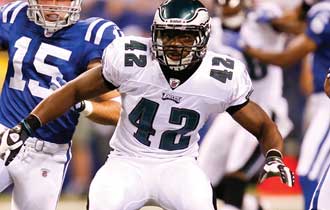 From Monday through Friday life was great for former Commodore safety Reshard Langford. It was Saturdays and Sundays that were hardest for him to stomach.
Five days during the week, Langford practiced like an NFL player, ate at the same training table as NFL players, watched film like an NFL player, but come the weekend, he was no more an NFL player than the guy seated in section 315, row 21, seat 8. Langford had the weekends off, but he’d rather have been working.
As a member of the Philadelphia Eagles practice squad, Langford spent the first 15 weeks of the 2009 NFL season practicing with the team’s 53-man roster during the week, but come gameday, he and the other seven members of the practice squad were nowhere near the sideline. While some teams have members of its practice squad watch games from a luxury box or on the sideline, others, like the Eagles, give the players complimentary tickets to watch the home games from the stands.
“The first couple of weeks it was very emotional, and I couldn’t even hardly watch the games because of how much I wanted to be out there,” Langford said.
Finding practice squad players on Sundays can almost be as difficult as finding them on NFL rosters. When you look at a team’s roster, you will see the players on the 53-man active roster. Below the active roster are the players on injured reserve and at the bottom of the page are the members of the practice squad.
Every team has a practice squad, which is comprised of players whose primary role is to do just as they are aptly named to do â€â€ practice. Practice squad players get $5,200 a week and do everything that members of the active roster do during the week, but they are not full-fledged members of the team. They are one injury away from being a part of a team’s active roster, but they are also one injury or misstep away from fading into football oblivion.
In most cases, at least one NFL player gets hurt on a team every few weeks during the season. That injury leads to a transaction, which could open the door for a member of the practice squad to make the active roster or spell doom if more depth is needed at another position on the practice squad.
Although he is just a rookie, Langford knows how quickly things can change on an NFL roster. Through the first 15 weeks of the season, Langford was the Eagles’ only remaining practice squad player from the start of the season.
“I’ve seen guys come in one week, be gone the next and be back three or four weeks later,” Langford said.
The uncertainty that practice squad players live each day adds pressure to each practice. For Langford, the pressure was welcomed with open arms.
“It does put pressure on me, but in reality, I like the pressure as a player,” Langford said. “You have to perform under pressure on the field, and feeling it at practice is good for me. It could get stressful at times if I thought about it too much, but then again, I knew I am here for a reason.”
The NFL implemented practice squads in 1989 to give teams extra players to use in practice or on the active roster in the event of an injury. With NFL Europe ceasing operations in 2007 and the Arena Football League shutting down before the 2009 season, practice squads have become a valuable way for teams to cultivate talent.
When Langford hoisted the 2008 Music City Bowl trophy after his final game as a Commodore, he had hopes he would be selected in the NFL Draft. When his name was not called, Langford signed as an undrafted free agent with Philadelphia.
“Coming in and not knowing your status as an undrafted free agent was tough,” Langford said. “In order to stay on the team you have to make the team.”
Langford did make the squadâ€â€Âthe practice squadâ€â€Âafter being cut during training camp.
Although it was just the practice squad, Langford believes he couldn’t have ended up in a better situation.
“I thought about how I got (to Philadelphia) of all places every day,” Langford said. “There were other choices for me, but I prayed about it, and I was fortunate to get to Philadelphia.”
In Philadelphia, Langford got to learn from a playoff team that was built around veteran players. He would study tape from the previous game with his teammates, and he would study tape of the team’s next opponent with his teammates. However, while members of the active roster practiced the game plan for the following week, Langford and the other members of the practice squad would work as the scout team to prepare the Eagles for the next game.
Each week, Langford had to know the opposing team’s offensive gameplan in case he was activated for Sunday’s game, and he had to know the opposing team’s defense in order to mimic it in practice.
“Working on the scout team is exactly what I did my redshirt year at Vanderbilt,” Langford said. “It was just like another rookie/redshirt year for me.”
Unlike his first year in college, Langford knew that his spot with the Eagles could be gone the next play. To help make his mark with the Eagles, Langford made sure to approach his role every day with a tenacity that was second to none.
“It is a business and I’ve come to understand that, but I also understand that it is still football,” Langford said. “You need to perform well, work hard and maintain responsibility because it is a job. You need to get people that you work with to have trust around you, and I feel like I became more trustworthy as the season went on.”
As the season progressed, Langford became more comfortable with the Eagles, but one thing he never could adjust to was not being a part of the team on game day.
“It was probably the hardest thing I’ve ever done in my life,” Langford said. “Going from starting and playing for four years at Vanderbilt, and going from that to not being able to was hard.”
Just as practice squad players can be released at any time, they can also be claimed by another team as long as they are signed to that team’s active roster. In the case of Langford, all seven of the players he began the season with on the Eagles’ practice squad had been added to the team’s active roster at some point or were signed to active rosters of another NFL team by Dec. 9. The departures left Langford as the veteran member of the team’s practice squad.
His stint as the veteran on the practice squad would not last long. On Dec. 25, Langford became the final member of the team’s original practice squad to find a spot on a 53-man roster when the Kansas City Chiefs gave him the best Christmas present he could have asked for.
By signing with the Chiefs, Langford received his first guarantee and one of the only guarantees in the NFL, which is sometimes referred to as being the acronym for Not For Long. By joining the Chiefs, Langford was guaranteed a spot on the team’s 53-man roster for the last two games. Although he was inactive for the final two games of the season, inking with the Chiefs meant a pay raise, and most importantly another step toward playing in his first NFL game.