

Oct. 8, 2008
 Bill Edwards Remembered (pdf) | Commodore History Corner Archive
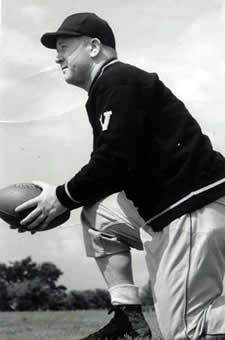 |
|
When Vanderbilt head football coach Red Sanders bolted for the sunshine of Southern California at UCLA after the 1948 season, the Commodores were in need of a new coach. Sanders led the Commodores for six seasons (1940-42, 1946-48) with a three-year stint in the military during World War II. The former Vanderbilt player compiled a 36-22-2 for the Commodores.
The Vanderbilt football program was very prominent and respected in this era of college football with many applicants eager for the coaching opportunity in Nashville. One of those applicants was Bill Edwards.
Edwards was born in 1905, but was forced to drop out of high school at age 14 briefly to work in the coal mines of East Greenville, Ohio to help support his family. At age 17, Edwards returned to high school and became a star football player for Massillon, Ohio. He enrolled at Ohio State where he became the freshmen’s team captain. His roommate and former Massillon teammate was another future coaching legendâ€â€ÂPaul Brown.
The all-time Massillon High School football team, which was selected in 1958, noted that Edwards was the “Greatest Tiger of them all.” Also wanting Edwards’ football talents were Princeton and Notre Dame. Edwards wanted to someday be a football coach and not a professional businessman.
Six of Edwards’ high school teammates enrolled to play football at Wittenberg College (Springfield, Ohio) and Edwards transferred from the Buckeyes. Grantland Rice wrote, “Edwards is the best center in the nation, but I can’t name him All-America because of his team’s schedule.” Walter Eckersall did not overlook him playing at a small college and did name Edwards to his All-America team.
Edwards was known as the fellow who liked to play football without a helmet, but told those who asked him about that answered, “Oh, I skin my ears once in awhile, but I don’t let it bother me.”
In 1931, Edwards began his coaching career by becoming an assistant coach at Springfield High School in Ohio where he also taught history. The next year, he was awarded his first head-coaching job at Fostoria High School and in the second season his team recorded an 8-2 slate; the best record in 10 years.
In 1934, Edwards joined the staff at Western Reserve (now Case Western) in Cleveland under head coach Sam Willaman. When Willaman died suddenly before the 1934 season, a group of Western Reserve players visited the Athletics Director in support of Edwards to succeed Willaman. Edwards was given his first challenge as a college head coach.
Edwards’ first two teams were undefeated. The highlight of his tenure at Western Reserve was a 1940 Sun Bowl win in El Paso, Texas. The Sun Bowl victory made Edwards a target for colleges looking for a top-level head football coach. He had offers from Colorado, Marquette, Dartmouth and Tulsa. Edwards’ six-year record at Western Reserve was 48-6 with three unbeaten seasons.
To the surprise by many, in 1941 Edwards signed a contract to become the head coach of the professional Detroit Lions who doubled his college salary. The 1941 Lions were 6-4-1 and after going 0-3 in 1942, Edwards accepted a commission in the Navy for a three-year stint during World War II.
After his discharge from the Navy as a Lieutenant Commander, Edwards sold sporting goods equipment in Cleveland for a year, but his mind was still on football. When Paul Brown was putting together the Cleveland Browns, he asked his old friend to be the tackles coach.
Edwards had a desire to be a head football coach again. After two seasons with the Browns, two college jobs became available in Miami (Ohio) and Vanderbilt. Edwards chose Nashville as Brown recommended he take the Miami offer. He is credited with popularizing the forward pass in the Southeastern Conference and was named “National Coach of the Week” six times at Vanderbilt for upsets over favorite opponents.
 |
|
| Edwards with 1949 captain Carl Copp (No. 75) |
Edwards inherited a Commodore team that consisted of 26 seniors, 22 juniors and a sophomore class led by Nashville-native Bill Wade. During his first spring practice Edwards announced that he was going to implement a pro-style offense that would eliminate Sanders’ single-wing offense for a T-formation.
It would not be uncommon to see Edwards returning kicks in practice or running a play on offense to show the boys how he wanted it done. Often Edwards would interrupt a practice session with a tale from his earlier days. At the conclusion of his first year at Vanderbilt, the Commodores lost to 18th ranked Tennessee in Knoxville, 26-20. In the game, two Commodore TD’s were nullified by penalties.
In the game Vandy’s punt returner, Lee Nalley, attempted a fair catch and was hit on a hard tackle and fumbled the ball. At the end of the game, Edwards stormed the field in pursuit of the officials, an action that some Vanderbilt officials labeled as “embarrassing to the University.”
He was given a one-year extension of his original three-year contract, but feeling the pressure he resigned after his fourth season with a 3-5-2 record. With the huge academic standards at Vanderbilt, Edwards once announced, “I had more engineers on my team than Bobby Dodd had at Georgia Tech.”
Edwards would leave Vanderbilt after four seasons and a 21-19-2 record. His yearly record was 1949, 5-5; 1950, 7-4; 1951, 6-5 and 1952, 3-5-2. Edwards would become an assistant coach at North Carolina for two seasons then return to Wittenberg as athletic director and head football coach. In 14 seasons at Wittenberg, Edwards managed a record of 98-20-4. This included three unbeaten teams, and five clubs with only one loss. His squad won or tied the Ohio Athletic Conference championship seven times.
The Washington Touchdown Club selected Edwards’ 1962 and 1964 teams as the nation’s best among the small colleges. Wittenberg dominated the small college division during the 1960’s with a 69-9-1 record. President Richard Nixon and the U.S. House of Representatives recognized this achievement.
The American Football Coaches Association named Edwards their “Coach-of-the-Year” in 1962 and 1963. Edwards became the first man ever to be named “Coach-of-the-Year” three times when the Football Writers Association voted him for “The lasting contributions he has made to college football.”
Edwards found his success at Wittenberg with his pro-style offense that taught the conservative OAC a new game of football with a daring passing attack. He was happy at his alma mater not having to bear the pressures of the big-time college’s recruiting and alumni’s desire to win.
Sports Illustrated once called Edwards “A combination of Genghis Kahn and Santa Claus” after realizing the coach had the personality to be both tough and companionate with his players. “Oh, I drove ’em hard,” said Edwards. “I’d drive them till their ankles smoked, but then I’d call them together and break the tension with a good story and put them back to work.”
Edwards retired as a football coach after the 1968 season, but remained as the school’s athletic director until 1973. In his 23 seasons as a coach, Edwards earned an all-time record of 168-45-8 with five unbeaten seasons and two national titles. He was inducted into Wittenberg Hall of Fame (1984); Case Western (Western Reserve) Hall of Fame (1986); Vanderbilt Hall of Fame (1986) and the College Football Hall of Fame (1986). Edwards passed away at age 81 in Springfield, Ohio in 1987.
“If I had it to do over again, I’d still be a football coach,” Edwards once said. “You know, I got as much out of coaching the kids as some of them say they got out of playing for me. It’s a little tough sometimes to admit to yourself that one of your players has more humility than you do, or is a little more honest, but it happens.
“If you teach a boy to compete, he will compete for the rest of his life. Football coaches are educators who teach, among other things, discipline, loyalty, sacrifices for a common good, and cooperation to achieve a worthwhile goal.”
Traughber’s Tidbit: Last Saturday’s 14-13 victory over Auburn gained national attention on ESPN with the “GameDay” crew settling down on the Vanderbilt campus. Vanderbilt’s first national television exposure came in the 1955 Gator Bowl where the Commodores also beat Auburn, 25-13.
Tidbit Two: Vanderbilt is ranked No. 13 in this week’s AP poll and No.14 in the USA Today poll. The highest that Vanderbilt has been ranked (not including preseason) is in 1948. In Coach Red Sanders final season at Vanderbilt, the Commodores won their final eight games to finish as the 12th ranked team in the nation.
Tidbit Three: In the years prior to 1945, Vanderbilt did not elect homecoming queens. Instead, band sponsors were picked. Mrs. Louise McCoy was the first selection in 1937. The next year a young Vanderbilt co-ed named Fanny Rose from Winchester, Tenn. was selected. Ms. Rose would later become a famous entertainer while changing her name toâ€â€ÂDinah Shore.
If you have any comments or suggestions you can contact Bill Traughber via e-mail WLTraughber@aol.com.