

Feb. 16, 2008
 |
|
Subscribe to Commodore Nation magazine / Archived Issues
It’s more than 42 hours before kickoff at Neyland Stadium when a moving truck and a Grayline bus pull away from the McGugin Center and head to Knoxville, Tennessee.
The bus isn’t filled with players, coaches, band members or even overzealous fans – instead the bus is filled with Vanderbilt’s equipment staff. Led by equipment manager Luke Wyatt, the staff is responsible for loading, unloading and transporting the 26-foot moving truck that contains all the equipment that Vanderbilt needs to play a game away from home.
As is the routine for every Commodores road game, the equipment crew spends each Thursday before a road game packing the truck and filling it to the brim with an eclectic mix of items ranging from the team’s helmets and jerseys to the training room supplies and radio equipment.
Once the helmets and shoulder pads are collected and loaded into the truck after Thursday’s practice, it’s off to Knoxville, where the staff will drive through the night and check into the team hotel. After catching a few hours of shuteye, the crew heads to Neyland Stadium Friday morning to prep the locker room before the team arrives for a walkthrough at 2 p.m.
Although their work and identities are usually unknown among fans and observers, the behind-the-scenes work of the equipment staff is as important to Vanderbilt’s football program as oil is to a car’s engine.
The People
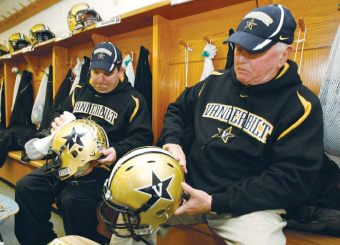
Led by Wyatt, who got his start by helping at practices and games as a kid, the football equipment staff is a close-knit group that forms a bond much like a fraternity. In addition to Wyatt, who has been in his current position for 18 years after serving as an assistant the previous seven years, the staff is comprised of three full-time employees, four part-time employees and more than a dozen volunteers. The group ranges in age from 20 to 70 and experience from their first season to their 30th.
There are the long-timers: Bobby Russell, Billy Smith, Ricky Stewart, James Arendale and Buddy Shaffer, who’ve all been working on the staff for more than 16 years.
“I do it because I love the game, and I love Vanderbilt,” Shaffer said. “I started working at Vanderbilt as a member of the chain gang during Black and Gold scrimmages and was hired by coach (George) MacIntyre in 1982.”
As a volunteer, Shaffer helps set up all of the headset communications between the coaches in the press box and the players and coaches on the sideline. Shaffer also sets up headset communications for the Tennessee Titans at all of their games.
There is Harold Gregory, who has been on the staff for 10 years and is the second-oldest member. Born in 1938, Gregory once performed at the Grand Ole Opry House and knew Elvis Presley through his wife’s aunt, Kitty Wells, the “Queen of Country Music.”
“I love just helping out with the team and being involved,” Gregory said. “I’ve been supporting Vanderbilt all of my life. I’ve missed one game since 1962.”
There is Sam Leban, who makes the 722-mile trek from El Dorado, Kan., to Nashville eight or nine times a year just to help the staff.
A salesman for Nevco scoreboards, Leban’s son Dan was a football player turned student manager for the Commodores in the `90s. Leban began volunteering with the staff when his son was working with the staff as a student assistant.
“Luke is great, and I’d do anything I could to help him,” Leban said. “The group is just fun to be around.”
Despite only getting a per diem as compensation like the rest of the volunteers, the cost of logging the 722 miles from El Dorado to Nashville, hasn’t stopped Leban from doing what he loves.
“When I tell people I do this, they either think that it is really neat that I get to be on the sideline at all of these games, or that I’m crazy,” Leban said.
While the majority of state schools have upwards of 30 students on their equipment staffs, Vanderbilt’s staff is mostly comprised of individuals beyond their college years.
“It is hard to find students at Vanderbilt that want to do it and are able to have it work with their class schedules,” Wyatt said. “It is a commitment to be able to make practices and be here in time to set up the field for practice.”
To staff the crew, Wyatt has tried to offset the shortage of student workers by utilizing the size of the city to find volunteers.
“I do have a good pool to pull from (in Nashville),” Wyatt said. “Vanderbilt also allows me to hire someone from another school because it is hard to find students at Vanderbilt.”
One local student on Wyatt’s staff is Garrett Walker, a junior from Trevecca Nazarene University, who is in his first year.
“It is something I’ve wanted to do for a career,” said Walker, who was a student manager at the University of Alabama before transferring to Trevecca. “When I transferred, I e-mailed Luke (Wyatt) and let him know I was interested in helping out.”
Build Up For A Road Game
If you’ve ever wondered how something got to the stadium or on the sideline, there is a fairly good chance that the equipment staff had something to do with it.
The preparation that goes into a road game for the equipment staff begins on Monday and continues until kickoff.
With jobs ranging from doing the team’s laundry after practice to repairing shoulder pads and cleaning helmets, the equipment staff spends Monday through Wednesday making sure every “t” is crossed and every “i” is dotted before Thursday’s departure.
Packing for the game begins on Wednesday when the equipment staff receives the official dress list and uniform combination from the coaching staff.
The actual loading begins on Thursday afternoon, which also is departure day for the staff.
“The only three things we can’t pack on Thursday afternoon are the shoulder pads, helmets and pad bags,” Wyatt said. “We wait until after practice is over, and we pick them up immediately after practice. We pack them and load them on the truck, and that is the final thing that we load.”
After the team concludes practice on Thursday at about 6 p.m., the equipment staff begins collecting the player’s helmets and stacking them in large carts as they enter the locker room.
Once the truck is loaded and every piece of equipment is accounted for, the staff departs on the bus to the team hotel, where they hope to catch a few hours of sleep. Some nights can be shorter than others, depending on the length of the drive.
“For the Florida game earlier this season, we had only three hours to sleep before having to head to the stadium,” Wyatt said.
The turnaround can be quick for Wyatt and the staff, which must head to the stadium at least four or five hours before the team’s scheduled walk-through.
Some of the work that is done on Friday before the team arrives includes selecting lockers for all of the players and putting up nametags above each locker.
“Coach (Bobby Johnson) likes offense on one side of the room and defense on the other, so that is how we set it up if the locker room allows for that,” Wyatt said.
Other legwork that is done before the team arrives includes putting each player’s walkthrough gear in his locker, placing the coaches’ headsets in the press box and checking the equipment for damage that may have occurred at Thursday’s practice.
“Friday at the stadium is the third check I will do to see if anything got scarred on that Thursday’s practice and needs repair,” Wyatt said. “Thursday is usually a pretty light practice, so there aren’t a lot of things that need to be fixed.”
While it would be possible for the staff to set up the locker room for Saturday’s game after the walkthrough, the risk of theft is too prevalent for Wyatt, who keeps the jerseys locked in a metal cage that has bars that are too narrow for a hand to fit through.
The entire country saw the importance of keeping jerseys under lock and key when Virginia Tech’s jerseys were stolen before its game at Georgia Tech. While Wyatt always packs extra jerseys, Virginia Tech did not have replacements, and a few Hokies were forced to wear old Georgia Tech uniforms.
“We won’t put out any game cloth on Friday,” Wyatt said. “I keep them locked in a cage and am very careful. We had a couple of jerseys disappear at Kentucky one year, and we had one jersey stolen at Arkansas a few years ago, but for the most part it is not a problem. Most places realize that they’ve got to come to your place, so they take care of you.”
Game Day
Although kickoff for Vanderbilt’s game at Tennessee is at 2 p.m. ET, a bus carrying the equipment staff departs the team hotel at 9 a.m., some five hours before kickoff.
“I try to time our arrival so that we have about an hour of downtime before the team arrives,” Wyatt said.
When the staff arrives, they go right into setting up each player’s locker. Wyatt instructs and demonstrates the precise way that every item is to be placed in each locker.
The laundry bags go on the middle of the three hooks, the long-sleeved Nike Dri-Fit goes on the right hook, the pants must drape the back of the chair and face up, the jersey must drape the back of the chair and face down and the shoulder pads must face the same direction behind every chair.
The precision is taken very seriously, and one mistake can cause the group to ridicule another. Sam Leban found this out firsthand and drew a good-humored ribbing from the staff after incorrectly placing a laundry bag on the right hook instead of the middle.
In order to speed up the process of matching equipment with each player, Wyatt grabs each piece of equipment and identifies it by shouting the players number followed by either “O” or “D” for offense or defense. Wyatt then hands the item to a member of his staff, and it is placed in the player’s locker.
While the majority of the staff is setting up the locker room for the players, Ricky Stewart, a 16-year veteran on the staff, is setting up the coaches’ locker room, as he does every game.
“I’ve been doing this for so long that I just know what they want,” Stewart said. “Some coaches want short socks, some long and the same with the shirt.”
Beyond the setup in the locker room, Buddy Shaffer, Chuck Arnold and David Frazier are responsible for setting up the headsets and phones on the sideline for communication between the field level and press box.
Once the frequencies have been programmed, each of the 10 headsets is tested by the trio, who walk up and down the sideline checking to see if there are any gaps in the communication.
While the headsets are being tested on the sideline, the staff in the locker room wraps up preparation for the game.
Assistant equipment manager Gary Veach is preparing to oversee the pregame warmup. A five-year veteran on the staff, Veach is in charge of directing the precise location for each position grouping to warm up.
Fellow assistant equipment manager Chris Singleton, a seven-year veteran on the staff, goes around to lockers and applies double-sided tape to the shoulder pads for players who request it. By placing the tape on the top of shoulder pads, it makes it difficult for the opponent to get a grip on a player’s jersey.
When Singleton finishes, it is just a little past 10:30 a.m., and the team isn’t scheduled to arrive until 11:50 a.m. The extra time is a welcome sign to the staff, and it signifies that the setup has been completed without any major hiccups. Maybe just as importantly, it allows the staff a little time to relax before the team arrives and it’s time to go again.
Any moments of rest that can be had on game day are very important because early mornings at the stadium turn into late nights on the road back to Nashville.
“No matter what time it is, we unload everything off the truck when we get back,” Wyatt said. “After we get it off the truck, we don’t do much unpacking that night except for the uniforms which go immediately into the wash. Everything else is done on Sunday.”
As soon as the final cart is off the truck and the jerseys have been washed, the cycle for next week’s game has already begun.
And while some people may question why someone would donate so much time and not earn a penny doing so, Shaffer knows there is nowhere he would rather be than helping Vanderbilt’s football team.
“I love Vanderbilt, and I love doing this because the people I work with are great,” Shaffer said.