

Nov. 10, 2010
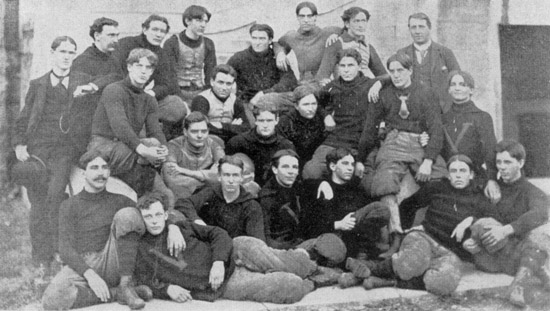
Commodore History Corner Archive (Above photo: 1896 Vanderbilt football team)
Vanderbilt began playing football in 1890 with a 40-0 victory over the University of Nashville (Peabody). Nashville was a natural rival since the universities were just several miles a part.
The students from both universities interrupted the 1896 game played at Vanderbilt. The Nashville American reported on the shameful melee with these headlines introducing the game story: “WAS MOST DISGRACEFUL, Local Students Appear in the Role of Hoodlums, Sideline Interference Breaks up a Dragging Game, Vanderbilt and University of Nashville Foot Ball Contest Ends in Ugly Row Which Started With Students.”
The American reported:
Vanderbilt athletic field was the scene yesterday of a very ugly affair, in which, the students of the local universities covered themselves with anything but glory. The University of Nashville men say that the slugging of the opposing eleven was the cause of disagreement, while the Vanderbilt men allege an unnecessary delaying of the game, during which the failing energies of the other side might be recuperated. Both of these reasons are, no doubt, true to a certain extent, but the prime cause was the bitter rivalry between the students of the two institutions.
The exhibition of temper is much to be regretted, as it will affect not only the game, but will also hurt badly the reputation of each team. If a moment’s thought had been given to the deplorable results which must inevitably follow it would have never occurred, but the cool heads in the minority and were liberally punched when they attempted to advise a suspension of hostilities.The contention of debate was two plays that happened in the second half. Phil Connell of Vanderbilt attempted a drop kick for a field goal, but the ball traveled too low, hit the linemen and bounced away. Connell fell on the loose football while Looney of Nashville fell on Connell “with considerable force, inflicting a large bruise upon his head.”
Vanderbilt tackle Chuck Hassett pulled Looney off Connell “roughly, and the students appeared from both sides of the field, each body with the intention of seeing that its man got a fair play.”
The American reported:
In a very short time words were supplanted by blows and for a few minutes both sides were engaged in a lively manner. After matters were amicably arranged the play was allowed to go on for a space of time, but a decision of the umpire being unsatisfactory to the University of Nashville, the men walked off the field, and while the two captains were discussing the matter the crowd came together again and necessitated a discontinuance of the game.
It was decided by the umpire and referee to call the game on account of outside interference. Captains Connell and MacRae both expressed themselves as very sorry that the affair occurred and are of the opinion that it was due to the excited student bodies.The second incident occurred in the second half that caused a controversy. With the game scoreless, Nashville captain John MacRae called for a timeout, which was not allowed. On the ensuing play, H. Davis of Vanderbilt ran the ball to the Nashville 20-yard line. As the run by Davis was allowed, MacRae in protest, pulled his team off the field and never returned.
So did Vanderbilt get the apparent forfeit victory?
The American did not mention a forfeit and reported the game as 0-0. The manager of the Vanderbilt team Granberry Jackson, sent this letter to The American:
- “As manager of the Vanderbilt football team I wish to enter a public protest against the above reported decision of the officials to in the game this afternoon between Vanderbilt and the University of Nashville. It is there stated that the game was decided to be a draw on account of interference of outside parties, preventing the game from going on.
“Whereas, it is a known fact to everyone present that the University of Nashville team left the field because of what they considered an unfair decision of the referee and refused to return within the limits provided by the rules. The Vanderbilt team during this time was lined up in position to play and the field was amply cleared for the game to proceed. I claim that by its failure to return to the field the University of Nashville team forfeited the game to Vanderbilt by the score allowed by the rules in such cases, 6-0.”
Of course, MacRae sent a letter to The American to explain the side from the University of Nashville’s perspective:
- “I regret that so much time was taken out for University of Nashville players and want those interested in the game to know that the delay was caused by Vanderbilt’s determined efforts to put our best men out of the game. Had the sluggers been disqualified when they were first detected in this dirty work the game would have ended differently.
“The University of Nashville men expected to be fouled and were instructed by their captain to play an especially clean game, and they followed his instructions. The conditions of some of our best men bear me out in my impression that they were being slugged in order to get them out of the game. The final decision is very satisfying under the circumstances. It would have been eminently unfair to call the game other than a draw at that stage of the game, for the conditions which made it best for us to leave the field were brought about by Vanderbilt’s malicious foul play.”
A few days after the game, the Vanderbilt administration met to discuss the rough play and the disruptions that occurred. It was agreed that trouble could have been foreseen with the emotions of the two rival schools. The committee concluded that, “only the merciful providence of God prevented results worse than black eyes and sore heads.”
One Vanderbilt player was banned from playing football at Vanderbilt forever and one was suspended for the rest of the season. Their names were not revealed. Administrators from both schools met and it was decided that the game should be forfeited to the Commodores. Vanderbilt claimed a 6-0 win by forfeit.
Vanderbilt finished the season with a record of 4-2-1.
Traughber’s Tidbit: Between the years 1890-1904, Vanderbilt played the University of Nashville in seven games, winning all of them.
Tidbit Two: After ending the 1897 season 6-0 and unscored upon, Vanderbilt agreed to host Virginia for the Southern championship. The teams played to a classic 0-0 tie in front of 2,500 fans.
Tidbit Three: The reasons for such few substations in football until 1910 were the rules like in baseball where if a player leaves the game, he cannot reappear.
If you have any comments or suggestions you can contact Bill Traughber via email WLTraughber@aol.com.