

Nov. 4, 2009
 View Commodore History Corner Archive
This interview between Bill Traughber and the late Dixie Roberts is from 2004. Roberts was 92 years old at the time of this interview and has since passed away. At the time Roberts was believed to have been Vanderbilt’s oldest former football player.
A former great Vanderbilt football player from the 1930s would have been in violation of NCAA rules if an incident he was involved occurred in this decade.
This ancient incident involves Vanderbilt’s legendary coach Dan McGugin and one of his players in 1932. The player was William Clyde “Dixie” Roberts who was about to enter his senior year for the Commodores. The “infraction” concerns a car.
“Coach McGugin bought a ’30 Model Coup and had brought it up to Beersheba Springs, Tenn. near where I lived in McMinnville,” said Roberts. “A lot of people from Nashville would go there for the summer. He came down one day that summer and was hit with this downpour of rain.
“Over the river there was a crooked bridge. Well, he drove that car right off that thing into the river. And the car was completely submerged. With the downpour, that little river would get big before you could say `scat.’ I heard that the insurance company was going to give the car to Ford Motor Co. if they could get it out of the river. So, I called Coach McGugin and told him not to give that car to them, but to give it to me.
“So he told the insurance company to give the car to me. When the river went down, I got a couple of the boys and we able to get a truck out into a field. We pulled the car right out. I took it home and set it out in the sun to dry out. The boy at the Ford Motor Co. in McMinnville helped me get the parts to get it running again.”
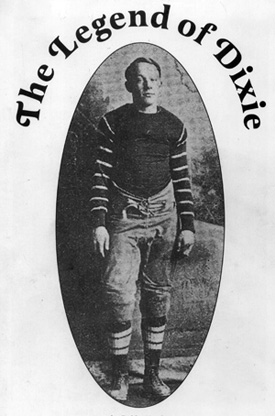
Roberts was raised in McMinnville, Tenn., and became a legend while breaking records on the prep football field. Roberts’ father owned the Dixie Hardwood Co. and the local farmers called his father “Dixie” and son Clyde, became “Little Dixie.” The nickname was carried over as his legend grew. When Roberts was born, William Howard Taft was president of the United States.
In his senior year (1928) at McMinnville, Roberts led the “Big Blue” to a perfect 10-0 record and a state championship. This would be McMinnville’s only undefeated season in their gridiron history. While record keeping in those days was sometimes questionable, Roberts did record 3,690 yards as a senior, which includes one game totaling 520 yards rushing.
“When we got through eight games in our schedule, Cleveland and Carthage were claiming the state championship as were we,” Roberts said. “So, the coach over at Cleveland called up our coach and a game was arranged. We always played our games at the fairgrounds. They came in a day early and practiced.
“They kicked off to us, I caught the ball and ran it back for a touchdown. I kicked the extra point. We kicked the ball off and held them on downs. They punted; I caught it and ran it back for a touchdown. That happened again and again. The score was 26-0, and we had not run a play from scrimmage.
“Then we went over to Carthage and they did have a good team and passer. They had just sold their tobacco and were betting up a storm. We didn’t know about that, but they hadn’t been scored on. On the third play of the game, I scored on a long touchdown run. That discouraged them so much that we went on to win the game and the state championship.”
College recruiters swarmed to the small community of McMinnville to secure Roberts’ football services. Notre Dame reportedly was interested. Roberts wanted to stay close to home so it came down to Tennessee and Vanderbilt for college.
“It was close,” said Roberts about his college selection. “I knew some people that were in Vanderbilt. A recruiter for Knoxville tried his best to recruit me. But, I went to Knoxville to watch a game where Tennessee played Florida. [Coach Robert] Neyland got on this great big ole boy that was a tackle who was doing the best he could. Neyland was too rough on him. I was asked if I was going to the University of Tennessee. I said, `No, I couldn’t do it.’ I wouldn’t put myself in that position. If he talked to me like that, there would be the damnest fight you ever saw.”
Freshmen were not allowed to play on the varsity in this era of college football. However, Roberts was on the Commodore freshmen team that was 5-0. Considered one of Vanderbilt’s best freshmen team featured Pete Gracey, “Chuggy” Fortune, Jim Beasley, Marion Talley, Julian Foster, Tom Henderson and Roberts.
The immortal McGugin began his tenure at Vanderbilt in 1904-17, 1919-34 and in 30 years is the Commodores all-time winningest coach (197-55-19). Roberts said that McGugin liked to delegate the coaching to his assistants as he neared retirement.
Vanderbilt was 8-2 in Roberts first season on the varsity in 1930. He scored his first collegiate touchdown while receiving a pass in the first game against Chattanooga. Roberts did not start in the Commodore backfield that year yielding to the experienced players.
In the first game of the 1931 season, Western Kentucky came to Nashville and Roberts learned a valuable lesson about the vigors of college football. The lesson came from his backfield teammate from the previous year. By now, Roberts was starting as a halfback.
“Jess Thomas graduated and went to Western Kentucky as a backfield coach,” Roberts recalled. “He told his players that if they would get me out of the game, that they would have a chance to win. Along during the game, I felt several times being stepped on. [They] were doing that intentionally with those cleats on.
“Once this happened over in front of our bench. I looked up at the old boy and said, `You son-of-a-b…., before you leave Nashville, I’m going to whip your [tail]’ and Josh Cody [Vandy assistant coach] heard me and took me out. He said, `Dixie, they will bar you from the conference for talking like that.’
“About four or five plays later, they had put Larry Burton in. He made a pretty good run and they tackled him on the cinder track (area between the benches and retaining wall). He came up fighting with his headgear and a whole bunch of them jumped in and started fighting. One boy said, `Who hit my brother?’ I said, `I did you son-of-a-b….’ and this was a fellow that had been stepping on me. And I hit him and knocked him down. They put him on a stretcher and carried him out of there.”
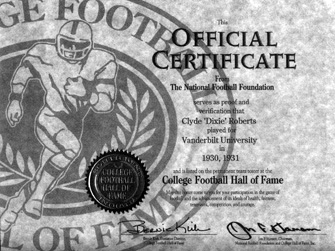 Vanderbilt finished that year at 5-4. The Commodores were at this time members of the Southern Conference. The Southeastern Conference would be established in 1933. Roberts never played a game in the SEC as all his college days were before its existence.
Roberts also played on defense as a safety. He was known for an unrelenting stiff-arm and was asked if he played a rough style of football.
“Yeah, a little bit,” answered Roberts. “If they are going to come into you and try and do it to you, then I always felt that I could take care of myself.”
Roberts said that naturally the Tennessee game was the biggest game of the year for him and Vanderbilt. One of the toughest players he went against was the Vols’ All-American running back, Beattie Feathers. In three seasons of varsity play, Roberts was 0-2-1 against the Vols.
In the 1932 game, and Roberts’ senior year, the UT game resulted in a scoreless tie. The only score of the game was called back in the second half. Feathers caught a pass, but was called for stepping out of bounds at the Commodore 27-yard line. He had to be shown his footprint where he stepped on the line.
“It happened right square in front of the Vanderbilt bench and some little fellow [a UT ball boy] ran out and tried to pat it down where his foot stepped,” Roberts reminisced. “Cody reached over and picked him up and set [him] back over. The Tennessee guy was trying to cover up the footprint. The referee took the game away from us.
“In this particular game, we punted and it looked like it was going to stop a yard in front of the goal line. We rushed over and [Charles] Leyendecker and I were about to cover the ball. We were coming in on the thing; the ball came up and hit a Tennessee fellow on the back. We fell on it and that means the ball belonged to us. But, he gave that damn ball to Tennessee.
“He said that Leyendecker pushed him. There’s nothing in the rules that says you can’t push him. You can knock him on his head if you want too. Neyland was a pretty rough customer. He had a lot of power in the conference and the referees favored him.”
The game’s leading rusher was Roberts with 79 total yards besting Feathers 16 yards. Tennessee concluded their season at 9-0-1 and shared the Southern Conference championship with Auburn. The Commodores finished with a 6-1-2 record.
Roberts earned an engineering degree from Vanderbilt and later entered the insurance business. He retired in 1964. Roberts has followed Vanderbilt football since he graduated in 1933. Roberts was asked about the difference between today’s players and the players of his day.
“They are a lot bigger; there’s no question about that,” Roberts said. “They don’t have to play offense and defense too. That’s the big difference. They would wear each other out; they couldn’t take all that contact today. Another thing, the size of the football has changed since the time I picked up the first one.”
A book was published in 2001 by Womack Printing Co. of McMinnville, TN and written by Bobby Newby. The book is titled, “The Legend of Dixie.”
Traughber’s Tidbit: On December 26, 1932, Nashville saw its first professional football game at Vanderbilt’s Dudley Field in an exhibition between the Chicago Bears and the Boston Braves. The legendary George Halas coached the Bears while the Braves were the forerunners of the Washington Redskins. The Bears defeated Boston, 25-0. In the Bears backfield were the great Red Grange and Bronco Nagurski.
Tidbit Two: Thirty-three years later on August 25, 1965, the Chicago Bears returned to Dudley Field with Halas in his 46th year as team owner and 38th as head coach. This time the Bears were led by former Vanderbilt quarterback Bill Wade with rookie teammates Gale Sayers and Dick Butkus. The Bears defeated the Los Angeles Rams, 28-14.
Tidbit Three: In what could be called “Halas’ Comet” the Chicago Bears (without Halas) returned to Dudley Field another 33 years later on October 25, 1998 when the Bears faced Nashville’s newest NFL franchise the Tennessee Oilers. While the Oilers (next year renamed Titans) new football stadium was being built, the Oilers/Titans used Vanderbilt’s Dudley Field for all its home games. The Bears defeated the Oilers 23-20 in a regular season game for an all-time record of 3-0 at Vanderbilt’s Dudley Field.
If you have any comments or suggestions you can contact Bill Traughber via email WLTraughber@aol.com.