
July 6, 2015
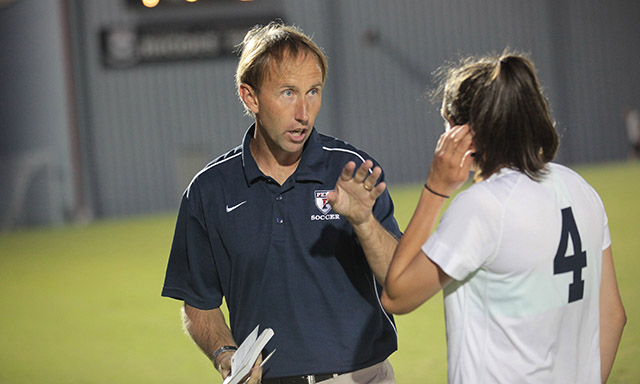
With the spring season under his belt, new Vanderbilt soccer coach Darren Ambrose is settling into his new city and preparing for his first season with the Commodores. Born in Sheffield, England, Ambrose spent the last 15 years at the University of Pennsylvania, where he coached the Quakers to three Ivy League championships and NCAA Tournaments and was the all-time winningest coach in program history. His wife, Sherry, and daughters, Madison (15) and Ainsley (11) made the move from Philadelphia and joined him in Nashville in June.
Commodore Nation: How was the transition when you left England to come over to play soccer?
Darren Ambrose: Growing up as a kid, I always wanted to come to the U.S. Back in the early 80s the vision of the U.S. was the Promised Land. All those things you hear about the U.S. outside of the U.S. I got a little bit of a fascination with it… I was a really good player in England for my age and was playing at a pretty good level. Like every kid I had aspirations to be a professional but also my academics were really crucial to me. I found, through various contacts, the opportunity to go to the U.S., go to college and play soccer. It meshed all three things that were important to me. So I jumped at the opportunity when it presented itself to come over. I’ll never forget the day I left Heathrow Airport, leaving my family for the first time. I had just turned 18. It was a moment in my life I’ll never forget for all the good reasons and all the sad reasons. It was something I wanted to do and I was really excited about the opportunity.
CN: Soccer was ingrained in you right away?
Ambrose: Soccer was something that was in the culture. It is like every kid who goes out and plays basketball here. There is a hoop everywhere. It is the same thing in England. You had a ball at every break at school. We played every sport as a kid. I think that is another thing different here now. Kids specialize at nine years old. I was still playing cricket, soccer and rugby all the way through until I was 16 years old. I played all three sports pretty much all the way through high school. Soccer was the one that was obviously my first love. But I actually gave it up for a year and just played rugby. I felt a little bit of a pressure. It was getting to the end of the tenure with Sheffield United and the decision was coming whether to try to turn professional or not. I wanted school, and I didn’t feel like it was a good fit. I kind of moved away from it for a little while—from the higher level. I played pub football on Sunday, which is really a bunch of old guys getting together. But that reignited the passion in me and I got back into it. I played for fun. We talk about it with the kids all the time—it’s got to be fun. I played for fun and really ignited it in me again.
CN: You were the Division II National Player of the Year at USC-Spartanburg and an Academic All-American in the same year. That balance of athletics and academics is very important to you and something you stress to your players?
Ambrose: I brought it up to the team in February (at the first team meeting) not to elevate myself but to show that it can be done. It requires an incredible commitment but you can’t use one as an excuse for performance in another. There are enough hours in a week to be great in all things. You can be an A student, you can focus on your studying, you can get your group work done, you can write papers. Athletically, you’re required to compete and there is a lot demanded of you. It also relates to sleep, eating right, all those things that are more and more important now. The kids that do that are the ones who are able to do both at the highest level. At the end of the day, the game is going to leave you at some point. You’re going to have what we all call a ‘real job.’ Education is something that can never be taken from you. My wife is a teacher. She has an influence on my view of that, too. There is a quote that I absolutely believe in—You will be the same person in five years as you are today except for the people you meet and the books you read. Essentially what they’re saying is surround yourself with good people and read a lot. That is the way you’ll continue to further your growth.
CN: That philosophy is why you’re here at Vanderbilt and why you spent 15 years at a prestigious institution such as Penn?
Ambrose: Exactly right. I saw the benefits of it at Penn. Like-minded people want to be around like-minded people. Those people affect each other. I just think when you’ve got people that want academics to be important in their life, and are motivated to be successful, it is good to be around people with a similar mindset. I think here is place where you can do that. You don’t have to sacrifice anything. You don’t have to be on a weaker athletic program. That goes back to what I said, If you can be great at both why not?
CN: The success you sustained at Penn (zero losing seasons in 15 years, almost 10 wins a year) you believe you can do that here at Vanderbilt?
Ambrose: Absolutely, I do. I think we can go a little further than we could at Penn with the (scholarship) restrictions in the Ivy League that we had. Again, (Vanderbilt students have) got that academic focus, they’re good students and the family supports the academic drive their students have and sees the value of it, then, yeah, we can recruit those kids here and give them the experience athletically they’re looking for. So when their four years of athletic competition is over, that they have a degree in their back pocket. It is not just the degree; it is how the degree works. It is not just the knowledge. It is the link to alumni, to the like-minded people.