
Bollig's Long Wait
by Graham HaysSidelined more than four years by injury, senior Ally Bollig’s road back is part of Vanderbilt soccer’s road forward this season
NASHVILLE, Tenn. — It didn’t look like much on the schedule, just an August exhibition game against Bowling Green. For a Vanderbilt team coming off an NCAA Tournament Sweet 16 run and eyeing similarly lofty goals this season, it was a glorified scrimmage—a chance to break preseason monotony by tackling unfamiliar faces under the gaze of real referees.
For Ally Bollig, the night before the Commodores took the field, it was why she couldn’t sleep. She knew she needed to, but she was restless. Too many thoughts raced through her mind. She reached for her phone and called her dad. Her first coach and forever mentor, she knew he would understand. Four years is a long time to wait for your next game.
“It’s almost as if I played the game in my head first—to try to calm myself down and know that I could handle it,” Bollig recalled. “I hadn’t had that feeling in so long, so I didn’t really know how to cope with it, other than to make a phone call to my dad to help me relax.”
She was hardly the first Commodore to be nervous ahead of her first fall game, exhibition or otherwise. Except she wasn’t a freshman. Or a sophomore. Or even a junior. Soon after the game against Bowling Green, she settled into her seat for the first class of her senior year.
Until she came on as a substitute against Bowling Green, Bollig hadn’t played in a fall game in more than four years. A string of knee surgeries and setbacks wiped out her final high school season and first three college seasons. Not satisfied with merely making it back, she’s now a midfield starter capable of playing 90 minutes and changing games.
She never gave up on the sport, even when isolation and frustration tested her resolve. Nor did head coach Darren Ambrose give up on her, watching someone who had played the game like a grown woman when still just a recruit grow into a leader with perspective beyond her years.
Some things—and some people—are worth the wait. Sometimes daring to grow means finding the patience to endure a very long wait.
“It’s a story that is heartwarming and full of strife and emotion and resilience defined,” Ambrose said. “In the athletic world, short of life and death, I don’t know how you find a better story of resilience—because the greatest thing you have as an athlete is your health and then your fitness. Ally’s had neither for three years. And now she starts and is a massive part of how we want to play.”
View this post on Instagram
A Life-Changing Practice
A journey of a thousand days of rehab begins with a single step. It was Oct. 1, 2019—a Thursday. Bollig is very clear about that. Her club team’s practice was nearly over, just enough time remaining for a final 11-on-11 session. Seconds later, moving the same way she moved so many times before, she felt a jolt of pain in her right knee.
The initial diagnosis was a possible strained LCL, a painful enough injury but something that might mend with time and rest. Having already seen her sister go through a torn ACL, she feared the worst. Ambrose encouraged her family to take her for a full MRI. Sure enough, the additional tests confirmed a torn ACL.
She had already verbally committed to Vanderbilt. The school was everything she wanted. It was an opportunity to compete in the SEC and pursue dreams of medical school at a prestigious university. Coming from a big town in South Carolina, big-city Nashville bustled with energy and possibilities. For all of those reasons, when she heard the results, one of the first thoughts that went through her head was how she was supposed to tell Ambrose.
What if he didn’t want to expend the roster and scholarship space on damaged goods?
Her club coach, a friend of Ambrose’s from the Vanderbilt coach’s days in South Carolina, assured her she didn’t need to worry. Sure enough, when they spoke on the phone, Ambrose told her she didn’t need to worry. Vanderbilt would be there. He told her focus on getting healthy. Little did either know all that would entail.
Global complications proved the first hurdle, with South Carolina’s high school soccer season postponed from fall 2020 to spring 2021 due to the COVID-19 pandemic. She made it onto the field for a handful of games when play resumed in the spring, her junior season, but never felt comfortable on her knee. With the unusually short turnaround between seasons, she then sat out her entire senior season at South Aiken High School that fall.
The knee was still troubling her when she arrived at Vanderbilt the following summer. She made it barely halfway through the beep test, the conditioning staple that is the bane of any player’s preseason. The first handful of practices left her in pain.
Nearly two years after the initial injury, it was readily apparent that her college career would begin with a second consecutive fall on the sideline.
"Soccer isn’t my identity, but it’s a big piece of me and a big piece of my life. And if I can do it for as long as I can, I’m going to do it."
Ally Bollig
The Most Difficult Year
Sitting out her final high school season was miserable, but at least the rhythms, routines and people in her life remained otherwise familiar. Moving to college, all of that was gone. Along with the one thing she knew best, of course. Playing the game.
She would often finish her rehab work with the team’s longtime athletic trainer Sara Melby and make it out to the practice field just as her teammates were wrapping up for the day—or even after they were done.
Looking back, Ambrose credits her for still finding a way to make her presence felt that season, for being a positive influence supporting her teammates. She appreciates the vote of confidence, but there is often a difference between what others see and what we feel.
“I just felt like I didn’t have a place and a voice because I wasn’t able to contribute in the soccer aspect of the team,” Bollig said. “You’re on a soccer team, so you would think that your contribution would be related to soccer. Now that I’ve grown and matured, I realize even just speaking up on the sideline is contribution. At the time, I just had a really hard time leaving home, adjusting and feeling like ‘Yeah, I’m part of the team, and I play for Vanderbilt soccer, but I don’t necessarily play. That was the hard thing to grapple with.”
Finding Herself
Melby is the unsung star in the story, someone Ambrose readily calls “the best in the business” and a constant resource helping Bollig navigate the long road back physically.
There was the surgery Bollig’s freshman spring to repair meniscus damage in the knee. Then, after a sophomore fall in which she participated in practices at times but was never able to stay on the field with the consistency necessary to play, she had a second ACL surgery when doctors determined the graft from her original surgery had failed. She made it back to dress for a handful of games last season, her junior year, but again never made it beyond the sideline. Another procedure awaited after last season to clean up scar tissue.
Even now, Melby remains Bollig’s secret weapon. When teammates head off to class or in search of food after practices and games, Bollig and Melby spend another 30 minutes icing, stretching and tending to the knee—just as they meet well in advance of each practice.
 The physical effort has been Herculean. It’s also only part of mending. The isolation and loss of identity Bollig described from her freshman year were exacerbated by her particular circumstances. But almost every student-athlete who comes into college sports deals with some degree of displacement. If they aren’t the superstar they have always been, who are they? It’s why Ambrose is as focused on mental as physical development and views sports psychologists as no less instrumental to growth as strength and conditioning coaches.
“Suddenly this doubt and fear that creeps in—and it’s not about their abilities, it’s about their performance and managing the emotions,” Ambrose said. “It’s an absolutely critical piece now of preparing individuals—and teams, too, for that matter. It’s another part of the game. There is the tactical, technical, physical and psychological. And the psychological is really, to me, the biggest part. The technical level is pretty consistent in college. The tactics are all things we can teach. It is really about how does a player manage herself as the pressure and stress and expectation increases. That’s a skill that, even at my age, everyone’s still learning.”
So, in addition to the physical rehab, Ambrose and Melby encouraged Bollig to work with a sports psychologist, part of the mental health resources available to Vanderbilt student-athletes. There has been inarguable progress in recent years in removing any stigma once attached to mental health in sports. But it’s still something many athletes find easier to embrace as a concept than a prescription. Bollig, for instance, grew up thinking that addressing mental health was a laudable idea—for people who needed it. Other people.
These days, she’s a convert and advocate. Other people, as it turned out, included her.
“If you’re not able to talk about your emotions freely, that’s something that can really bring you down as a person,” Bollig said. “Over time, seeing somebody to learn about positive self-talk, reassurance and that you’re not alone in your journey—even when you feel alone—taught me to not isolate myself. There were a lot a teaching moments for me, accepting things and being open to help.”
She missed weeks of high school classes after her first ACL injury, not because of the physical effects but because she couldn’t understand why the injury happened to her in the first place. She felt singled out, her world crumbling. The second ACL surgery wasn’t any more pleasant, but even though it delayed a comeback already years in the making, she approached it with a different mindset. She told herself that the world didn’t have it in for her. She had an injury. That’s all. Rehab wouldn’t be easy. When she wanted to be alone, she could be—she’s learned to cherish solitude. But she also reminded herself that she had a community around her—dozens of teammates, coaches and staff—ready to help.
Taking the Field
Ambrose was convinced Bollig was made to compete in the SEC from almost the first moment he watched her play when she was 15 years old.
“I was amazed at her technical ability and IQ for a kid of that age,” Ambrose recalled. “She was big and strong, but that wasn’t it. It was more that for a kid that size, she had such great feet. She just had such a presence about her, so calm and so clever and unruffled.”
That never went away. After her lost freshman fall, she was at least around the team most of the past two seasons, participating in practices until the knee inevitably flared up again. In those moments, 5-v-5 or 6-v-6 drills that emphasized technical skill over endurance, there were always glimpses. Wearing her bulky brace, she would pick out a pass that few other players would think to try or feel a defender’s presence and almost casually slide out of the way.
“There was always enough there to see that if we could ever get her completely healthy, there’s a player in there,” Ambrose said. “We know it. And this spring, when we started doing individuals and ramping up into team stuff, I think everyone’s head kind of turned.”
After a handful of minutes in August’s first exhibition game, she progressed to 48 minutes off the bench in the regular season opener against Austin Peay on Aug. 14. She earned her first career start against Yale on Aug. 29, the same night Vanderbilt’s volleyball team played its first home match in 45 years. Notably, she waited almost as long for her Vanderbilt debut as volleyball head coach Anders Nelson, who arrived a few months after her in 2022.
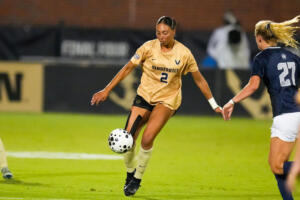
A week later, she made her first goal count. In a battle of ranked teams, her finish from a tricky angle late in the first half provided the margin in a 1-0 win against Georgetown. She had planned a goal celebration well in advance—she had four years, after all. But in the jubilation of the moment, the carefully planned Stanky Legg choreography slipped her mind.
“Everything went out the window,” Bollig said with a laugh, lauding Margo Matula and Vivian Akyirem for their roles in the play. “I can’t take any credit for it because they did the hard work and I just finally put the ball in the back of the net. Honestly, it will be a core memory for me. First televised goal, on my home field with my parents here. It was just crazy.”
View this post on Instagram
A Number to Remember
Every now and again, Ambrose will enlist a few alumni to write notes to a current member of the team who wears the same number. Last fall, almost as an aside in the course of normal conversation with her coach, Bollig lamented that she had never had a number. It floored him. Officially, she had a number, of course. She even donned the No. 2 jersey on occasion when dressing for games. But he understood what she meant. Three years into her Vanderbilt career, she was still waiting for the opportunity to make the jersey hers.
“It really hit me hard,” Ambrose said. “The weight of that statement made me realize that for three years this kid has had no hope of getting into a game, and yet here she is, a voice of reason in team meetings, a bright, outgoing, bubbly personality who’s carried God knows what emotion and disappointment and sadness and thoughts quitting and all these things.”
So, no, it wasn’t just another substitution when he told her to check in during the Bowling Green exhibition. He didn’t try to impart any tactical instructions. He just told her to enjoy the moment. It’s the same thing her dad had said the night before, when sleep wouldn’t come and she called for advice.
She hopes to return for a fifth year and play as a graduate student next fall. When friends ask her if she might even entertain thoughts of trying to play professionally, she shrugs. As long as her body holds up, why not try?
When she waited this long, why not enjoy it as long as she can?
“I don’t want to regret not trying when I knew I could,” Bollig said. “Even though there might be some pain day to day, and even though I’ve cried so many tears over not being able to play and being hurt, nothing outweighs the fact that I get to play the sport that some people never get to play. It’s a privilege to play college ball. Not many people get to play in college. It’s not something I want to take for granted. Soccer isn’t my identity, but it’s a big piece of me and a big piece of my life. And if I can do it for as long as I can, I’m going to do it.
“If I were to tear my ACL again tomorrow, I would do it all over again.”