

Better Than They Found It
by Graham HaysBy believing in the mission from the beginning, the Commodores from Clark Lea’s first recruiting class helped Vanderbilt become a college football destination
NASHVILLE, Tenn. — Langston Patterson understood Saturdays growing up. His uncle and grandfather played big-time college football. As a high schooler at Nashville’s Christ Presbyterian Academy, he watched his older brother play for Clemson. In a family with its share of Alabama fans, the Crimson Tide were never far from the television on weekends.
He knew enough to know that Sundays in the Vanderbilt football offices in 2021 felt like a long way from Saturdays. Clark Lea’s first Vanderbilt commit, he visited the Commodores’ offices most Sundays that fall. He watched the previous day’s film with then-linebackers coach John Egorugwu, now a New York Giants assistant. Then Patterson made his way to Lea’s office, and the two assessed what had worked and, more often, what hadn’t. Not enough people believe, he remembers Lea lamenting. There isn’t enough will to win.
“There wasn’t a lot of tangible hope that season,” Lea recalled recently of a 2-10 campaign that began with the celebrated alumnus hearing boos after an opening loss against an FCS opponent. “It was as hard of a year as I’ve ever experienced.”
It would get worse before it got better.
Yet sitting in those film sessions, Patterson believed it would get better. Not because of anything he saw on the screen but rather because he believed in what Lea thought was possible. That’s really all the coach had to offer his first recruiting class. A vision of what was possible—a program capable of contending in the best conference in the country and turning Nashville’s energy loose on college football.
For the remaining members of that first class, that has been enough. That’s the constant.
Saturday, No. 16 Vanderbilt travels to No. 10 Alabama for arguably one of its biggest regular season games in living memory. And in SEC football, being able to argue about these things is the point. It’s a seat at the table. On the heels of its first 5-0 start since 2008, Vanderbilt will play a game between top-16 opponents for the first time since 1956.
View this post on Instagram
Vanderbilt’s success is a story about embracing change. At a school that touts the benefits of radical collaboration, radical change reshaped the Commodores after a frustrating, two-steps-backward 2-10 record in 2023. There were new faces, from a certain talismanic quarterback to assistant coaches and advisors with new ideas and experiences. There were new roles, like Lea shedding a CEO’s distance to take over defensive play-calling duties. All to tackle the challenges of a new era in college football and make good on the university’s newly redoubled commitment to athletics, evident in the construction that remade the South’s first football-specific stadium into a home for the 21st century.
Change brought progress, a famous win against top-ranked Alabama and the program’s first bowl victory since 2013. And progress spurred more change, transfers and freshmen eager to write this season’s story in front of FirstBank Stadium full houses. But change without a foundation is no more likely to succeed than building a skyscraper on wet sand. In Vanderbilt’s case, change happened on the shoulders of 14 men who believed in what was possible, stayed when others left and are part of why Vanderbilt is now the place to be.
“I stayed because I love Vanderbilt,” Patterson said. “I didn’t come here to have everything handed to me. I knew it was going to be hard. I knew it had to be earned. But I wanted to be a catalyst for change. When everyone was jumping ship, I had other opportunities where people were reaching out to me. But I wanted to do it here. I wanted to do it with Coach Lea and [co-defensive coordinator and linebackers coach Nick] Lezynski.
“It can be done here. And I wanted to be the reason why it does happen here.”
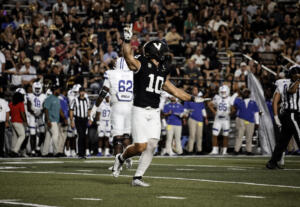
Langston Patterson has 91 tackles since the start of the 2024 season (Isaac Leedham/Vanderbilt).
Choosing to Believe
Patterson had family experience to call on when it came to separating fact from fiction, or at least sincerity from sales pitch, in the recruiting process. His decision came down to three criteria: culture, coach and education. The last was a given at Vanderbilt. In his mind, so was the second once Lea took the job. Lea had worked hard to convince the prep star to come to Notre Dame when the former was a Fighting Irish assistant coach. And when it came right down to it, Patterson figured the best way to ensure a positive environment was to follow someone he believed was committed heart and soul to building one at Vanderbilt.
Lea’s greatest asset at that time was his own unwavering, and initially perhaps even naïve, confidence that he could unlock his alma mater’s potential. Sincerity has a way of cutting through the noise and resonating across differences.
Yilanan Ouattara’s path couldn’t have been more different than Patterson’s. He didn’t have a previous relationship with Lea—didn’t speak with him face to face until his official visit. He didn’t know much about Vanderbilt’s recent struggles, let alone its distant glory days. And he definitely wasn’t local. He just knew that football called to him like no other sport ever had. Growing up in Germany, he was already 16 years old when a friend told him he was too big not to at least give the sport a try. He loved the physicality and camaraderie. He loved that the more he invested in the sport, the more rapid his improvement. He wanted to see how far he could go in the game, and he knew the first stop had to be the United States.
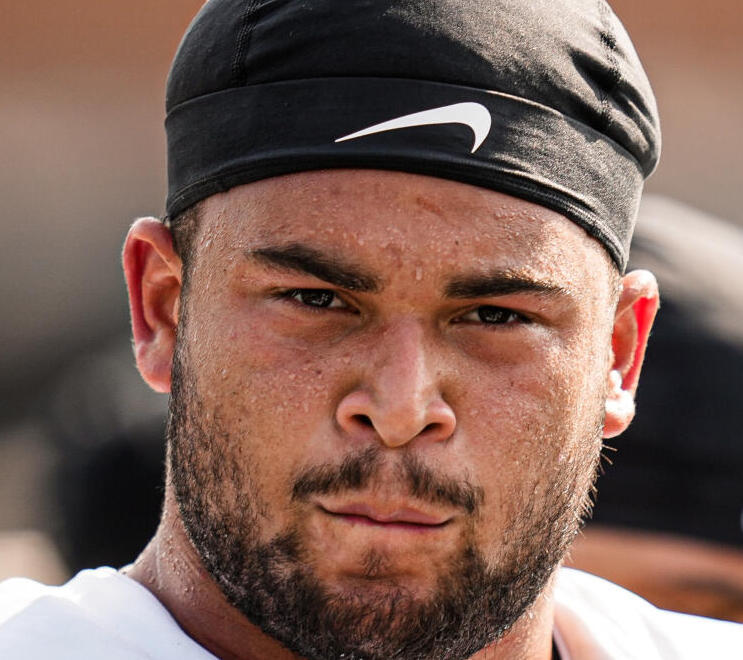
"You don’t want the people coming after you to have to go through the same struggles you went through. Paying your dues like that is not a rite of passage, in that sense."
Vanderbilt DL Yilanan Ouattara
Introduced to Vanderbilt by an international recruiting service, he listened to Lea describe his vision for a program built to compete and win while focused on holistic development.
“You could tell how genuine he was about building a program the right way,” Ouattara said. “It was a personal thing for him—I knew that this wasn’t going to be a two-year job for him to get to the next place or anything like that. You could tell that he wants to be here and he wants to stay here.”
Lea convinced recruits he didn’t just want to build a successful program. He wanted to build a successful program at Vanderbilt. And it’s a lot easier to listen to someone talking about growth when you believe they’re going to be around for more than a few harvests.
“The thing I appreciated about him is he kept it real,” Ouattara continued. “He told me that I had a lot of work ahead and it wasn’t going to be easy. But he also showed me how Vanderbilt built the support system that I needed to grow as a player and a person.”
Growing up in Tallahassee, Bryce Cowan was surrounded by big-time college football. In that world, he never paid much attention to Vanderbilt. His initial interest was pragmatic; the Commodores offered him the best scholarship and an opportunity to play in the mighty SEC, so he listened. But the more he heard from Lea, whether calling on late athletic director David Williams II’s memorable phrase about the long-term value of a Vanderbilt education or dialing into why Cowan had the frame and skills to grow from barely 200 pounds into an SEC linebacker, the more he believed. Believed enough, in fact, to accept redshirting his first season to put on weight and get stronger.
“I trusted Coach Lea a lot coming in,” Cowan said. “I remember when he came to visit my school and we talked—just talking about the 40-year plan instead of just the four-year plan. Just building that relationship with him was important, knowing that it’s bigger than football and all of that. That’s what I really loved about his vision. After hearing that, I was ready to get to work.”
False Dawn and a Reckoning
After the rough debut, Vanderbilt appeared to take a significant step forward as the new class arrived on campus in 2022. The Commodores scored 63 points in an opening rout at Hawai’i and registered back-to-back SEC victories in November, including a win against Florida. They came within a win—a three-point loss at Missouri perhaps all that stood in the way—of bowl eligibility. Optimism abounded as the 2023 season approached.
Then it all fell apart.
Vanderbilt went 2-10 in 2023, including 10 consecutive losses to end the season. Ouattara said it felt more like 0-12, each setback made worse because he entered the season so confident that they were ready to take the next step with what appeared like a more talented roster.
“We trained hard in the winter, we trained hard in the spring, we did good work in the summer,” Patterson agreed. “But it doesn’t work when your leaders and your best players give up, which is what you saw happening—when they’re the ones who were like, ‘I can’t wait for this season to be over.’ And then you have the younger guys looking up to them being like, ‘Dang, I guess I can’t wait either if our leader is telling us that we can’t wait for this season to be over.’ And then you go out there and have a bad practice. That’s how it was day after day.”
College football is a challenging grind at the best of times, all the more in the SEC. Vanderbilt is no leisurely stroll, either, the Monday-to-Friday academic challenge hardly a respite from the on-field exams that arrive each Saturday. Now, try doing it while hearing many on the outside whispering about the ‘same old Vanderbilt’ and too many on the inside looking to assign blame and get out of town.
“I mean, it gets hard—I can’t even lie, it gets hard,” Cowan said. “But you just had to trust Coach Lea. And I feel like a lot of guys didn’t trust him as much. But for me, as I got older, I gained more and more trust in him, just like he gained more and more trust in me. That’s how I was able to stay level-headed and keep believing in our mission and keep going with what we got going.”
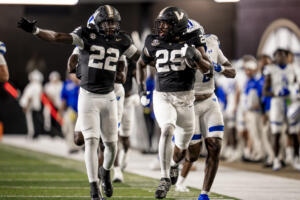
Bryce Cowan (No. 22) escorts Miles Capers after a blocked kick in a 70-21 win against Georgia State on Sept. 20 (Truman McDaniel/Vanderbilt).
Why They Stayed
In the era of the transfer portal, for better or worse, it has never been easier to for student-athletes to leave one situation for another. As 2023 turned to 2024, and the NIL economy boomed, there had also never been greater incentives to look elsewhere. Whatever each person’s individual motivation, barely half of the 33 student-athletes who arrived alongside Cowan, Ouattara and Patterson in 2022 remained by the start of the 2024 season. Staying became less a default setting than a conscious decision. Even if you didn’t want to leave, you almost had to ask yourself if you were the misguided one for sticking it out.
“I always believed in Coach Lea,” Ouattara said. “I felt like the mission was always right. We just didn’t always have the right people to fulfill that mission, if that makes sense.”
They chose to stay because they still believed. They still believed because, whatever the wider world saw, they saw the growth that Lea had told them was possible.
When Ouattara first took up the game in Germany, the plays and formations he saw diagrammed made about as much sense to him as the score of a Beethoven symphony. Less than five years later, as a Vanderbilt freshman, he was on the field making tackles against No. 1 Georgia. Still, he never kidded himself about how much he needed to learn. It’s why he hopes there’s no surviving footage of his first few practices that fall.
But he did learn. Moving from defensive end in his brief youth career to defensive tackle in the SEC, he put on weight and got stronger. He studied the schematics of football, as he put it, how to read a play based on the blocking. A regular on the SEC Academic Honor Roll, he felt his football IQ grow on an almost daily basis.
From spot duty as a freshman, he appeared in nine games and started six in 2023. That season was miserable. He doesn’t even try to sugarcoat it. But that doesn’t mean it was useless. Not for the team. Not for him.
Cowan could have had even more reason to feel antsy by the end of 2023. After not playing at all in 2022, he was only starting to see the field on something resembling a regular basis by the end of the following season, making 11 of his 15 tackles in the final three games. Recruiting Cowan wasn’t about a quick fix, always tempting for a new coach looking to make an early splash. And at a time in the sport when it can feel like a risk to invest in development, when the year-to-year trumps the long run, that investment proved to be a two-way street.
 “Coach Lea believed in me, and I believed in him,” Cowan said. “I feel like, as far as our culture, relatedness is our edge. We’ve got to stick together if we want to do the big things we plan on doing. And we’ve just got to stay grounded. As a team, we’ve got to become harder to break. Every day, we’ve got to get better and better so we can keep this mission going on.”
Lea tried to hang on to most of those who ultimately left. By his own admission, that was to some extent an exercise in ego and wounded pride. The vision he had shared with them as recruits wasn’t any different than what he shared with those who stayed. It hurt to see that, for some, that was no longer enough. But if the alternative was changing what he believed was possible at Vanderbilt, there really wasn’t any choice at all.
“I realized quickly that this this was the best thing that could have possibly happened because people that didn’t connect with the vision any longer, that were holding it back in certain specific ways, were no longer here to do that,” Lea said. “In their place we were able to find people that not only saw the goodness in this program and in what we were creating but also the potential that we had on the field. They were excited about the challenge of getting over the hump in the SEC and appreciated Vanderbilt for all the things that it is.”
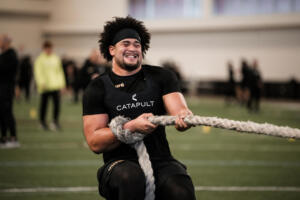
Yilanan Ouattara during offseason workouts ahead of the 2025 season (Brendan Ross/Vanderbilt).
Fight for Each Other
After four years in Nashville, there is scarcely a trace of a German accent in Ouattara’s words. But when it comes to discussing how he and his teammates have successfully blended old and new the past two years, he can’t help but fall back on a German idiom.
Eine Hand wäscht die andere.
One hand washes the other. No one can do it alone. Expressed another way, it’s at the heart of one of the team’s core principles: fight for each other, not with each other.
It is human to be territorial. You don’t need to compete at an SEC level to understand the impulse. It’s the same as in something as insignificant as when your favorite local musical act goes big time and its fan base explodes. You were there from the beginning, before it was cool. Surely, that ought to count for something.
That was Vanderbilt’s challenge in 2024. Not in relation to the latest country music act to make it big in Nashville but how to blend those who remained from the 2021-23 teams with an influx of transfers and freshmen, quarterback Diego Pavia only the highest profile of the bunch. Many of the new faces had achieved success elsewhere—bowl appearances, all-conference honors. They could have felt they were due deference, that they were riding to the rescue.
“If you’re coming from a different program, you may feel entitled to other things that you did at that school,” Cowan said of the dynamic. “But here it’s like, we are on the same page, dawg. So we got to get everybody on that page so we can succeed at what we’re trying to get to. And that’s winning.”
It cut both ways. The returning Commodores could have felt longevity entitled them to take the lead. It was their program. Ouattara could have seen transfers like Zaylin Wood and Khordae Sydnor as threats, if not for playing time than at least for places of prominence on the defensive line. Instead, Wood, a former team captain at Middle Tennessee who started three games for the Commodores in 2024 before an injury, and Purdue transfer Sydnor, who started 11 games for the Dores last season, helped bring the best out of Ouattara. They made practice competition fiercer, sharper. They helped him learn his craft. He welcomed them as mentors, and they treated him with the same respect.
“The thing I’ve challenged every single transfer we’ve taken is please get to know our program as it is, then help us move it forward,” Lea said. “What your experience has been in college football, don’t force that perspective on this program. We say relatedness is our edge. We want to care for one another. This isn’t manipulative. This isn’t transactional. It’s about how we create something that doesn’t exist anywhere else.”
That doesn’t mean there wasn’t friction or that competition didn’t get heated, especially as people got to know each other that first spring. There was, and it did. For Lea, friction is part of growth. He uses the analogy of sharpening an axe. Apply too much pressure holding the blade to the grinder and the axe dulls. Yet without some friction it can’t grow sharp.
In the months that followed, the Commodores made believers out of many, from the memorable wins a season ago to record-setting performances and surging fortunes in the national polls so far this season. That happened on the field—with the first class playing its role. That was Cole Spence starting 11 games and catching a touchdown in the Birmingham Bowl win. That was Nick Rinaldi making 10 tackles in the bowl win against Georgia Tech and coming out of the gates with five tackles behind the line of scrimmage in the first four games this season. That was Linus Zunk getting 1.5 sacks in last year’s tone-setting win against Virginia Tech and Cowan forcing his first fumble in this season’s road win at South Carolina. That was Patterson earning preseason fourth-team All-SEC honors and Ouattara joining him as a captain.
View this post on Instagram
But before any of that could happen, this season’s seniors sowed the seeds for success by welcoming those who could make the program sharper. Rather than simply believing in what was possible, they took the lead in making it reality, relationship by relationship, each person accountable to the next.
An early enrollee last winter, defensive back Carson Lawrence was days removed from sitting in high school classrooms when he took the field for his first practice with the Commodores—as they prepared for the Birmingham Bowl. A highly-touted recruit who stuck with his early verbal commitment to the program despite heavy interest from SEC rivals, among others, he nonetheless felt more like a high schooler than a college athlete, looking around that practice field at teammates who had years of strength and conditioning training on him.
But as he settled in at Vanderbilt after the bowl victory, teammates showed him the way. Working out together, eating meals together, going to class together, fifth-year safety and captain Marlen Sewell and sophomore CJ Heard took lead roles in mentoring someone who otherwise could have been getting ready for events like his senior prom. They were preparing him not just for spring practices or his first season but to take over for them.
It’s what Patterson does when he pulls freshman Austin Howard along to extra workouts. It’s what Cowan does in taking fellow Tallahassee product Josiah Broxton under his wing.
“It’s understanding that none of us can do it by ourselves,” Ouattara said. “You don’t want the people coming after you to have to go through the same struggles you went through. Paying your dues like that is not a rite of passage, in that sense. We’re trying to build a great thing, and their commitment to that is all they need to be part of the mission.”
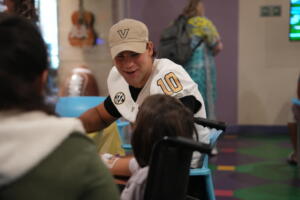
Patterson during a recent visit to the Monroe Carell Jr. Children’s Hospital at Vanderbilt (Brendan Ross/Vanderbilt).
A Class to Remember
Speaking at a recent event to celebrate completion of the Vandy United campaign’s south end zone project, a facility spanning 130,000 square feet and offering amenities from premium seating to the new football locker room, Lea recalled the moment when student-athletes entered the new locker room for the first time on the eve of this season’s opener against Charleston Southern. There were a few misty eyes among the old-timers, including not just the seniors but also fifth-year lifers like Miles Capes, Charlie Clark, Sewell, and Kevo Wesley, who have truly lived the whole experience.
As Ouattara put it, the previous locker room was just, well, a room. With lockers. The new space was more. Creature comforts aside, it signaled that the community whose donations brought it to life believed in what Vanderbilt football can achieve.
In the darkest days, they hadn’t been sure anyone believed. Maybe they even had to remind themselves why they did.
“If you weren’t around for 2021 and 2022 and 2023, you don’t actually know the pain and sacrifice and suffering that’s happened here,” Lea said. “Those guys who were here for that, they know perfectly what we’ve endured to get to this point. And inevitably, they will fight a little longer and a little harder to never have to go back.”
As they will tell you, the only way to do that is by always going forward. Lea says he wants to win a national championship. Maybe these seniors won’t be here for that (but don’t tell them that). Maybe no one on the current roster will be, if it ever comes to pass. But none of those involved believe they’ve realized the vision yet. Not even close. They’ve just taken the first steps toward what is possible at Vanderbilt.
And in doing so, they’ve given all who follow a blueprint. Leave it better than you found it.
“That nucleus, that group that we retained has been such an important part of success we found,” Lea said. “And those guys, once their time is done here, it’ll be their legacy that kind of carries us into sustained success.”