
Oct. 23, 2007
Subscribe to Commodore Nation magazine – click here
By Will Matthews
 |
|
Nick Zeppos still remembers as if they were yesterday the times during his childhood when he and his two older brothers would spend endless summer hours at the old County Stadium in his native Milwaukee watching his beloved Braves play.
For a kid growing up in one of America’s most enduring sports towns, there was nothing more exciting than the opportunity to watch the iconic Hank Aaron carve out his place in history as baseball’s greatest home run hitter of all time.
“I was an incredible baseball fan.” Zeppos said. “My brothers and I, we’d go to Braves games all the time. I must have gone to hundreds of those games. Rain or shine we were at the ballpark.”
The Braves organization jilted Milwaukee by relocating to Atlanta in 1965, but by that time a love not only of baseball but of all things athletic had long been ingrained in Zeppos’ psyche.
It is a love that Zeppos, Vanderbilt’s new interim chancellor, says has been nurtured and expanded during his 20-year career at the university.
“We had overlapping seasons in Milwaukee, but if we didn’t have multiple sporting events in a day growing up, then it wasn’t a day growing up,” said Zeppos, who earned his B.A. and law degrees from the University of Wisconsin. “I always have loved sports. I just very much enjoy athletics and athletic competition. To be a part of that at Vanderbilt, one of the greatest universities that has had so much success in athletics, so many great kids, great coaches and which competes in the Southeastern Conference, it is like a dream come true.”
When Zeppos – who came to Vanderbilt in 1987 as a professor of law and has subsequently served as associate dean of the Law School and, for the last six years, as provost and chief academic officer – rose to succeed former Chancellor Gordon Gee who left the post after seven years in July, there was some concern over what would become of the university’s athletics department under the stewardship of a man who largely had been known as the keeper of the school’s academic standards.
But in fact Zeppos was a key co-orchestrator of the once controversial move to fold Vanderbilt’s athletics department under the auspices of student life – a move that has yielded unprecedented competitive success for many of the university’s sports programs.
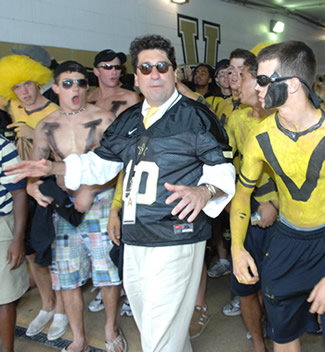
And, like Gee, Zeppos sees no reason why success in the classroom cannot happen in concert with success on the playing field. An unabashed sports fan, Zeppos said he relishes the fact that Vanderbilt athletics now is an important part of his new role as interim chancellor and is quick to reassure anyone and everyone that it is only onward and upward from here for Commodore sports.
“I’m going to have to budget my time very carefully because I would probably spend 90 percent of my time with the teams if I could,” Zeppos said. “I’m excited about being able to have a hand in the continued success of our athletic program.”
It will be a role that is not altogether unfamiliar to the 53-year-old Zeppos.
In his role as provost and vice chancellor for academic affairs, Zeppos sad he had a direct hand in recruiting many of the athletes that have matriculated at Vanderbilt in recent years.
“One thing I considered the ultimate compliment is when a coach would call me and say, `I’ve got a couple of recruits here. Could you meet with them?'” Zeppos said. “So I have always tried to stay involved and supportive in so many different ways, from recruiting to admissions to academics. So while my involvement has not been as visible as it certainly is going to be, it was a significant and very exciting and enjoyable part of my job. Nothing made me happier than to be able to hear from Kevin [Stallings] or Bobby [Johnson] that we got a kid we had been after.”
Zeppos said he has been as excited as anyone to witness the kind of national success that Vanderbilt sports teams have enjoyed in recent years, and that in many ways one of his primary roles as the interim chancellor will be to work hard to mitigate the impact that change at the top of Vanderbilt’s administration will have on the athletic program.
“I don’t do the operations, I don’t call the plays, I don’t throw the passes,” Zeppos said. “I see my job as simply trying to do whatever I can do to support all of the talented people who do those things. What can I do for them? What can I do for them to help them realize their dreams? I want our coaches and student-athletes to understand that this change doesn’t have to have a negative impact. I view myself as working with them. They are not working for me. If anything, my role is to support them and work for them.”
Vanderbilt’s recent athletic success has enabled the university to make increasing strides toward garnering significant support from within the greater Nashville and Midstate areas, something else Zeppos hopes will continue under his watch.
“I think that Vanderbilt’s success in athletics is a great source of pride to this neighborhood, this city and this region,” Zeppos said. “I go out to those baseball games, and it is really something to go to, to see a family out there enjoying a ballgame. That’s really heartening to know that we are touching people in the community. I’m proud to be able to welcome sons and daughters and fathers and mothers and grandparents to an athletic event whether they went to Vanderbilt or not. It is great for me to hear people say things like, `I saw Jay Cutler play in the NFL last week and I am so proud’ or `What a great player David Price is.’ And these aren’t people from the class of ’58, ’68 or ’78. They are people who live in Nashville, and that’s great.”
Zeppos said he understands why there might be some unease over the ramifications of the departure of Gee, who was widely seen as a fervent cheerleader for Vanderbilt athletics and the creator of the new model.
But Zeppos also is quick to point out that the vision for Vanderbilt sports that was developed at the turn of the century was created by a cadre of university administrators – almost all of whom remain in place and who maintain their commitment to seeing the vision come to full fruition.
“It was a team approach that did that,” Zeppos said. “Gordon talked to the management team, and we decided this was the right way to go. But it has been the leadership of all the vice chancellors, the deans, the coaches, the staff, the assistant coaches that has really built the incredible momentum coming off a fairly controversial decision that many people thought was hair-brained, frankly. If it ain’t broke, I’m not going to tamper with it.”
Indeed, the only substantive change that Zeppos anticipates will be positive ones: “more ticket sales, more wins and more championships from the smartest, best athletes in the country. I’m getting ready for our bowl game. And I’m expecting that bowl game to be in January, not December.”