
Dec. 27, 2006
CHC- Y.M.C.A. Ramblers (pdf) | CHC Archive
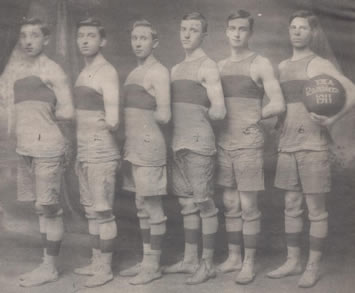
During the early era of Vanderbilt basketball, teams in the Nashville were scarce. Therefore a shorten schedule was derived until traveling to an opponents city became natural. One of Vanderbilt’s fierce rivals was the Nashville Y.M.C.A. athletic team.
 |
|
Y.M.C.A. Ramblers |
The Young Men’s Christian Association, founded in London in June 1844, was organized in Nashville in 1855. The YMCA constitution was limited to male members under the age of 40 who were active in their churches. The initiation fee was $2 with dues of 10 cents a week. The organization was formed to expand in six days what the church does on the seventh day.
The origin of many sports is inaccurate, false and lost in time. Who knows if Abner Doubleday invented baseball? There is overwhelming evidence that Doubleday did not have anything to do with originating baseball.
However, basketball cannot be placed in this category. Its birth is accurate and documented. The place was Springfield, Mass., in the fall of 1891 by Dr. James Naismith.
Naismith was enrolled in the International Young Men’s Christian Association Training School (later Springfield College) in Springfield. The school was a base for training physical education instructors and general secretaries the YMCA’s within the United States.
The participants were required to enter a physical education program, which included an hour of daily physical activity. Baseball and football were fine as outdoor activities in the warmer weather. However, the cold winter months forced the students indoors. The indoor program consisted of marching and calisthenics. The students complained, and Naismith was assigned to instruct this class and attempt to please the incorrigible students.
Naismith attempted to convert the outdoor sports into an indoor sport. Rugby was not practical with tackling on the gym floor, and soccer was ruled out due to the confined quarters and broken windows resulting from hard shots. The players occasional hit each other with sticks when lacrosse was tried indoors.
He decided to invent a new game involving running and a ball. Naismith envisioned throwing a ball into a box hanging from the gym’s balcony. The height of the balcony was 10 feet above the floor and the janitor substituted peach baskets for the unavailable boxes. A soccer ball was used for the game.
The class consisted of 18 members dividing the class into two nine-member teams. Later Naismith instilled his original 13 rules and the game began to spread as the members introduced the game in their hometowns. The new game of basket ball became the primary winter sport throughout the other YMCAs in the United States.
Eventually, the sport spread into the South and Nashville. Vanderbilt played the game as a winter sport on an intramural level and formed a team to represent the school in December 1900. High schools would compete against each other and colleges. The limited number of schools playing in Nashville forced the teams to travel in other cities for games.
The YMCA in Nashville formed a team during this era and became known as the Ramblers. Throughout the years, after playing for the Commodores, some players became members of the Ramblers. In the latter years, the Ramblers played other YMCA teams in other cities. As the YMCA and Nashville grew, other associations were born each with basketball teams. In certain years some of these were in East Nashville (the Orientals), West Nashville (the Pine Knots of the West), South Nashville (the Unions), Central Nashville (the Hubs).
The Ramblers were reorganized in 1907, playing their games at the Hippodrome on West End Ave. (present site of the Holiday Inn at Vanderbilt) and a nearby barn. It was while playing in the barn in 1907 that Henry “Monk” Sharp became the manager of the Ramblers. Sharp was also the team captain for 22 years until the team disbanded in 1930. He transformed the team into a city power throughout these years.
Competing with Vanderbilt, Nashville athletic clubs and area YMCA teams, the Ramblers won several city basketball championships in Nashville. Tournaments were not played, but if Vanderbilt and the Ramblers split during the season, a third game would be added to determine the champions. Or if the Nashville Athletic Club held the best head-to-head record within the city, they vied for the city championship.
However, controversies did happen. Such was the case in 1913, when Sharp was a student at Vanderbilt and became a player on both teams. In February of that year with the city championship on the line, The Nashville Tennessean cancelled the event.
Basketball fans in this city will be disappointed to learn that the scheduled game between Vanderbilt and the Y.M.C.A. Ramblers, which was to have been played Friday night, and upon which hung the championship of the city, has been called off.
Captain Oscar Nelson of the Commodores, announced last night that the date would not be filled. The reason for the split-up is that two of the Commodore players, Sharp and Hutchison, had signified their intention of playing with the Ramblers, with which team they have played for three seasons. Without these two the Vanderbilt five would have been badly crippled, since it would have been necessary to supply their places with substitutes, and therefore, they have decided to call the game off.
It was understood at the time the game was scheduled, according to Y.M.C.A. officials, that Sharp and Hutchison were to play with the Ramblers, and the feeling at the association is that Vanderbilt has not treated the Y.M.C.A. right in the matter. When asked the reason for Vanderbilt’s action, Captain Nelson said last night that as a college team, they would not play against two of their own players.
Cooler heads prevailed and a compromise was negotiated. Both teams decided it was best for neither Sharp nor Hutchison to play for either team. Vanderbilt was the largest institution in the city for learning, but the athletic clubs and the YMCA clubs were at an advantage, since their roster consisted of older and more experienced players.
Vanderbilt was more concerned with scheduling other southern colleges that were prominent in basketball. The Tennessean reported the widely anticipated 1913 game.
The Y.M.C.A. Ramblers are now city basketball champions. Before the largest crowd that has witnessed a game in Nashville in several seasons, the crack five of the local association defeated the Commodores last night in the Y.M.C.A. gymnasium by the score of 43-38. Although cleanly played, the game was one of the most bitterly contested seen in this city since the days of the old N.A.C., and kept the spectators on their feet during the majority of the forty minutes of play.
Both teams went into the game undefeated by a five in this city. Each also opened the game with substitutes in the line-up, as a result of the squabble over Sharp and Hutchison, who are members of both teams. It was at last decided that neither of these men should play, although Hutchison was allowed to go in at guard for the Commodores in the first half, when they ran out of available subs. Sharp, however, remained on the sidelines.
One newspaper article reported that the secretaries of the YMCA would play a game against a collection of players from three Nashville newspapers. Also reported was the rumor that the results of this contest for fun would not be reported in the newspapers if the YMCA won.
Another YMCA controversy involving Vanderbilt occurred in February 1920. The Nashville Banner broke the story with this headline and story: Meet Mr. T. Zerfoss, Ex-Commodore, Now Rambler Star.
Sad tidings await the future foes of the Ramblers.
The Memphis “Y” is in mourning.
The Chicago Athletic Club sheds buckets of tears.
And Vandy is silent.
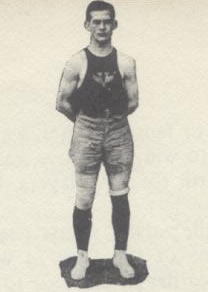
Tommy Zerfoss
Tommy Zerfoss, peerless forward, was chased from the ranks of the Gold and Black by the cruel athletic bosses at Vandy, but they can’t keep Tommy down. He’s a Rambler now.
Announcement has been made by “Monk” Sharp, captain of the Rambler crew, that the speedy Tommy will wear the colors of the crack “Y” five from now on. Banned from the varsity five of the university on the account of the four-year rule, Zerfoss is ineligible to play against college teams in the future while wearing the Gold and Black of his alma mater, and as long as the Ramblers can’t have him for a foe they grabbed him for a friend.
In some circles it is being whispered that Mr. Sharp and his henchmen had much rather be friendly with Tommy than to be enemies. Zerfoss is without doubt one of the crack basket performers of the country today. He could hold his own on a national basketball team with any other forward in America, and his friends, on foreign fields as well as at home, are numbered by the thousands.
Followers of the rough and tumble basket game who thought they had seen their last of the great Tommy in a gym suit have another guess coming.
Zerfoss was a Vanderbilt medical student, but played one season at Kentucky before transferring to the Commodores. When this was discovered, the university near the end of the season dismissed him. He was a prominent player on the Commodore football team and later became a head coach at Peabody Demonstration School on the prep level.
Next week read about Vanderbilt basketball coach Bob Polk, the father of modern Commodore basketball.
Traughber’s Tidbit: Tom Hagan was the last Vanderbilt player to score 40-plus points in a game when he scored 44 in 1969 versus Mississippi State. That performance remains a Commodore scoring record today. Bo Wyenandt scored 42 points against Alabama in 1967.
If you have any comments or suggestions you can contact Bill Traughber via e-mail WLTraughber@aol.com.