
Oct. 3, 2012
Subscribe to the Commodore Nation | September issue
“African wild dogs hunt in formidable, cooperative packs of 6 to 20 (or more) animals…. Packs hunt antelopes and will also tackle much larger prey, such as wildebeests….”
— NationalGeographic.com
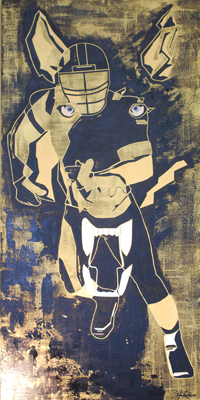 |
| painting by Haley Rossow |
The lights go dark in a meeting room inside the McGugin Center, and there is silence. Soon the screen flickers to life. A camera quickly pans across a dusty landscape, and the hunt is on.
Through miles of open plains, the predators pursue their prey relentlessly. Eventually, the quarry succumbs to the pack, and a loud roar erupts from the assembled group of men.
Thus begins a meeting for football coach Sean Spencer and his group of defensive linemen. Known as the “Wild Dogs,” the unit has taken on the pack mentality of the famed hunters of sub-Saharan Africa. Spencer sometimes screens National Geographic footage during his position meetings.
“We’ll show it to them, and they’ll sit in there and they’ll be all fired up about it,” Spencer said. “With any group, you need them to buy into a psychology. We have that. In practice, when they’re wilted and they’re tired, I tell them, `I gotta see those dogs come out.’ And they start barking. It has nothing to do with being a Commodore, but everything to do with the way I want them to practice as a team and compete as a team.”
That team approach values the whole over the individual, and Spencer’s group embraces collective success over personal accolades. But everyone gets a chance to produce.
“(The wild dogs) attack in groups, which I try to get my guys to understand: this is how we’ve got to attack,” Spencer said. “We rotate nine or 10 guys into the game, so everyone’s gonna get their shot of getting to the quarterback and making plays.”
Defensive coordinator Bob Shoop calls Spencer’s rotation of players “as sophisticated as anyone I’ve ever been around.”
The result is two-fold: the unit stays fresh for a full 60 minutes, wearing down its opposing group, and the individual members feel a sense of accomplishment regardless of which players happen to be on the field for a given play.
“You go in for four or five plays, give everything you’ve got, then you’re off for four or five more,” senior end Walker May said. “Once you get that rotation going, you know you’re going to be fresh. And if you wear down the other guy enough, you’re going to win.”
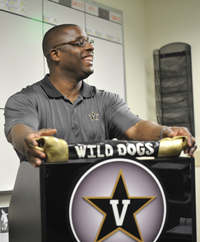 “I believe that our defense is based on us having interchangeable parts,” senior end Johnell Thomas said. “If I need a break, we’ve worked together long enough to trust that the person behind me is just as good, and we’re all working together toward the one common goal.”
So when you come to the sideline and your replacement gets to the quarterback on the next snap?
“It’s the greatest feeling,” May said. “Because that’s my brother, and he’s made a sack, and that’s the goal. That’s what we want.”
“In some places, they’d look at that and say, `I should have made that play. That could’ve been mine.'” tackle Rob Lohr added. “But with our team, you’re always behind your guy. If he makes a big play, it looks good on all of you and you can celebrate it together.”
Spencer’s team-first mentality helped the line anchor a Commodore defense that was ranked 18th in the nation in total defense last year. The group graduated veteran T.J. Greenstone at tackle and NFL Draft pick Tim Fugger at end, but Spencer is confident that younger players who logged valuable time last season are poised to step into even bigger roles.
“No one rises to low expectations,” Spencer said. “And my expectation for that group is that we’re even better than we were last year.”
Even with the undeniable strides the unit made on the field, Spencer is proudest about the way the group has adopted his family mindset. He remembers a closed-door meeting with a defensive end that was being replaced on the first-team unit.
“When you call a guy in that’s a starter, and you say, `This guy’s outplaying you. I’m gonna play you, but I think he deserves to start.’ And the guy just gets up and says, `No problem. We work as a unit. I’m fine.’ That’s when you know you did something special in that room. It’s selfless, but you also know that guy is going to compete and try to earn that starting spot again.”