
Feb. 19, 2018
By Zac Ellis
VUCommodores.com
NASHVILLE, Tenn. – Candice Storey Lee has spent her entire professional career at Vanderbilt, earning three degrees from the university including a doctorate in higher education administration in 2012. Currently, Lee serves as Vanderbilt’s Deputy Athletics Director and Associate Vice Chancellor for University Affairs, the most recent in a host of roles Lee has embodied in more than two decades on West End.
But Lee’s infatuation with Vanderbilt truly began as a member of the Commodores’ women’s basketball team. She played an injury-extended six seasons for former coach Jim Foster, eventually serving as team captain. Now, Lee credits her stint as a female African-American student-athlete as a launching point for her athletics career.
“You learn things as a student-athlete that are transferrable to other phases of life,” Lee said. “You learn how to be part of a team, form healthy relationships, how to communicate. At Vanderbilt, we try to create a well-rounded experience for our kids. Athletics can be a platform to the next step, and that’s been my experience.”
That’s the idea behind the “VU Black Girl Magic” event jointly hosted by Vanderbilt Athletics and the Black Cultural Center this upcoming weekend, including Sunday’s women’s basketball game against Arkansas (2 p.m. CT SEC Network+). In recognition of Black History Month, the event is part of a national initiative and aims to celebrate and empower African-American female students, faculty and staff. “VU Black Girl Magic” includes several events on campus at Vanderbilt University, including a photo shoot and empowerment workshop hosted by Vanderbilt women’s basketball legend Chantelle Anderson.
During Sunday’s game, the Commodores will highlight specific trailblazers who broke barriers within Vanderbilt’s athletic programs. VUCommodores.com will spotlight those individuals this week as a lead-in to the weekend.
“We want to connect the past with the present and make sure our kids understand just how many people came before them and paved the way,” Lee said. In 1977-78, Teresa Lawrence (Phillips) broke the glass ceiling by becoming Vanderbilt’s first female African-American student-athlete as a member of the Dores’ basketball team. One season later, Mt. Juliet native Cathy Bender joined the Vanderbilt women’s basketball program as its first female African-American scholarship student-athlete. 
Those two figures directly influenced Carolyn Peck’s decision to play college basketball at Vanderbilt. Lawrence was an assistant with the Commodores when Peck, a Jefferson City, Tenn. product, arrived on West End ahead of the 1984-85 season. Bender’s story, meanwhile, piqued Peck’s interest. Peck went on to author a Hall of Fame career as a player at Vanderbilt and later as a coach and executive in the WNBA and college basketball.
Today, Peck is back at her alma mater as the Commodores’ associate head coach, and she hasn’t forgotten those who blazed trails before her.
“It’s really amazing to see how far women’s basketball has come and the influence of what African American females have made on the game,” Peck said. “When you look at the work that Vivian Stringer and Marianna Freeman and Marian Washington did to break down barriers and give someone like me, an African-American young female at the age of 32, the chance to be the head coach at a Big Ten school like Purdue, it was because of women like that who fought not only for Title IX, but also the example for African-American women of what could be done when the opportunity presented itself.”
Added Lee: “I don’t get the chance to play basketball at Vanderbilt if not for Teresa Phillips and Cathy Bender and all the people who came before me.”
“VU Black Girl Magic” originated with a partnership between Vanderbilt athletics and Vanderbilt University’s Black Cultural Center. The Center’s director, Dr. Rosevelt E. Noble, spearheaded the “VU Black Girl Magic” initiative on campus.
“This is a fantastic opportunity for Vanderbilt athletics to collaborate with the Black Cultural Center, under the direction of Rosie Noble,” Lee said. “As a former student-athlete himself, Rosie understands the true impact of a partnership like this, which spotlights the importance of teamwork within college athletics.”
In the years following Lawrence and Bender, female African-American student-athletes shattered more barriers at Vanderbilt. In 1992, the Commodores’ Nakia Davis became the first female African-American golfer in SEC history. Donna Harris played four seasons for the Dores’ basketball squad but arrived at Vanderbilt as the school’s first African-American member of the women’s soccer team during the 1989-90 season.
But not all firsts are etched in the distant past. Brandi Byner (lacrosse, 2011) and Sarah Lynch (swimming, 2009-10) are among those who made history with their respective programs within the last decade.
That gradual progression remains in the mind for Simone Charley, a senior who starred for both Vanderbilt soccer and track & field from 2013-17. While she recalls plenty of diversity in track meets, Charley said she grew up as the lone African-American on her youth soccer teams. That, she says, reminds her of the work yet to be done. 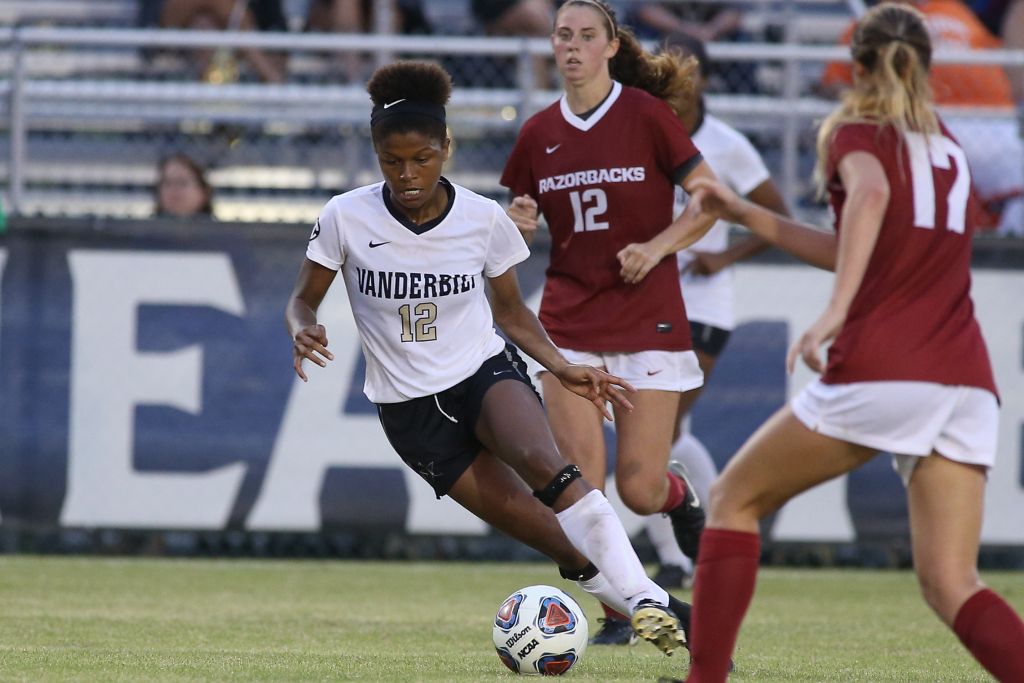
“After games, little kids will come talk to you on the field, and so many times little black girls will come up and say, ‘I want to be just like you!'” Charley said. “I never forget stuff like that… Obviously, I wouldn’t be here if it weren’t for those who worked hard and had the courage to stand up for what they believe in.”
Charley saw proof of that history in her family tree. Her cousin, Christina (Penn) Charley, attended Vanderbilt on a track & field scholarship in the mid-90s. In 2016, Simone Charley set a school record in her event of choice, the triple jump (44′) – breaking a record set by her cousin Christina 20 years before.
Now the older Charley says she has witnessed the progress for female African-American student-athletes in the years since her Vanderbilt career. But it remains important to feel a sense of belonging, she said.
“I think it’s really important for black student-athletes to come to the school knowing they have an incredible opportunity,” Christina Charley said. “If they’re here, they were meant to be here, and there’s a purpose and a role that only they can play. To walk on this campus knowing that you’re supposed to be here and be bold, go all out, be 100 percent, don’t hold back. You have a special gift to give to this school, and you make a difference here.”
While the wheels of progress often turn slowly, Vanderbilt’s “VU Black Girl Magic” weekend strives to spotlight those who have already paved the way for female African-Americans in college athletics.
“It’s important to recognize that we have work to do,” Lee said, “but it’s equally important to celebrate how far we’ve come. That’s what Black Girl Magic is all about.”
Zac Ellis is the Writer and Digital Media Editor for Vanderbilt Athletics.