
Nov. 11, 2014
By Jerome Boettcher | Subscribe to Commodore Nation
Luckily for Vanderbilt fans, coaching panned out in a huge way for Tim Corbin.
If it hadn’t, though, the national championship winning baseball coach knows what profession he would have chased – military officer.
The son of an Army soldier, he grew up with a respect for the armed forces.
“It has always been ingrained in me and instilled in me personally about our country and what it represents,” said Corbin, who begins his 13th season at Vanderbilt. “I’ve always made it very important in our teachings with the kids regarding the opportunities we have. I think the basic premise is explaining to them that before they’re from any state in our country and before they represent Vanderbilt University, they’re always representing our flag, our country and what we stand for as people. I think that is very important.”
Corbin is not alone.
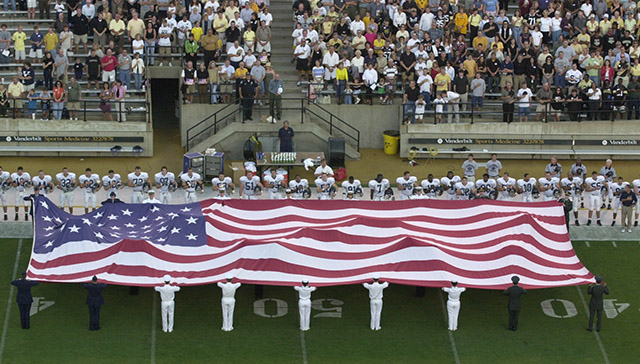
With Veterans Day this month, Vanderbilt student-athletes, coaches and staff salute those who have served in the military and died while defending their country. For several Commodores, the holiday stirs up personal connections and hits close to home – especially for several members of the football team.
Redshirt freshman kicker Tommy Openshaw’s paternal grandfather served in the Army and his mother, father, uncle and maternal grandfather all graduated from the U.S. Naval Academy. Redshirt sophomore offensive lineman Will Holden’s father is retired from the Navy. Redshirt junior safety Andrew Williamson has lived in Germany and the Netherlands as both parents served in the Army.
Fellow offensive lineman Sean Dowling aspires to follow in his parents’ footsteps and make his living out of the military. His dad is a colonel in the U.S. Marine Corps and his mom is a retired Lieutenant Colonel in the Marines. Defensive lineman Nigel Bowden’s father is retired from the Army and both his brothers served in the Air Force.
In the Olympic sports weight room, strength and conditioning coach Darren Edgington and his intern, Josh Willhite, have direct ties to the military. Edgington served six years in the Navy and Willhite fought as an infantry solider in Afghanistan and Iraq with the Marine Corps.
“My respect is absolute,” Sean Dowling said. “I don’t know how, if I can put into words, how much I respect those who have served and those who are serving. All my heroes come from the military. If I could say one thing it would be thank you.”
Two of the first movies Jack Corbin took his son to watch in theatres were “Patton” and “Tora! Tora! Tora!”
Having served in the Army for five years, Jack wanted his sons to understand their country’s history, build a sense of respect for what it meant to be an American and realize the sacrifice many made to protect their freedom.
“It was important to him,” Tim Corbin said. “It was important in our home. Our country was important in our home. He made that very apparent by how we spoke and how we were raised. I just felt it was a good thing. It was not neglected.”
Nor have those values been lost on the younger Corbin.
In his coaching, Tim Corbin has laced in military lessons and traditions to remind his players to be thankful of their opportunities.
“I tell them that rather than wait until a holiday occurs make it a part of your fabric, that you celebrate it every day,” Corbin said. “We might not celebrate it through music or representation of the flag. But I do bring it up quite frequently. There is not a week that goes by where some American tradition is not inserted into our culture.”
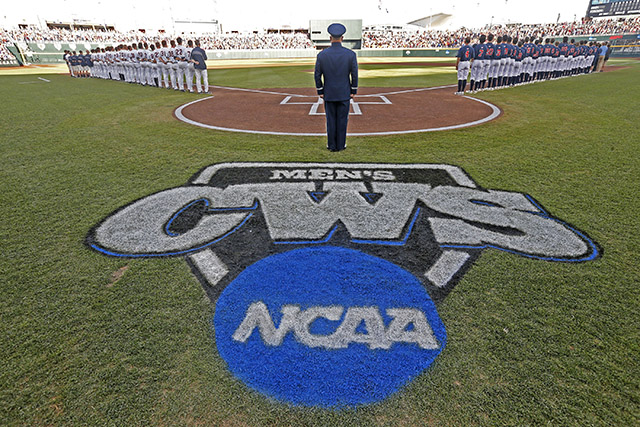
Before every season, Corbin teaches his players how to stand at attention for the national anthem: right hand planted over their chest, heels clicked together, with toes pointed out at a 45-degree angle, left hand holding an imaginary roll of quarters down on the seem of the pants and strong posture with shoulders back. The players remain standing at attention until the last note of the “Star Spangled Banner” is played or until the end of the colors being presented.
For the last six years, the team has worn red, white and blue uniforms for Sunday games and tries to honor a member of the military before the game. Much of the verbiage for drills at practice or at the baseball facility align with military or American traditions. Corbin taught the team about Pat Tillman. He has discussed key moments and shown movie clips of World War II and the Battle of Normandy.
“I want them to understand what mental and human struggle took place in order to salvage our country, in order to protect our country,” he said. “It was difficult living for those human beings and I wanted them to see that. Those are lessons right there that point to servant behavior, point to country first, and I want those kids to know there are issues and situations that are bigger than what their personal life is all about and what baseball is all about. It goes far beyond that.
“… Not to say that our kids will be war heroes. They won’t. I think there are people in their life that they need to know more about.”
It was hard for Nigel Bowden to get away with anything when he was growing up. Not only was he the youngest of four children but he had two older brothers – 10 years and 13 years his senior.
“Those were my fathers when I grew up,” he said. “They would knock me upside my head and set me straight. My mom disciplined me but she really had a lot of help. Even my sister (helped), too. That is what helped me become the person I am today.”
Nigel admired his older brothers Joe Nathan and Jason Nathan. Both served in the Air Force and Nigel aspired to make them proud on the football field and in the classroom.
He hung on Jason’s every word. Ten years older than Nigel, Jason was athletic, smart, a devout Christian and driven. He dreamed of fighting for his country and wanted to work for the FBI.
“I always looked up to him,” Nigel said. “He was very athletic, a strong guy. He always put faith in everything he did. His grades were top notch. He was one of those outstanding people. You just want to live up to your brother and his goals and what he has accomplished.”
On June 23, 2007, Jason Nathan was killed in Iraq. While on gunner duty, an improvised explosive device detonated near his vehicle. He was only 22.
Nigel was just 12 at the time, about to begin seventh grade. He had just talked to Jason two days before.
“When he died it actually made me work harder,” Nigel said. “It hit me so hard because I wanted to show him I could do the same thing.”
The death of his brother, role model and best friend, stunned Nigel. He remembers staring at his bedroom wall hours after two soldiers came to their front door in Macon, Ga., with the tragic news. When he saw Jason’s body at the funeral, the reality of the situation sunk in. It was hard for him to stay strong every time a friend or family member came up to him and brought up his brother. He hurt to see his mother and brother, Joe, in so much pain.
Then he remembered the joy Jason spread to everyone he met. And Nigel brought up those memories, those jokes and began to make people smile.
“That’s actually how I got over it,” he said. “First two times I got someone to smile from it, that’s what made me feel more comfortable talking about it.”
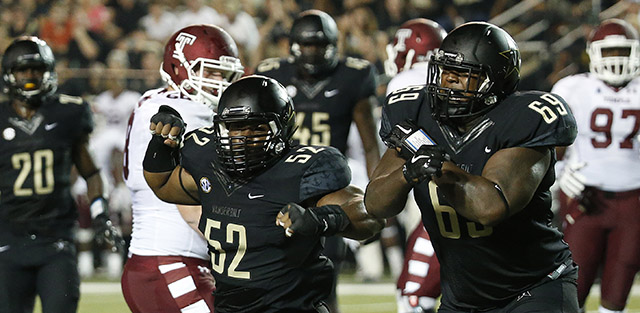
Seven years later, Nigel continues to try to live up to his brother’s expectations. The leading tackler and a rising star on the football team, Nigel honors Jason every time he steps onto the football field.
His jersey number, No. 52, pays tribute to Jason, who always told Nigel “you can mess up 52 times and you can get things right 52 times. Fifty-two times is going to make you a man.”
“He is that person that keeps me going,” Nigel said. “I just appreciate how much love he had for all of us.”
Just from listening to him rattle off his father’s military history with ease and precise details of location, dates and length, one can pick up how much Sean Dowling idolizes his father.
And it is easy to see why.
Christopher Dowling is a colonel in the Marine Corps and is currently on his ninth tour in Afghanistan, advising and preparing Afghani army as U.S. troops leave the country.
“Growing up I always wanted to be like my dad and do what he did,” Sean said. “He is one of the most prolific leaders I have ever been around in my life. He has control over his audience. Being a Marine Corps officer is incredibly, physically challenging. He is able to push himself to do some incredible things. I take a lot of confidence that I come from his stock and I am able to do whatever I put my mind forth to do.”
As a high school senior, Sean Dowling not only accomplished a huge feat by playing in the Semper Fidelis All-American Bowl in 2013 but he did so as the son of two Marine Corps officers.
His mother, Karen, is a retired Lieutenant Colonel from the Marines, where she was a judge advocate.
“She is another one of my heroes,” Sean said. “Really fortunate when my dad was gone, she, and the saint she is, had to take over both roles being a Marine Corps officer and a mother and a father. Taking care of her two boys who played football and basketball and were constantly doing stuff. I looked up to her as much as I did my dad. She can and has proven she can do it all.”
The military lineage runs deep for the Dowling family. Col. Dowling’s father, Edmund, was a Lieutenant Colonel in the Marines and was deployed five times during the Vietnam War. Two of Sean’s uncles graduated from West Point.
Not surprisingly, Sean wants to carry on the family business.
In January, he’ll join Vanderbilt’s Naval ROTC as a Marine Option student. Upon college graduation in a couple years, he hopes to complete Officer Candidates School and be commissioned as a Marine Corps officer.
“Becoming a Marine Corps officer nowadays is incredibly competitive and I would like to start by getting my foot in the door any way possible,” he said. “That has always been the plan.”
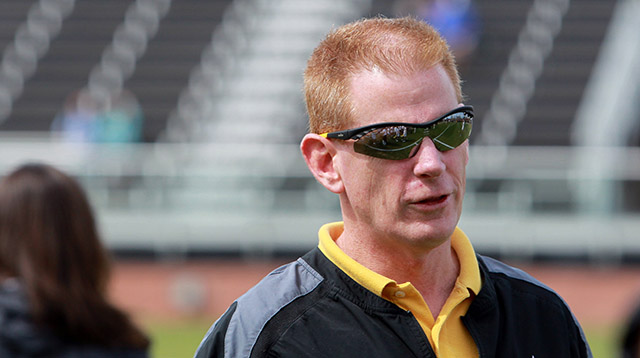
If Darren Edgington tells the bowling team or lacrosse team they need to be in the Olympic sports weight room at 7 a.m., he expects them to be there by 7 a.m. 7:01 won’t cut it.
Accountability is one of the biggest qualities Edgington preaches his to his student-athletes as one of Vanderbilt’s strength and conditioning coaches. Personal responsibility and discipline are very important to Edgington, especially after he spent six years in the Navy and more than four years on a submarine.
“In my instance, you have to learn to be accountable in taking care of the little things,” Edgington said. “Because, if you don’t, people die. You don’t take care of the little things on a submarine – you’re several hundred feet under water, all that pressure is trying to get into that sub – you make a mistake and 120 guys die. The athletes, they make a mistake, we might lose a game. You might have some up-downs for being late. But it is, in the long run, to teach them to be better outside of college.”
Growing up on a farm in Norene, Tenn., a small town south of Lebanon, Edgington enlisted in the Navy’s nuclear engineering program out of high school. He volunteered to man a 120-member fast-attack submarine that, as Edgington puts it, is designed to “go out and hunt and kill other submarines.” He was a machinist mate in charge of atmospheric control equipment, refrigeration, air conditioning and hydraulic systems along with monitoring the sub’s diesel generator.
His sleeping quarters were 20 yards from a nuclear reactor. Without windows or port holes, he and his fellow Midshipmen relied on sonar to detect enemy submarines. Some stretches he’d go 45 hours without sleep. With 18-hour days and rotating six-hour shifts, it was easy to lose track of time.
“You told time by what meal was being served,” Edgington said.
After he finished his time in the Navy, he returned home and graduated Cum Laude with a degree in wellness and fitness from Middle Tennessee State University, where he also later earned his master’s degree. He has worked at MTSU and Ole Miss and is in his third season at Vanderbilt.
He admits as a 24-year-old when he exited the Navy, it was more of a relief than celebration. But as he has gotten older, he has gained perspective on his time in the military. The discipline and accountability he learned from his time in a submarine, he still carries with him today.
And Edgington, like all those brave men and women who have served our country, can’t help but reflect on Veterans Day.
“No matter when you served, if you were ever in, you signed a blank check and that blank check was for your life,” he said. “In one sense, they are no different than anybody else who has served during the Cold War or peacetime because when you signed up you signed a blank check for your life, giving it to America, giving it to the people. It just didn’t get cashed. That is a pretty neat thought to be able to sign that over.
“Now that I have gotten older, and looking back on it, Veterans Day has more meaning. I am proud I have served my country – that I have given back to the country that gave so much to me.”