
Feb. 8, 2017
By Zac Ellis
VUCommodores.com
On campus in Nashville – Rain fell in sheets on Vanderbilt’s campus on the night of Jan. 19, when six athletic directors made their way to Admiral’s Room on the second floor of Memorial Gymnasium. The group, comprised entirely of African-American ADs from Power Five schools, converged on Vanderbilt’s campus to take part in a unique roundtable presented by ESPN’s The Undefeated.
The plan? Embark on an open and honest discussion on the state of college athletics, all from the perspective of black administrators in the industry.
“You can’t think about the last time you’ve heard about this discussion like this,” said Caleb Wilkerson, senior digital producer in charge of video for The Undefeated. “It’s a way to open that dialogue. It’s just a great opportunity for us at The Undefeated to cover this, because that’s what our site is: it’s the intersection of race, sports and culture.”
In a joint plan hatched by Vanderbilt and ESPN, Commodores vice chancellor for athletics and university affairs David Williams II extended invitations to several African-American athletic directors in town for the 2017 NCAA Convention at the Gaylord Opryland Resort. Five ADs agreed to join Williams for the discussion on campus: Ray Anderson (Arizona State), Warde Manuel (Michigan), Bernard Muir (Stanford), Stan Wilcox (Florida State) and Mike Williams (California). The discussion was moderated by The Undefeated writers Domonique Foxworth and Jason Reid and managing editor Raina Kelly. It was also taped for use on The Undefeated and other ESPN affiliates.
For almost two hours, the six administrators debated pertinent issues surrounding college athletics. Williams, who called each of the five visiting ADs longtime friends, saw the roundtable as an opportunity to present and consider other perspectives.
“There’s a degree of commonality [between us], but also a degree of individuality,” Williams said. “The schools are different, things like that. Anytime you’re with a group of people, you do learn something. That’s the fun part about it.”
The discussion touched on a number of topics over the course of the evening. Foxworth surveyed the group on the significance of serving as black athletic directors at Power Five universities. The men agreed to the feeling of pride – and obligation – toward future generations of colored administrators. “There’s definitely a sense of responsibility to those black youth who are looking up to you,” said Wilcox.
Added Williams: “I really think being a black AD gives a lot of support and hope to the kids playing the sports.”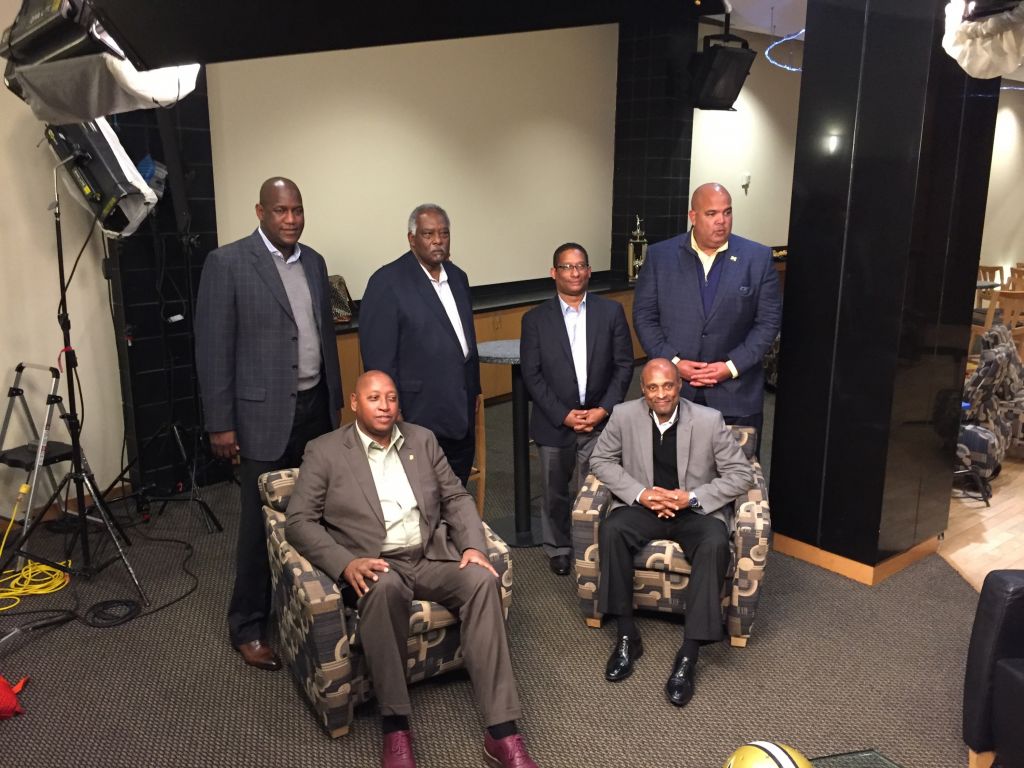
The conversation dovetailed into other areas as the evening progressed. At one point, Foxworth and Reid questioned the group on career paths for African-Americans in college athletics. One challenge, some ADs said, is the lack of a true and diverse “search” process for certain jobs. Williams also noted that progress must extend beyond a single hire. “The first means nothing if there’s not a second,” Vanderbilt’s athletic director said.
The panel debated issues of student-athlete expression and striking a balance with academics and athletics on today’s scale. At one point, Foxworth referred to what he called the “exploitation” of student-athletes, which sparked a lively conversation on the issue of student-athlete compensation between Foxworth and Michigan AD Warde Manuel.
Student-athlete activism, in particular, became a hot topic of the conversation. In an era of protest and civil discourse — and juxtaposed with social media — Cal AD Mike Williams said a university’s role is not to limit a student’s freedom of expression. “They’re students first,” Williams said.
The athletics directors were later asked about shouldering added pressure to hire minority coaches. That same pressure seemingly extends to every corner of their current jobs, particularly as African-American administrators. But each AD in attendance was proud to represent the potential of the entire student-athlete experience. “We are the front porch of our universities,” said David Williams.
In the end, the group of men found comfort in revealing more common ground than uncommon ground during the discussion.
“There’s a phrase I used to always say to some of my colleagues when I’d see them,” Wilcox said. “They’d say, ‘How’s it going?’ and I’d say, ‘It’s going great — same fight, different round.’ That’s what it is. We all kind of face similar issues on our campuses. We can talk amongst one another to get different ideas on how to handle situations.”
ESPN’s feature on Vanderbilt’s roundtable can be found here on The Undefeated.