
March 3, 2016
By Jerome Boettcher | Subscribe to Commodore Nation
Vickie Woosley wasn’t a college athlete.She didn’t make a winning shot infront of 15,000 fans in a soldout gymnasium.She didn’t rally her team to a come from behindvictory on the road in a hostile environment.She never played with a championship onthe line.
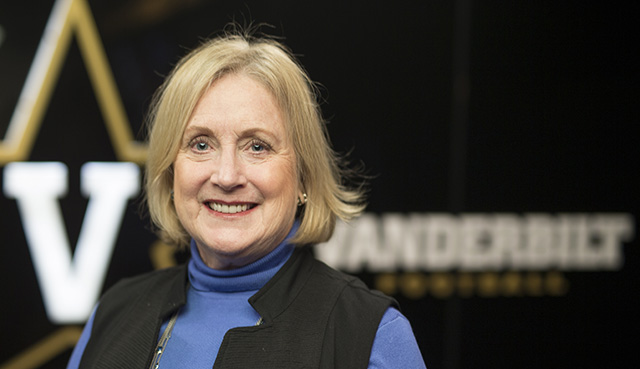
But as Vanderbilt’s sports psychologist, she canrelate to Commodore student-athletes when theyare faced with high-pressure situations. Trustingher training, preparation and instincts were vitalwhen Woosley found herself in dire situations ather previous job.
“I was searched one time while I was wearinga wireâ€â€that was a sobering situation,” she said.”They did not find the wire. I had to talk my wayout of it.”
Since 2006, Woosley has worked at Vanderbiltas a clinical psychologist. She started first atthe Psychological and Counseling Center andhas spent the last four as the athletic department’sresident sports psychologist in theMcGugin Center.
But, prior to that, she spent 21 years of distinguishedservice as a Special Agent for the FBI. Amajority of her career was in covert operations ina variety of cases, from white collar to child pornographyto terrorism, but primarily in narcotics.Her undercover work took her all over the countryfrom Indianapolis to Los Angeles.
After 16 years in investigative work, sheended back up in Quantico, Va., home of theFBI Academy. There she served as a SupervisorySpecial Agent, administering psych assessmentsfor agents in covert operationsâ€â€or the “checkupfrom the neck up,” as she calls it. At Quantico, shealso taught new agents, large case managementand instructed at the undercover certificationschools. She even traveled to countries such asBudapest to teach agents at international covertoperation schools.
“I certainly feel I had been given the opportunityto live a life beyond my wildest imagination,”she said. “I had to find the courage to liveit. I did find out a lot about myself. I think thatyou have to be very aware and you find out youare capable of doing more. You think you knowwhat you can do and the training teaches youthat you can do more.”
Working for the FBI wasn’t a lifelong dreamfor Woosley. Contrarily, she stumbled uponthe career.
Woosley received her undergraduate andgraduate degrees from Louisiana Tech University.She was the coordinator of women’s housing ather alma mater, overseeing the residence hallsand programming. At Louisiana Tech, she becamefriends with a couple of FBI agents, who thoughtshe would be a candidate for the bureau.
Woosley had never fired a weapon before inher life. She didn’t have a military or investigativebackground. But she loved her country, and thechance to improve it while also delving into anexciting, undercover life intrigued her.
“Never in a million years would I have thoughtthat was what I was going to do,” she said. “But,much like life, when an opportunity presents itself,walk through the door, take the risk. So that’s whatI did. I’m a true patriot. I believe in this country andall that we have, and very thankful for it. I felt like itwas my duty to do what I could to make it better. Ithink that is what kept me there for 21 yearsâ€â€thedesire to make this a better world, a better place.”
Looking back, Woosley feels a sense of satisfactionknowing she played a role in making hercountry safer.
She was instrumental working on the Unabombercase, which spanned 17 years. The FBIhad an 800 number open for calling in tips, whichultimately led the bureau to Ted Kaczynski. Woosleywould filter leads from the 800 number.
“That meant I talked to every ex-wife in Americabecause they all thought their ex-husband wasthe Unabomber,” she said.
On April 3, 1996, Woosley was one of thenumerous FBI agents who arrested Kaczynski athis cabin in Montana.
“That was extremely satisfying,” she said. “Hewas very, very sick and certainly hurt some people.It had been a long, historical case. There is a lot ofsatisfaction in the culmination of a case like that,knowing you have been instrumental in puttingsomeone like that away.”
Most of Woosley’s FBI career, however, wasspent undercover.
Her first case after graduating from the FBIAcademy was a narcotics or RICO (RacketeeringInfluenced Corrupt Organizations) case in Indianapolis.What was believed to be a short-termcase actually lasted four years.
She experienced the psychological effectsof working covertly with criminals, becomingattached to them and finding her ethics challengedas the line blurred between right andwrong.
“All of my time was spent with bad guys,” shesaid. “I was a part of their group. They had a birthday;I celebrated their birthday. The whole pointof it is to establish a relationship knowing you aregoing to betray that relationship at some point. Itis easy to say that, it is much more difficult to do…So I lived firsthand the psychological impact ittakes on you. That is what people don’t seeâ€â€youget very attached.
“That’s the whole reason behind the checkupfrom the neck up. It is sort of like the Stockholm’ssyndrome with the kidnap victim. You hear theseguys, men and women, talking about illegal activity.You start to think, ‘You know what they aredoing is really not so bad. That is not so terrible, isit?’ You have to have a lot of clarity about who youare, your value system. And you also have to havegood support team, meaning a handlerâ€â€the personyou have contact with. They are tasked with,‘How is she doing? Is she still with us?'”
In her 16 years of investigative work, Woosley’scover was never blown. Of course, therewere moments where she feared for her life likewhen she was wearing a wire as a drug dealersearched her.
But the fear actually aided Woosley. Knowingthe consequences of what would happen if shewere caught actually heightened her senses.She was very aware of her surroundings anddid not get complacent. She kept her story andbackground very seal-tight and solid, cautioningthat criminals aren’t as dim witted as thepublic assumes.
Her appearance also didn’t hurt her. At 5-foot-4with blond hair and the sweet, innocent voice ofa child, Woosley didn’t look or sound the part ofsomeone trying to infiltrate a drug deal.
“No one ever suspected I was an FBI agent,”she said. “I imagine it had something to dowith my voice. I always knew this voice wouldcome in handy and it did (laughs). I would keepas much of my own personality as I could andchange very little.”
It was during her time undercover where Woosleybegan to think about her future. She wantedto give back to the academy, so she went back toteach new agents about the mental, physical andacademic rigors of the academy and the bureau.
And that’s where the parallels between workingin the FBI and with Division I student-athletesbegin for Woosley, who received her doctoratedegree from the American School of ProfessionalPsychology in Washington, D.C.
Both jobs require trust. In working undercover,she had to gain trust from the criminals and shehad to trust her superiors would be there if somethingwent wrong. At Vanderbilt, she must earnthe trust of student-athletes in order for them toopen up. That is also where her interviewing skillsin the FBI have come in handy. Obviously beingphysically fit as an athlete and special agent aremusts. At the academy, Woosley went from a novicein shooting a gun to an expert in just 14 weeks.Similarly, she tries to instill in student-athletes thatthey can learn anything with time and effortâ€â€anew skill, a new position, a new subject in theclassroom. The traits of being flexible, adaptableand coachable prove beneficial in both fields.
“There are many parallels that make the workvery similar, more similar than different,” she said.”I felt like now (working with the FBI) I had anadded dimensionâ€â€this performance piece. Thisis what anxiety does to you, where it comes from,how you can harness it, how you can be morethan you think you are, how you can push yourselfto the limit.”
She correlates that to the everyday stress 18- to22-year-olds endure on the field, in the classroom,with family matters, returning from injuries.
Woosley serves as an objective third party whoVanderbilt student-athletes can come to and talkwithout fear or reservation, knowing what theydisclose is confidential.
“I see my role here as an advocate,” she said. “Icall it the care and feeding of the student-athletein that I don’t have an agenda where their sportis concerned. I do have an agenda as far as thembeing well and ready for their sport, their academiclife and life beyond Vanderbilt, which is agreat mission that this department has.”
Woosley also believes her presenceâ€â€and thegrowth of more and more sports psychologists incollege athleticsâ€â€will help decrease the stigma ofmental health.
When freshmen arrive in the summer they areintroduced to and screened by Woosley almostimmediately. She comes to practice, cheers loudlyat games. She is as valuable of a resource as theacademic support team and athletic trainers.During the school year, and even on holidayand summer breaks, her door is barely open asshe keeps a busy daily schedule meeting withstudent-athletes and staff. She doesn’t just dwellon athletic performance issues; student-athleteshave turned to her when issues in their personallife arise, such as coping with the death of a familymember or friend.
An average day at work no longer meansputting her life at risk. But Woosley says lessonslearned at the FBI continue to leave a daily impact.
“I do think it has made me the person I amtoday, the psychologist I am,” she said. “I thinkhaving the ability to listen, to sit in the room withsomebody else’s pain is a gift. I think when peoplecome in here they are doing the best they can inthe moment, whatever that is… It is a place whereI want them to feel safe, that they can say anythingthey want to and there is no judgment in here,hopefully creating that space. I’m really fortunatethat Vanderbilt athletics sees the need and is willingto provide that resource to athletes.”