
Aug. 27, 2008
 History of VU Athletics Part 1 (pdf) | History Corner Archive
 |
|
<>In conjunction with the celebration of Vanderbilt’s Hall of Fame weekend September 12 and 13, Commodore History Corner will present a three-part series on the history of Vanderbilt Athletics. Vanderbilt’s inaugural Hall of Fame class will be honored with an induction Banquet Friday evening September 12 and the Class of 2008 being presented at halftime of Saturday’s Rice game.
This series will cover the founding of Vanderbilt University athletics in 1886 through the 2007-08 sports seasons.
Vanderbilt University was founded in 1873 with a $1 million gift from Commodore Cornelius Vanderbilt. The university’s student body has been coeducational since 1875. The original campus which opened in a single building on 75 acres, expanded to the current 3,330 acres in 1979 when Vanderbilt merged with neighboring George Peabody College for Teachers.
The Vanderbilt University Athletic Association (V.A.A) was formed in 1886 with Dr. W. M. Baskerville serving as president. In those early days most of the Vanderbilt student body was included in the membership. The V.A.A. would oversee the sports played on the Vanderbilt campus including baseball, bicycling, tennis and track and field events.
The first official organized athletic event involving Vanderbilt was the first of an annual Field Day held on May 7, 1886 at Sulphur Springs Park (Sulphur Dell). The event was the first track meet held in the South with teams throughout Tennessee and the surrounding region participating in this annual spring event.
The first track teams trained at what is now Centennial Park. Bishop Holland N. McTyeire supervised the construction of a campus quarter-mile track in 1887 that was located across Kirtland Hall presently referred as Wilson Lawn. Vanderbilt’s track program flourished with the arrival of new head coach W.J. “Bill” Anderson in 1907. Anderson would become the “Dean of Southern Track Coaches” with nearly 40 years of devotion to the sport.
Ernest H. “Herc” Alley assumed the track head coaching title in 1949 after being a Commodore assistant football coach. Though his teams never won an SEC championship, Alley did produce several individual conference champions in miler Fred Abbington, long jumpers Kent Russ and Ben Rowan, discus champion Dan Boone and two-time javelin thrower Edward Burkhardt. Vanderbilt men’s track was discontinued soon after Alley’s death a club sport. Commodore men’s track is today a club sport.
Dr. William L. Dudley was the Dean of Medicine at Vanderbilt University from 1895 until his death in 1914. He is also considered the father of Vanderbilt athletics and a pioneer of Southern football. Dudley took over the running of the V.A.A. in 1887. In 1893, Dudley organized and became president of the Southern Intercollegiate Athletic Association (S.I.A.A.). This organization included competing athletic teams from North Carolina to Texas.
As the Eastern sport of football gradually invaded the Southern states, Vanderbilt students would gather for unorganized games by the late 1880s. Then in 1890, the University of Nashville (Peabody) challenged Vanderbilt to a football game on Thanksgiving Day. Vanderbilt captain and fullback Elliott H. Jones organized a team that beat the cross-town rivals 40-0 at Sulphur Springs Park.
Jones would also serve as head coach for three years (1890-92) compiling records of 1-0, 3-1 and 4-4. With the growth of football in the South, additional teams were gradually formed and schedules expanded. Vanderbilt became one of the stronger teams in the S.I.A.A. A football field was established on the Vanderbilt campus, which was named for Dudley. The original Dudley Field presently is the site of the Vanderbilt Law School.
In 1904, Vanderbilt hired Dan McGugin as its new head football coach. He played football at Michigan and was an assistant to Wolverine legend Fielding Yost. McGugin would achieve legendary status himself remaining on the Vanderbilt campus for 30 years. His first team was 9-0-0 the only undefeated, untied team in Commodore history.
Vanderbilt football became so popular in Nashville, a new Dudley Field was constructed in 1922. It was the first football-only stadium in the South. Yost’s Michigan squad was the opponent for the inaugural game, which saw the heavy underdog Commodores fight the Wolverines to a 0-0 draw. Captain Jess Neely led the way for Vanderbilt that historic afternoon. McGugin retired from coaching in 1934 and died two years later. He is Vanderbilt’s all-time winningest football coach with an amazing record of 197-55-19.
The Vanderbilt football team was in Washington, D.C. on November 2, 1934 for a game against George Washington University. One of President Franklin D. Roosevelt’s secretaries was a former Vanderbilt student that arranged a gathering at The White House. McGugin’s squad’s greetings with FDR only lasted 10 minutes while the Commodores would defeat G.W., 7-6 in Griffith Stadium.
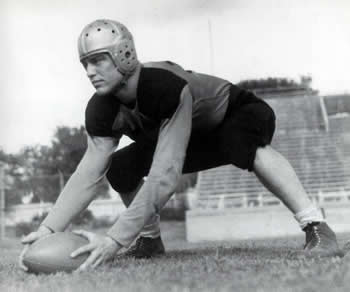
In 1937, Vanderbilt tackle Greer Ricketson recorded of the most famous plays in Vanderbilt and SEC history. Ricketson picked of a “hidden” ball from his offensive tackle position and streaked around end for a 50-yard touchdown. It was the Vanderbilt’s only score of the game as the Commodores upset LSU, 7-6 on Dudley Field.
Vanderbilt produced many great players in this early era of Commodore football. Such players to gain national attention as All-Americans include Ray Morrison (1910), Josh Cody (1919), Lynn Bomar (1923), Henry Wakefield (1924), Bill Spears (1927), Pete Gracey (1932) and Carl Hinkle (1937). McGugin, Morrison, Bomar, Spears and Cody are also enshrined into the National College Football Hall of Fame.
When Dr. James Naismith of the YMCA needed an indoor sport to avoid the bitter winters in New England, he invited the game of basketball in 1891. This new sport also spread into the South and onto the Vanderbilt campus. Vanderbilt played its first recorded basketball game in 1893 with a 9-6 victory over the Nashville YMCA. Several years would pass for Dudley to realize the impact the game as a means of exercise for his students.
A formal basketball team was produced to represent the university in December 1900, with W.D. Weatherford the first head coach. The first official schedule consisted of three games against the Nashville YMCA and one against the Nashville Athletic Club. The Commodores lost their first meeting against the YMCA, and finished that inaugural season 2-2. A pair of victories did come against the YMCA.
In those early years, basketball home games were played in the Old Gym, which continues to stand today. The cramped Old Gym, built in 1880, was used for basketball and gymnastics–both men and women. As the crowds began to cultivate, it was necessary to find another venue to host games. Vanderbilt home games were moved to the city-owned Hippodrome. The Hippodrome once stood on the present site of the Holiday Inn Select near campus. The primary use of the Hippodrome at the time was for ice-skating.
Vanderbilt captured its first S.I.A.A. basketball championship in 1920 with coach G.T. Denton and captain Tom Zerfoss. The Commodores posted a 14-4 record. The S.I.A.A. was reorganized in 1920 with schools added and deleted. Vanderbilt was now a member of the Southern Conference. The Commodores would win the Southern Conference championship in 1927 by winning the postseason tournament held in Atlanta. Vanderbilt recorded its first 20-win season that year by going 20-4 with former football great Josh Cody as head coach.
The Vanderbilt ladies have never been neglected as to their participation in physical activities. There were some early apprehensions about the women students being active in sporting events considered by some as not being “lady-like.” Then Stella Vaughn, a Vanderbilt graduate (1896), would become a pioneer in Vanderbilt women’s athletics. After her graduation Miss Stella, as she was known with affection, became the women’s physical education director.
Vaughn quickly absorbed basketball as a portion of activities for the women. The women wearing bloomers, tie down shoes and voluminous blouses, played a recorded game in March 1897 against Ward Seminary (Belmont). The game was held in the Old Gym and played before a women-only crowd. The doors were locked and windows covered by female teachers. However, one anonymous enterprising male reporter for The Hustler claims to have sneaked in for his descriptive story on the Commodores 5-0 victory.
Those early teams included Vaughn as a player and coach. Only traces of information are available for these infant years of the women’s basketball program. Some publications indicate they began playing a regular schedule in 1902, and some report 1905. By this time crowds, including the men, were attending games in large numbers.
The ladies generally played a five-game schedule, which expanded as more local schools began to produce women’s teams. As the game became a national sport the women, who were playing mostly high schools, did play other colleges. The women would travel for road games to cities as Kentucky and Cincinnati and after 1910.
Reports on the women’s basketball progression were included in the university’s newspapers and yearbooks. Teams are listed through 1919, but information fade into the 1920s. The Girl’s Athletic Association was formed in 1928 and basketball became an intramural league. Vaughn would continue to support women’s athletics until her death at age 89 in 1960. These early Vanderbilt women would also participate in gymnastics and tennis.
Next week read part two of this three-part series to learn more about the history of Vanderbilt athletics. If you have any comments or suggestions you can contact Bill Traughber via e-mail WLTraughber@aol.com.