
CHC- The Historic 1921 VU Baseball Team (pdf) | CHC Archive
Vanderbilt baseball coach Byrd Douglas had an inspiration in propelling his 1921 team to the Southern Intercollegiate Athletic Association championship. It began with “Cap Alley Day” early in the season.
 |
|
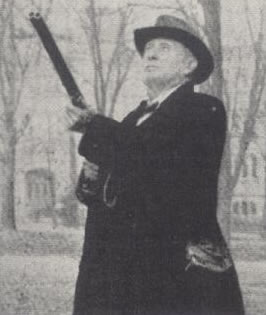
| James “Cap” Alley |
The Nashville Tennessean gave this report on the Commodores’ game with Howard College:
Today is “Cap Alley” day out on Dudley Field. In honor of the man who has patrolled the campus for thirty-six years, the revenue of receipts from tickets for Howard College-Vanderbilt game to be played this afternoon, are to go to the venerable policeman.
“Cap” has worked at Vanderbilt for 36 years. He has lived in Nashville all his life and is 61 years old. He has made 400 odd arrests during his career as a campus cop, including Bill Neely, the former Vanderbilt football star and others of more or lesser light. He has known practically every captain of football, baseball, track and basketball teams at the college and is generally beloved by faculty and students. His favorite expression is, “You’ll have to git out er here boys.”
Coach Douglas conceived the idea of injecting sentiment into baseball, believing that it goes a long way towards a successful season and there has been but little of it at Vandy heretofore.
James “Cap” Alley was for a longtime a one-man police force on the Vanderbilt campus. He began his work in 1886 and continued until his death in 1927. An article in the Vanderbilt Alumnus Magazine (April 1916) stated that Alley was a landscape gardner, special policeman, and custodian of the campus of Vanderbilt University.
Alley must have been somewhat of a legend when the 1916 article stated that Alley had “made 550 arrests, has killed 14, 395 sparrows, has raked up approximately 600 long tons of leaves, and chased 2,500 bad boys an approximate distance of 11, 050 miles.”
Cap explained that he had lived a useful and exciting life and sparrows were his nemesis. He said he usually hit them especially when he was close enough. Alley also said, “It’s mighty hard for me to arrest my friends.”
Vanderbilt won that first “Cap Alley Day” with a 17-1 pounding of Howard College. The Tennessean reported on the second “Cap Alley Day” the next day:
Vandy celebrated second “Cap” Alley Day with another slugfest at the expense of a pair of Howard hurlers copping the second and last game of the series with little difficulty some 13 to 1. The Commodores swatsmiths slugged hard, collecting ten hits, including a pair of four ply swats by McCullough, one by Brown and another by Scotty Neil. Speaking of Babe Ruthers, no less of nine were made in this Harvard series.
Vanderbilt concluded the 1921 baseball season with a 20-5 record and the S.I.A.A. championship. Vanderbilt had not lost a conference series the entire season. The conference clincher came in a game against Kentucky on the Vanderbilt campus. The Tennessean reported:
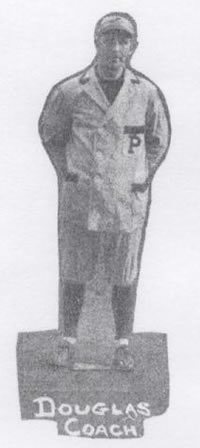 Byrd Douglas
You will find those Commodores this morning, straddle the crest of the Dixie college ball world. They sealed the peak yesterday when they slaughtered Kentucky State by an 18 to 3 count and thereby grabbed the last series with a Southern Conference team. The lopsided decision over the Lexington outfit, which performed in wretched fashion defensively, ran the Vandy total of season victories to 16 with but three reverses. Tennessee won a dual on Dudley Field and one in Knoxville while Mercer bagged one decision on the home ball pasture, No rival of the Commodores during the campaign has been able to collect the meaty end of a series from Vandy.
If that doesn’t entitle them to sit on the topmost perch among Dixie college baseballers then the San Francisco Bay is full of eight percent beer.
The smashing victory yesterday over Kentucky was a characteristic specimen of Vandy’s work this season. They brought out the heavy artillery and flattened the opposition. Throughout the college campaign the Commodores have butchered no end of good pitching through the vicious larruping of Scotty Neil. Tot McCullough, Manning Brown and all the rest. Their home run hatchery was worked on double shifts.
Douglas was in his second and last season as Vanderbilt’s baseball coach. In 1920 his Commodores achieved an 11-11 record. He was a Nashville native and received a Bachelor of Literature degree from Princeton in 1916. While at the Ivy League school, Douglas became an All-American catcher. In 1921, Douglas authored the book, The Science of Baseball.
The 1921 Vanderbilt yearbook, “The Commodore” wrote about Coach Douglas:
The season of 1921 brought great glory to Vanderbilt through the great S.I.A.A. championship baseball team, the first which has graced Dudley Field in a number of years. The marked success of this team was due almost entirely to one man, Coach Byrd Douglas, Vanderbilt alumnus, and later star catcher of the Princeton baseball team.
Byrd took charge of Vanderbilt’s baseball destinies in the spring of 1920, without any glowing prospects, as Vanderbilt had been one of the lesser lights in Southern baseball for several years. However, by hard, consistent effort, and through his sterling ability as coach, in his very first year he built up a team which commanded the respects of all opponents, even though filing to win the laurels of a championship nine.
But in 1921, Vanderbilt came back into her own, and in the second year in the reign of “King” Douglas, his host of Commodores swept through all opposition with wildfire, winning twenty games and losing but five, occupying the position at the crest of college baseball in Dixie.
After Princeton, Byrd earned a law degree from Cumberland University and later became a Board of Trust member and Director of Athletics for two years. Douglas coached the Princeton baseball team from 1928-30 compiling a 31-45-1 record.
In 1930, Douglas returned to Nashville and began practicing law with his brother Lee. In 1942, he became a Judge of the 2nd Circuit Court. Douglas was appointed Judge of the Circuit Court of Davidson County in 1958. He was a civic leader in the Nashville county most of his life and was President of the Larry Gilbert Junior Baseball League, just one of his many devotions. Douglas died in 1965 after serving 21 years on the bench.
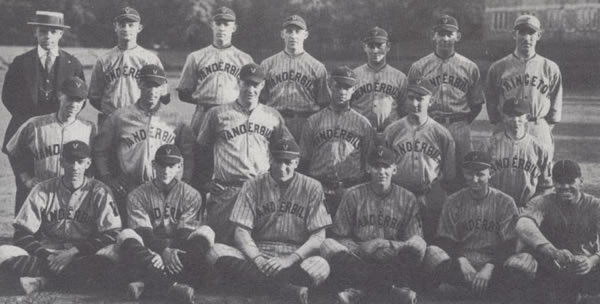 1921 Vanderbilt Baseball Team
Traughber’s Tidbit: In the 1921 Vanderbilt yearbook “The Commodore” states that in a 1921 game against Southwestern Presbyterian University, the Commodore baseball team established the world’s record in scoring 13 runs in one inning, after two men were out. The Tennessean reported on the events of that fifth inning:
Neely singled as did Kuhn; Neil fanned but Thomas got his third straight hit and both tallied. Big Tot got hit by a pitched ball and Smith was safe on a fielder’s choice with one out. Woodruf flied out to right. Tyner slammed one to center which Jetty juggled and everybody advanced a pair of sacks. Ryan was safe on another error and two runs came over. Neely beat out his second hit of the inning and Kuhn walked. Neil walked. Thomas was safe on an error and Big Tot McCullough picked one over the right field fence, clearing the sacks–but oh, what’s the use? Why continue?
If the newspaper account is correct and I’m reading it correctly, two runs scored before a second out was made and only 11 runs scored after two outs. But still that is quite an accomplishment.
The major league record for most runs scored after two outs is 13 held jointly by Cleveland (vs. Boston) on July 7, 1923 and Kansas City (vs. Chicago) on April 21, 1956.
Next week read about Vanderbilt’s “Field Day” in 1886.
If you have any comments or suggestions you can contact Bill Traughber via e-mail at WLTraughber@aol.com.