
Jan. 31, 2007
CHC- Vaughn Pioneered Women’s Sports (pdf) | CHC Archive
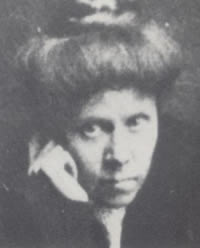
When Stella Vaughn passed away in Nashville at age 89 in 1960, a chapter of Vanderbilt women’s athletics’ history was closed. Vaughn was an 1896 graduate of Vanderbilt, a sorority founder and former head of the women’s athletic department.
 |
|
Stella Vaughn |
William J. Vaughn was her father and head of the Vanderbilt mathematics department. The Vaughn family lived on the university campus while Stella’s early education was derived from a one-room school for faculty children.
Vaughn entered Vanderbilt in 1892 where women were “admitted by courtesy” in the Academic Department. Women in this period were not officially enrolled into the university, but were allowed to compete for any of the degree programs. Women were expected to follow the same rules and regulations as the men.
In 1894, the faculty voted to allow women to compete for awards and prizes. In 1895, a record number of three women graduated from the university. Two years later women were allowed to enroll as official students of the university. The Vanderbilt women were not allowed in campus dormitories, but lived in approved boarding houses near campus.
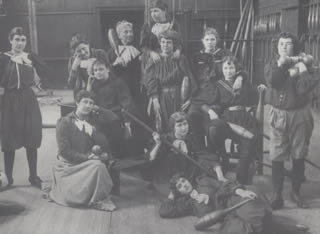
After graduating in 1896, Vaughn became the women’s physical education director and Vanderbilt’s first female instructor. In the fall, Vaughn organized Vanderbilt’s first women’s basketball team. The Vanderbilt men had been playing basketball since 1893 mostly as an intramural sport for the winter months. James Naismith invented the game of basketball in 1891.
Vaughn’s “co-ed” teams, as they were known, had such a modest beginning that men were not allowed to watch their games or practices. Wearing bloomers, tie down shoes and voluminous blouses; these women played their first recorded game in March 1897. This basketball game was played against Ward Seminary at the old university gym, which was built in 1880 and remains on the campus today.
Ward Seminary was the first women’s team in Nashville and the South. Later, the school became Ward-Belmont and is known today as Belmont University. Vaughn was a player-coach.
The doors and windows were blocked and guarded by female teachers to screen all interested in viewing this inaugural game.
The following newspaper article from the March 14, 1897 edition of the Nashville American describes that first recorded women’s basketball game for Vanderbilt:
The “co-eds” of Vanderbilt and the Ward Seminary team played a game of basket ball in the University gymnasium yesterday morning which the former won by a score of 5 to 0.
Reporters were debarred, but the contest is said to have been one of spirit, evidenced by the sunny locks found on the floor later by the janitor. There were no broken bones, black eyes or scratched faces reported, however, and the members of either team were willing to sacrifice a few strands of hair to the good cause.
The throwing was pronounced somewhat erratic at intervals, but at least one time proved the very thing. The lucky cast was made by Miss (Elizabeth) Buttorff of the co-educational contingent. The players on the other side aver that she had no idea it would be successful, and that it was all luck.
Be that as it may, it won the game, though bouncing from the wall at the time it landed in the basket. Much interest was manifested in the game both by the participants and the attendance, which was very large.
A detailed account of this inaugural game was provided by a male reporter of the university’s newspaper The Hustler. The reporter admitted he sneaked into the gym and hid in a dark corner to witness the game. This secret reporter gave this personal account:
 In spite of the precautions and vigilance of don’t-let-a-man-come in girls, teachers and instructors. I gained admission to the gymnasium and hid myself in a corner and awaited developments.
Soon the crowd began to gather, consisting of the girls’ schools, old and young ladies. On the faces of the sweet school girls were not seen the usual bewitching smiles. Something was lacking. What was it? It could not have been a girl friend, for all kinds of femininity was there.
It must have been the absence of the college boys, whom, alas, the teachers had excluded from the rare sight of seeing girls play basket ball. There was a look of expectancy on many faces, as if they expected that some ‘man’ would run the gauntlet and make his way in. But they were doomed to disappointment. Only “Little Gardiner” and the other girls were to be seen.
The rules were different for the women as a field goal was awarded five points. The game was 0-0 until the very end when Vaughn passed the ball to Buttorff, who threw up desperation, shot at the goal. It was reported that the referee’s whistle sounded just as the ball left her hand. The ball went in for a goal.
There was a “lively discussion” at the conclusion of the game as to the validity of the goal. The referee declared that the ball was in the air when the whistle blew and the goal counted. Vaughn would have been credited with the first assist as a Vanderbilt woman player if assists existed.
This shy reporter from the Hustler also gave his anticipated thoughts and observations.
After the doors and windows had been barred and locked and a guard (female teachers) placed at each, time was called for the game to begin. ‘Now, thought I, we will see some scratching and hair-pulling and hear a half dozen screams.’ I was not deceived; they showed that they were still girls.
The agility of some of them was really surprising, as they got around after the ball in a manner that would put some of our gym graduates to shame. The teams seemed pretty evenly matched, the co-eds having a little advantage in the matter of weight. The Ward girls made several pretty throws at the basket, but failed to score.
Vaughn served as physical education instructor and basketball coach for nine years without pay. In 1905, Vaughn did receive a salary of $100 a year, but in 1913 Chancellor James H. Kirtland stated:
“I recommend that Miss Stella Vaughn be given $200 instead of $100 for her work with the young ladies. It is of great value to the young women studying at the university, and she has not measured her services by the time demanded of her according contract. She has not only taught them in the gymnasium, but has supervised their sports and in a general way has acted as advisor and friend.”
Only traces of information are available for these early years on the women’s basketball program. Some publications indicate they began playing a regular schedule in 1902 and some report 1905. By this time crowds including men, who was encouraged began to attend games. They generally played a five-game schedule, which was expanded as more area schools supported and produced women’s teams. Later, as the game became a national sport, the women, who were playing mostly high school teams, did play other colleges. They would travel to Kentucky, Cincinnati and other cities in the years after 1910.
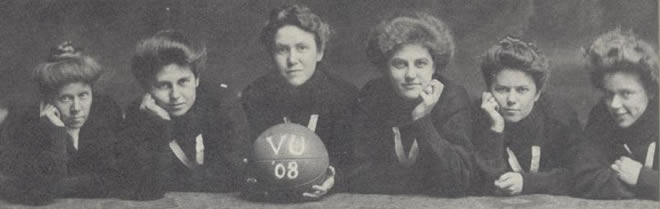
By this time rosters, and statistics would be recorded for publication in the school’s newspapers and nearly received as much press as the men. Coach Vaughn’s lineups would be listed as: Miss Johnson or Miss Miller. Team members are listed through 1919, but information on the women fade into the late 1920’s.
Mona C. Fredrick writes from her documentation of the Vaughn family:
“Miss Stella’s accomplishments and those of her “girls” came not without a struggle. As women garnered more academic honors during the early 1900s, questions about women’s proper role on the campus arose. In 1914, the women outpaced the men with an academic average of 81.72 percent compared to the men’s 71.47 percent. Women won the Founder’s Medal in the Academic Department each year from 1908 through 1912.
Chancellor Kirtland continued to believe that coeducation was harmful to the institution, and hoped for a separate educational facility for women. `The girls at Vanderbilt have worked against the odds,’ wrote Miss Stella at about this time, `but they are a `plucky bunch’ and not discouraged. They have slowly but surely won a place for themselves by their perseverance.'”
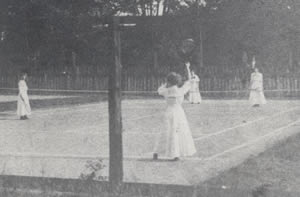
Vaughn had been considered the unofficial Dean of Women, but the position did not become reality until 1925. She remained the physical education director for women and Vaughn’s home on Highland Avenue became one of the approved boarding houses for female students.
 |
Also in 1925, Kirtland made an address on the commemorating of the University’s 50th anniversary He confirmed his position that Vanderbilt was founded as an institution for men and that “its general tone and atmosphere is that of a college for men and will probably so remain.”
A year later Vaughn spoke to the Vanderbilt’s Women’s Club where she talked about the university’s first 50 years and her experiences as a child growing up on the campus. Vaughn said: “In closing I want in imagination to take one more trip with you around the campus. In place of the old gymnasium there will be a commodious building with all the conveniences and with swimming pools for both the girls and boys; and we observe a girl’s dormitory, the removal of the professors’ houses, additional science buildings, the second unit of the hospital, and in place of the old Science Hall and residence in the rear, a magnificent library to which all roads will lead.”
Vaughn was the founding member of the Kappa Alpha Theta Sorority, which was originally established on campus as Phi Kappa Upsilon. She became the first initiated member of a women’s national fraternity on the campus. Vaughn’s also gave the group a small portion of her home for meetings and social occasions.
Vaughn served as advisor to the chapter for more than fifty years and gave the annual orientation speech to the sorority’s new members. The Girl’s Athletic Association was formed in 1928, which was an intramural league. Later this became the Women’s Athletics Board, which organized Vanderbilt’s women’s sports.
Upon Vaughn’s death in 1960, the Nashville Banner reported, “Miss Stella Scott Vaughn, the grand old lady of Vanderbilt University is gone.” In 1963, the university named one of four new women’s dormitories in the Margaret and Harvie Branscomb Quadrangle the Stella Vaughn House.
The Vanderbilt Board of Trust, in 1987, passed a resolution naming one of the original seven faculty houses on the campus the “Vaughn Home” in recognition of the Vaughn family’s historic commitment to the university.
Stella Vaughn would be fascinated with the progression of the women’s game of basketball and Memorial Gymnasium packed with 15,000 fans. She would be more fascinated if she had a Heidi Gillingham (6-foot-10) at her post in 1896.
“This campus life is a very great privilege,” Vaughn once said when asked about her relationship to Vanderbilt. “It’s the life of me.”
Next week read about Vanderbilt’s men’s and women’s 1909-10 basketball teams.
Traughber’s Tidbit: The highest the Vanderbilt’s men’s basketball team has ever been ranked in the country is No. 2. The ranking was achieved on December 28, 1965 with an 8-0 record. The Clyde Lee led team finished the season 22-4 (13-3 SEC) and second place in the conference.
If you have any comments or suggestions you can contact Bill Traughber via e-mail WLTraughber@aol.com.