
March 7, 2007
CHC- Rupp Puts Curse On Vandy (pdf) | CHC Archive
Friday, the Commodores enter the SEC postseason tournament with a No.2 East seed against Thursday’s winner of the South Carolina/Arkansas game. Vanderbilt has only won one SEC tournament championship ever and that was in 1951. The interviews from this story are from 2000.
 |
|
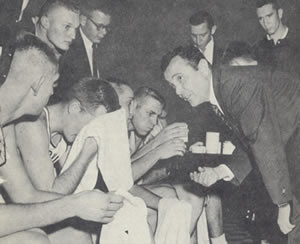
Vanderbilt Head Coach Bob Polk |
More than 2,000 people were waiting at the Nashville airport when the aircraft arrived carrying a group of tired, but triumphant athletes. This airport gathering of exuberant fans occurred 55 years ago. The occasion for this overwhelming greeting was as a result of the Vanderbilt basketball team returning home with the 1951 SEC Tournament trophy.
The original SEC Tournament began with the founding of the Southeastern Conference’s 13 members for the 1932-33 season (the current lineup minus Arkansas and South Carolina and plus Georgia Tech, Tulane and Sewanee). During a few of these years, the Commodores did not participate, since their poor record did not warrant an invitation.
Just as the Kentucky Wildcats are consistently one of the tournament favorites each year, the Wildcats were favorites every year until the tournament’s demise after the 1951-52 season. Adolph Rupp’s first season at the helm for the Wildcats was that inaugural SEC 1932-33 year.
In the previous seasons, the tournament champion was awarded the SEC championship and invited to participate in the NCAA National Tournament. However during the previous spring, the conference decided to award the regular season champ the official SEC championship. The regular season champion Cats, entered the 1951 tournament in Louisville having won eight consecutive tournament championships and 12 since the conference was formed.
Coach Bob Polk took his second place Commodores (15-8, SEC 10-4) into the annual event with a great deal of optimism. The last time the Commodores faced the Wildcats in the tournament was 1947, when Rupp’s boys embarrassed Vandy, 98-29. At the conclusion of that game Vanderbilt’s administration decided to take the game serious and hired Polk its first full-time basketball coach.
“From the beginning of the year, we seemed to develop a certain maturity, and I think we really hit our peak at the tournament,” said former Vandy forward Bob Dudley Smith. “We played four good games in row and the momentum just kept going. I believe we were a tournament type team.
“George Kelly played for the same coach I did in high school, Emmett Strickland of West End (Nashville). The both of us played on state championship teams and played in the finals three consecutive years. Dave Kardokus played in Indiana, and of course, the tournament fever in Indiana was sensational. Jack Heldman was the same way and there was just something about tournament fever that you get. We played an outstanding four games.”
 |
|
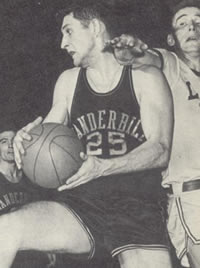
Jack Heldman |
Polk, in his fourth season as Vanderbilt’s coach, led his team in the opening round against Tennessee. Commodore senior captain Kelly’s hard work under the boards and scrappy play gave Vandy a 43-32 halftime lead. The Vol’s poor second-half shooting enabled the Commodores to pull away for an 88-52 blasting.
The balanced scoring consisted of five Commodores in double figures. Center Al Weiss led the game with 20 points, followed by Kardokus (19), Kelly (12), and Gene Southwood (10), and Heldman (10). It was the worst loss Vanderbilt had ever given the Vols at that time and the Commodores first tournament win against Tennessee.
In Vandy’s second-round game against Georgia, there were 51 personal fouls called. Kelly, a guard-forward, collected 19 rebounds in a 70-60 Vandy victory. Smith led Vanderbilt in scoring with 18 points, followed by Kardokus (17). Vanderbilt hung on as Weiss, Kelly and Southwood fouled out of the game.
Vanderbilt’s third game ended in a 75-63 victory against LSU. Weiss’ streak shooting and Kelly’s rebounding led the Commodores who reached the tournament finals for the first time in school history.
The second game of this Vanderbilt double-header and fourth game in three days was against the seemingly invincible Kentucky Wildcats for the championship. Louisville’s Jefferson Armory was packed with 7,000 partisan Wildcat fans.
This edition of Rupp’s powerhouse had been considered his greatest at that time. Leading the Wildcats were All-American seven-foot center Bill Spivey, guard Frank Ramsey and forward Cliff Hagan, all of whom were All-SEC selection. Kentucky entered the game with only one loss of the season, a 43-42 overtime thriller against St. Louis. The number one ranking in the national polls also belonged to the Wildcats.
“We had a good team; we finished second in the conference two straight years and in all honesty, we didn’t think we could beat Kentucky,” said Kardokus. “They beat us twice, during the season pretty handily, and we just thought they were too good. We thought we could win the other games since we split with Tennessee and beat Georgia. We didn’t play LSU in the season.
“Kentucky was the No. 1 seed, and they had to play three games, where we played four in three days. We played, Thursday, Friday, Saturday morning and later that evening. So we were tired. I just didn’t think we could beat Kentucky and I just didn’t want to be embarrassed.”
Smith opened the scoring with a basket in the first minute. Four minutes later, a Spivey tip-in gave the Wildcats an 8-3 advantage. Vanderbilt hung tough regaining the lead, 15-14, after the 10-minute mark. With five minutes to go until halftime, the Commodores struggled to 20-19 margin.
After resting on the bench, Spivey entered the game and sparked an 11-6 Wildcat run to give his team a 30-26-halftime lead. The nervous partisan crowd began to relax with the strong finish by the Big Blue.
“When we went into the game, we had a special offense that coach designed to have three guards with me in the center,” said Smith. “Since I could drive, I would fake and drive down the middle, and we put Kelly over on the wing, which moved Spivey out of the middle, so he couldn’t block our shots. Then, we had a weave out on the front and that was our basic offense.
“After playing that LSU game, gee whiz, we were so tired we didn’t know if we could make it. We just plugged along. We were down in the dressing room at halftime, when all of a sudden there was something over the loudspeaker that announced Kentucky would celebrate immediately after the game in the Kentucky hotel. I was standing beside George Kelly, and he turned to me and said, `My goodness, they have already counted us out.'”
In the first five minutes into the second half, Kentucky was on the verge of blowing open the game with the scoring of Spivey and Ramsey. The duo pounded the offensive boards, extending their lead to 40-30. Kentucky began to substitute, when Vanderbilt caught their second wind.
The lead was 48-39, when Kardokus hit an outside jumper that pumped up his teammates. Later, Smith connected on another jumper, then Smith followed with a set shot. A two-pointer by Heldman stunned the cold shooting Kentuckians. The score was 48-47 in favor of the Wildcats, who were scoreless in the previous four minutes.
After a Vanderbilt timeout, Kentucky’s Walt Hirsch broke the scoring drought with a lay-up, but Southwood hit consecutive set shots to give the Commodores back the lead, 51-50. Spivey tipped in a basket to give the lead back to Kentucky.
Kardokus and Spivey traded baskets, but Weiss fouled out of the game sending Spivey to the free-throw line where he made just one foul shot. Kentucky was now leading 55-53 but was about to fall due to the Commodore pressure.
Kentucky was getting one shot at the goal, and Kelly’s pressure lead to consecutive baskets by Kardokus and Southwood. Kelly hit two free throws. Then a Smith lay-up gave Vanderbilt its biggest lead, 61-55. Spivey’s two fouls shots cut the lead to 61-57 with 1:33 left on the clock.
 |
|
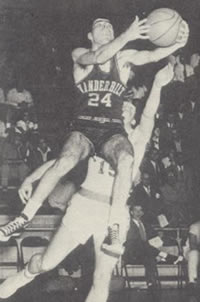
Dave Kardokus |
“The only time I thought we were really going to win was when we were up by two points, and George Kelley hit two free throws to put us four points ahead,” said Kardokus. “That was the first time in the game I thought we could beat them. They were good. I mean good. They had Ramsey, Spivey, and Hagan, who were three All-Americans, and Bobby Watson who never missed.”
The rules in this era gave the foul shooter the option of taking the shot or possession on an inbound pass play. If a player was awarded two foul shots, he could shoot the first one and waive the second shot to pass the ball into play.
Spivey was on the foul line again for two shots and missed the first attempt. He waived the second attempt, but Vanderbilt’s Bob White stole Hagan’s inbound pass. Kentucky fouled the Commodores three times in the final minute, but waived each free throw and was able to run out the clock for the Commodores first SEC Tournament Championship.
“When we were freezing the basketball at the end of the game, Kardokus drove to the basket twice, and they wouldn’t foul him because of the waiving,” said Smith. “They knew we would just take the ball out of bounds anyway. Coach’s philosophy was if they don’t get the ball offensively, then how are they going to score.
“Jack Heldman did something near the end of the game that I will never forget. We raced down the court to get into defensive position, and Heldman starting screaming, `Everybody play good defense; we’ve got this game won. Play defense. Play defense.'”
UK’s Spivey led the scoring with 21 points. Smith led Vandy with 15 points, followed by Southwood (14) and Kardokus (13). Kelly fouled out late and produced eight points. Kentucky was awarded the SEC Championship due to their regular season accomplishment. The Wildcats continued the season by winning the their third NCAA Championship with a 68-58 win over Big Seven champs Kansas State.
Vanderbilt was expected to receive an at-large bid to the National NCAA Tournament or the then-prestigious NIT, but that never materialized. Newspaper reports suggested that the team was too tired from their exhausting tournament run that it voted not to except any post-season bids.
“That was the time that the Madison Square Garden was the Mecca, up until the year before,” said Kardokus. “That was the NIT event, which was on par if not superior, to the NCAA Tournament in prestige. Nobody wanted to go to the Garden anymore and Bradley was hosting an on-campus tournament. We were invited to that, but we turned that down.
“We didn’t just say we weren’t going to any tournament. In those days the NCAA was a 16-team tournament. You had to win the conference championship, and ironically up until that year, the tournament champion went. But they changed it that year to where the regular season champion went. We weren’t invited to that or the NIT.”
After the game, coach Rupp entered the hospitality room where writers and coaches were gathered. Dudley Green of the Nashville Banner reported Rupp’s remarks.
 |
|
1951 SEC Tournament Champions |
His opening remark to the Commodore leader was said in a curse-like tone, “Bobby, you made a grave mistake tonight. I want you to make the most of it. It is not going to happen again. You have been getting the best boys for the past three years. I haven’t been recruiting, but I’m starting tomorrow. I’m going out and get me some good boys.”
The angry tone in Rupp’s voice caught the attention of Polk.
“How can you say something like that, Adolph,” asked LSU coach Harry Rabenhorst. “When by your own admission you have the greatest college player in the country in Cliff Hagan performing on your second team?”
Rupp, sporting a patch over an injured right eye, wheeled to put a tense glare on Rabenhorst.
“I haven’t been out of Lexington in three years to look at a boy, shot back Adolph.”
The SEC tournament was disbanded after the next year and revived for the 1978-79 season. That 1951 classic is the only SEC tournament championship for the Commodores in either era.
The “Rupp Curse” on Vanderbilt has lasted fifty-six years.
Next week read about Vanderbilt’s NIT win over Tennessee at Memorial Gymnasium in 1990.
Traughber’s Tidbit: Brant “Pinky” Lipscomb” is the first Vanderbilt player to earn SEC First Team All-SEC Tournament honors in 1939 and 1941. Other First Teamers were Dave Kardokus (1951), Al Miller (1981) and Barry Booker (1989). Second team members include Willie Geny (1934), Dick Plasman (1936), Joe Little (1939), Ross Hanna (1940), Billy Joe Adcock (1948-50), Al Weiss (1951), Bob Dudley Smith (1951) and Dave Kardokus (1951).
If you have any comments or suggestions you can contact Bill Traughber via e-mail WLTraughber@aol.com.