

Road to Success
by Graham HaysVanderbilt volleyball’s trip to Japan was a once-in-a-lifetime experience—and a blueprint for sustainable success as the Commodores take the court this fall
NASHVILLE, Tenn. — Maybe what happens in Las Vegas really does stay in Las Vegas, as a memorable marketing campaign promised. But as the days tick down until Vanderbilt’s first competitive volleyball match in more than four decades, the Commodores are counting on their recent experiences in Osaka, Kyoto, Tokyo and bullet trains across Japan to resonate from Austin to Tuscaloosa. What happened in Japan will help shape the years ahead.
As May gave way to June, more than 30 student-athletes, coaches and staff traveled from Nashville to Japan for 10 days of competition and cultural exploration in Osaka, Tokyo and Kyoto. A little more than three years after Vanderbilt announced it would reinstate volleyball as its 17th varsity program, and as the reborn program’s first student-athletes completed their first year on campus, the international trip was one more in a line of ‘firsts’ that will continue through the opening match against Kansas on Aug. 23 in Lincoln, Nebraska, and their home debut against Belmont on Aug. 29 on Wyatt Lawn.
The Japan trip created once-in-a-lifetime memories running the gamut from food to history to volleyball. It was a meaningful part of each student’s Vanderbilt experience solely on its own merits. But it was also part of an ongoing effort to build a team capable of competing on day one and a program that can grow into something remarkable. From the value of preparation to the benefits of competition to camaraderie, every part of the experience underscored the importance of making the most of right now and preparing for what’s to come. The trip, in other words, was part of a journey.
Preparing to Succeed
From almost the moment he was hired, head coach Anders Nelson intended for his team to take an international trip prior to its debut season. NCAA rules allow teams to take international trips once every four years, and with every hour together on and off the court even more valuable in building something from scratch, there was no sense waiting.
But when the first recruits committed many months later, the coaching staff still couldn’t tell them the trip’s destination. That, too, was part of the plan. Emphasizing their equal agency in building whatever the program was to become, one of the initial tasks for the first Commodores was choosing from among a list of possible trips. All right, perhaps coaches, particularly intrigued by a trip to Japan, exhibited extra enthusiasm as they made the case for each destination, but Reese Animashaun, Maddy Bowser, Taryn DeWese, Hailee Mack and Rachel Ogunleye ultimately cast the deciding—and unanimous—votes.
Whether it was assistants Russell Corbelli and Lauren Plum integrating Japanese terms and concepts into weekly practice plans or the sports nutrition team incorporating Japanese flavors into easy everyday recipes that student-athletes could follow, the trip became a core part of the team’s first year together.
“Anders was really intentional about keeping the trip front of mind,” Corbelli said. “If we didn’t keep hyping this trip up, it was going to be here before we knew it and the excitement wouldn’t have been nearly what we wanted it to be. We wanted to create anticipation. We tried to do as much of that as we could, whether it was incorporating the language or the style of play or any aspect from the culture.”
They leaned on the university’s collaborative power to stoke enthusiasm. As they got the program up and running, Nelson and his staff had set up classes open to university staff to help better understand and appreciate the sport. Now, they invited Asami Nakano, senior lecturer in Japanese, to address student-athletes in classroom sessions that helped introduce some basic language skills and discussion points about the culture.
The team also forged a bond with Tyler Walker, assistant director of global health and safety. Fluent in Japanese and Korean after studying and working in both countries, Walker also previously worked for Vanderbilt Study Abroad before shifting to the Global Health and Safety team. She helped student-athletes understand norms that would allow the Commodores to be considerate guests on their travels. That might be something as simple as lowering the volume of public conversations—particularly useful as the team used public transport for almost all of its travel within the country. After initially making a series of PowerPoint presentations this spring, Walker ended up joining the Commodores on the trip.
Granted, even the best intentions sometimes run aground on the reefs of reality. Corbelli at one point convinced graduate transfer Sydney Conley to join his bid for additional fluency through a language-learning app. Like many of us in such efforts, neither lasted all that long. Fortunately, Google Translate always stood at the ready.
View this post on Instagram
The point of the efforts, after all, was never to blithely assume they could master a language, learn millennia of history or understand the nooks and crannies of a culture of more than 120 million people. You don’t do any of that over the course of a semester, any more than you take your place as an NCAA title favorite in a matter of months. But any effort to learn, any willingness to try, speeds development and enriches experiences.
“I think what people enjoyed most was learning about the cultural differences,” Conley said. “Just learning about Japan, from the food to everything else, really helped build anticipation. It was really cool because it definitely made being there more exciting when we had been learning about it for the entire semester and it was finally here. I enjoyed that a lot, and I’m glad they did that for us.”
Learning to Compete
The competitive component of an international trip is always a variable. For some teams, competition is essentially an afterthought, a scrimmage and a practice or two squeezed in between prioritizing other activities. The Commodores didn’t have that luxury. They wanted the full cultural experience, but they also needed the time on the court.
When Vanderbilt plays Kansas next month, the sum total of the Commodores’ competitive experience together on this continent will come from spring exhibitions against Tennessee, Lipscomb, Louisville and Purdue. Their opponents have cheered each on other after victories and probably also grumbled about each other after defeats—hopefully learning from both.
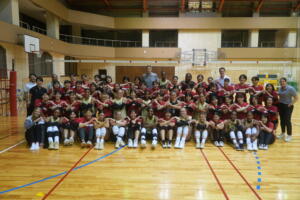
The Commodores and their peers from Nihon University (Amon Kehr/Vanderbilt).
Any opportunity to catch up, even when no one will remember the scores, matters. Over a little more than a week, the Commodores doubled their total match time by playing Senri Kinran University, Kansai University, Nihon Taiku University and Nihon University.
“At this point, every time we get to compete, it’s a special thing for us, especially the ones who have been here for a full year now—or two and a half years for our staff,” Corbelli said. “It was some of the best preparation we could get, in some ways even more than playing the teams we played in the spring, who are powerhouses in the volleyball space. The Japan matches were such meaningful preparation for the season because of the difference in style and all the other components around competing in a foreign country.”
While not necessarily gaining as much mainstream recognition as their peers in soccer or softball, Japan has a rich history in women’s volleyball—including Olympic gold medals in 1964 and 1976. Regular participants in the Olympics and World Championship, the national team embodies a style of play based on speed and technical precision that filters down to the university-level teams that the Commodores faced.
“None of the people in the spring—nobody I’ve ever played—played as fast as them,” Conley said. “They were doing these really creative plays, coming out of nowhere and none of us knew what was going on. In the fall, we’ll have game plans, of course, but it was a way for us to learn how to better adapt to teams that we don’t recognize. I don’t know if we reacted well to it at first, because we were just all amazed at what was going on. But I think throughout the trip, each game we got better at preparing, because each team played pretty similar—but completely different than teams in the U.S.”
View this post on Instagram
Adapt and Thrive, Together
Instagram influencers notwithstanding, travel is rarely glamorous—or even all that comfortable. After missing out on international trips during her four years at Florida State, Conley got her chance this year with the Commodores. Complete with a 12-hour flight. In the back two rows of economy. In the middle seats. At least she was sitting next to a teammate, DeWese, and not a random stranger. They talked. They tried sleeping, with little success—despite the special pillow Conley had secured for the trip. They ate. By the time the team arrived in Japan and struggled through an initial dinner, the student-athletes were united in a shared desire to find their beds.
It says something about the scale of the challenge involved in building a program from scratch that the team’s longest road trip prior to crossing the international date line came when it crossed the dividing line between time zones on the four-hour bus ride to the Indianapolis area for an exhibition against Purdue in April. Jet lag wasn’t an issue there.
Collective experience isn’t just about playing matches together. It’s about riding buses and waiting for flights, eating meals and passing time. Playing together means trusting the people around you to have your back—to make the right set or run the right play. And while you don’t have to be best friends with someone to trust them on a court, knowing and understanding them goes a long way toward building that trust.
That isn’t easy. The Commodores who arrived in Japan together took different routes to Vanderbilt. They came to Nashville as members of the first recruiting class, transfers, early enrollees and more, from last summer through this spring—the newest member of the traveling party just a matter of weeks into her time at Vanderbilt. The shared misery of a long-haul flight and jet lag might seem inconsequential. But the more experiences that are shared—whether spring exhibitions or economy seating—the more a group of individuals figures out how to be a functioning team.
“I think just playing together made us get to know each other better,” Conley said of evolving group dynamics. “This past semester, I’d say we really started to hang out more in different groups and branch out and make more friendships off the court. And then on this trip, I was seeing people hang out who I had never really seen hang out very much before.”
To that end, Nelson and his staff wanted to give the student-athletes as much freedom as a packed itinerary would allow. The group came together to practice and play. They ate most meals together (phones allowed only briefly as a concession to a modern generation eager to share visual evidence of the cuisine). They visited unforgettable sites like Osaka Castle and the Fushimi Inari Shrine in Kyoto. But in a country with impeccable communication networks, easy public transport and celebrated public safety, the Commodores also had opportunities to explore (and in what became a particularly popular pastime, shop) in ad hoc groups of their own choosing.
“You can handle this as adults and individuals, and we’re trusting that you’re going to be able to follow the parameters that we’ve set out,” said Kim Williams, volleyball’s director of operations. “We built a lot of solid trust in that realm. Carry yourself and present yourself well because you’re wearing Vanderbilt volleyball, but get the full travel experience of getting lost, translating things, figuring out a currency on your own. I feel like they grew a lot as far as trusting themselves to handle these situations.”
Each of them came home with bags full of souvenirs for family and friends, not to mention Japanese candy for themselves. Each returned with new tastes to try and fill at home—whether the authentic ramen that Conley and a few teammates found on their final night in Tokyo or the Wagyu beef that Corbelli fears will never again be as affordable as it was when he and his wife had an evening meal to themselves. And they brought back the stories that make travel so much more than anything tangible—like the laughter in recalling the group stranded on the subway when they missed their stop and the grand adventure of finding their way back from the next stop.
All of it a shared experience—their shared experience. Made by them.
“Typically when you travel as a team, you just listen to what the ops person or the coach says,” Williams explained. “There was a lot more independence here. I think, for me, that helped give a new lens to see that, ‘All right, they can handle these things.’ It doesn’t always have to be laid out picture perfect for them. They’ll adapt. They’ll adjust.”
If it turned their time in Japan into the trip of a lifetime, imagine what it can do when they hit the road in the SEC.