
Feb. 25, 2015
 Commodore History Corner Archive
When Title IX became federal law in 1972, the United States Government wanted women’s sports in high schools and colleges to become equal to the men’s competition. Colleges across the nation established basketball as an official sport for women on campus, which included scholarships. Basketball had been played as an intramural sport for decades, including at Vanderbilt.
In April 1977 Vanderbilt’s commitment to women’s athletics began with the promotion of Emily Harsh as the newly created athletic director for women. There were four initial sports for women at Vanderbilt — basketball, swimming, tennis and track. Vanderbilt became members of the Association for Intercollegiate Athletics for Women (AIAW). The AIAW was established in 1971.
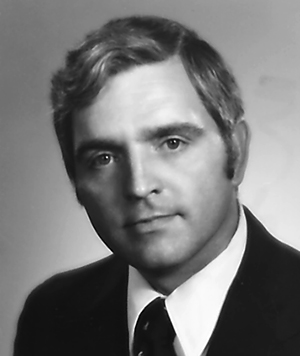
Joe Pepper was selected as the first Commodores’ women’s basketball coach. Pepper was from Springfield, Tenn., and graduated from Springfield High School and the University of Tennessee. At the time of his hiring, Pepper was living in Nashville where he was the athletic director, football and girl’s basketball coach at St. Henry’s Elementary School.
“I just got a call one day from Vanderbilt,” Pepper said recently from his Nashville home. “I was recommended to the Vanderbilt women’s athletic director Emily Harsh. I was told an associate of hers that taught and coached at Harpeth Hall (a Nashville all girls high school) recommended me and it went on from there. I don’t know how many women college coaches were available at that time. The pay was not very good and it was part-time. I don’t know whom else she interviewed, but there were several that were interested.”
Pepper was 37 years old when he became the head coach of the Commodores. He had been employed in the construction business for 20 years prior to his association to St. Henry’s, which was mostly volunteer work. He was at St. Henry’s for seven years before he arrived at Vanderbilt. Vanderbilt was not offering scholarships that first season so players were sought out.
“The first year they walked on,” he said. “They just came out of the Vanderbilt classroom. We had one young lady, Karen McGinn (Father Ryan), that I had coached at St. Henry’s and she contacted me to play basketball. She received a very small, partial scholarship that first year. Everybody else was a walk-on. We had (current Tennessee State athletic director) Teresa Lawrence (Phillips) who was a walk-on and on an academic scholarship.
“We had Jan Jordan who was a senior from Franklin and had not played basketball since her senior year in high school and was all-state. Karen helped us quite a bit. We had a young lady from Harpeth Hall — Allison Floyd. We had of number of other girls I hate to leave out. They all worked hard and did a really great job and were dedicated.”
The other roster members of that first Vanderbilt squad included Ann Morrow, Rachel Williams, Sissy Maddox, Betty Caldwell, Kathy Cunningham, Dee Donley and Molly O’Toole.
The SEC did not offer women’s basketball yet, though several schools were competing in women’s basketball. In Vanderbilt’s inaugural 1977-78 season, the Commodores played mostly local schools in Tennessee State, David Lipscomb, Cumberland, Motlow State, Cumberland and Austin Peay. SEC foes included Mississippi State, Ole Miss, Auburn and Alabama.
“Most of the schedule had been put together before I arrived,” said Pepper. “We played our first game with TSU. I was nervous. It was a big jump to coach in the St. Henry’s gym to Vanderbilt’s Memorial Gym even though it was empty. We had about 300 people there for the first game. It was still a big thing and it was Vanderbilt. We won two big games early with TSU (73-60) and Mississippi State (81-66).
“We had a 14-seat van that first year and we’d take off with the girls, (athletic) trainers, managers and luggage. I’d drive and we had a big time. We used the van for the short trips and out-of-state games to Western Kentucky, Ole Miss and Mississippi State. I never felt pressure to win and we did not feel like we were experimenting. We wanted to play well and win.”
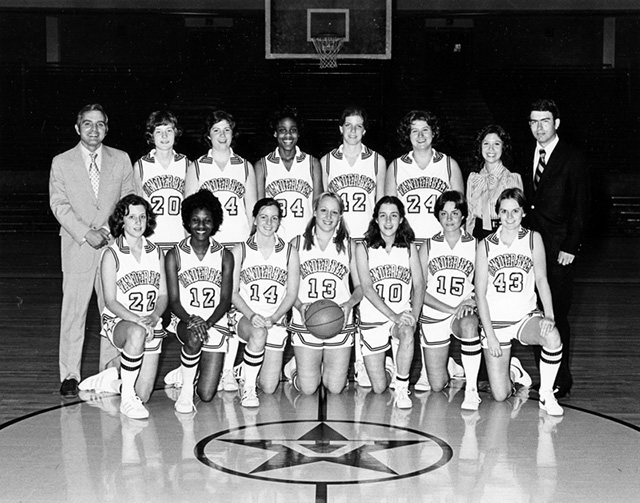
Vanderbilt finished the season 15-9 with an 8-2 home record. Leading scorers were McGinn (16.5 points per game), Jordan (13.4), Morrow (12.8), Floyd (11.0) and Lawrence (7.8). Jordan was the top rebounder (10.7) while McGinn (83.8 percent) was the top free-throw shooter.
Vanderbilt awarded three full scholarships in the team’s second season. The first recipient was Sheila Johansson from state power Mt. Juliet. She was joined by teammate Cathy Bender and Cindy Freeman was from Portland, Tenn. Most of the recruiting was local due to the restricted recruiting budget.
“I didn’t really have a plan for the program,” Pepper said. “I didn’t really know what was going to be allocated to us the first two years. We were just growing and taking a step at a time. It is hard to take those steps when you are not deeply funded from the beginning. Vanderbilt took care of all that as the years went by and they got further into the program. It didn’t take them long.”
During Pepper’s time at Vanderbilt the men’s head basketball coaches were Wayne Dobbs (1977-79) and Richard Schmidt (1980-81). Did these two experienced coaches aid Pepper?
“They were cooperative,” said Pepper. “We didn’t have any problems with practice times, which was something we had to look at. Everybody goes to class in the daytime and had time in the afternoon. We didn’t have any major problems. I wasn’t over there much since I had to work in the mornings then I came over in the afternoon. We usually practiced about 4 p.m., and the men usually practiced from 2 to 4 p.m. I never sat down with the men’s coaches to go over things. That’s not to suggest they were not cooperative. I thought a lot of Wayne. I knew Wayne better than Coach Schmidt.”
In the second season the Commodores were 11-16 with an upgraded schedule and newcomers Georgia Tech, Middle Tennessee State, Auburn, Florida, Alabama, and Georgia. Roster additions included Maria Cardona, Dianne Beasley, Jean Henniger and Ginnie Myers. Top scorers were Morrow (14.4), McGinn (12.4) Freeman (11.5) Lawrence (8.5) and Maddox (8.0). Freeman (88.8 percent) led the team in free throw percentage while Morrow (5.8) collected the best rebounds per game average.
“Our schedule was upgraded,” Pepper said. “We now had the first three scholarship ladies. Unfortunately we lost the first one we signed. Shelia (Johansson) tore her knee in the high school state tournament in her senior year so we didn’t have her that second year. She needed surgery. Cindy (Freeman) came on and played early for us, but she broke her foot. Then Cathy Bender had surgery during the year for an appendectomy. We really didn’t get to use our resources that second year like we wanted to. We only lost one starter from the previous year. I wasn’t displeased.”
In Pepper’s third and final season at Vanderbilt, the Commodores had a 12-14 record when two more scholarships were added. The first game against the University of Tennessee was played in Memorial Gym. The ‘Dores lost 77-53 to the Lady Vols and coach Pat Head Summitt, who had been head coach since the 1974-75 season.
“At that time UT was still at the top and one of the best women’s college teams with Pat,” Pepper said. “My family had a history with Pat. She was someone we knew very well. Pat and my wife’s sister were college roommates. Anytime Vanderbilt plays Tennessee it is a big thing. They were nationally ranked with (current Vols coach) Holly Warlick playing for them, who was the point guard at the time.
“Most of the schools we played were only a year or two ahead of us. By the second year everybody was giving scholarships and we were behind. We had a few problems and missteps, but good relationships. One of our biggest wins that season occurred when we went down to Ole Miss and beat them (84-81). They were ranked in the top 10 at the time.”
Leading scorers for the Commodores were Aljeanette Bramlett (18.3), Johansson (14.0), Gayle Kinzer (9.2), Freeman (7.5) and McGinn (5.3). Bramlett (7.5) and Johansson were top rebounders.
Pepper was replaced by Phil Lee, Vanderbilt’s first full-time head coach. Pepper’s career record was 38-39 with a 23-12 Memorial Gym mark. Pepper coached Nashville’s Montgomery Bell Academy’s 7th and 8th grade basketball team the next year for his last season as a coach at any level.
“That was the plan from the beginning to eventually have a full-time coach,” said Pepper, 75. “I wasn’t disillusioned at all at that point. Money had to be considered and I had to have a certain income. I had a family. I spent the previous two years basically just coaching at Vanderbilt and I sold some real estate during the summers.
“The program was growing and I knew it was going to get bigger. I had discussions with my superiors at the time and I felt for me it was time to move on. And I had an opportunity to go into business myself. That was the direction I took.”
The NCAA began incorporating women’s sports in 1981 and Harsh converted the women’s athletic department as a dual member of the NCAA and AIAW. The AIAW disbanded the next year and Vanderbilt became full-time members of the NCAA. Phil Lee’s squad won the 1984 Women’s National Invitation Tournament.
The SEC Women’s Tournament was first held in 1980 with Vanderbilt as a participate. The tournament winner was determined to be the SEC champion. The SEC began a uniform conference schedule in the 1982-83 season, but the SEC Tournament winners were the official champions. Starting with the 1985-86 season, the SEC declared the conference championship to the team with the best in-season record.
It is remarkable that Pepper’s only coaching experience prior to be naming Vanderbilt’s first women’s head basketball coach was at an elementary school. Pepper was successful in starting the Commodores’ women’s basketball program.
“I was learning as we went along,” Pepper said. “We didn’t put a lot of pressure on ourselves. In the first year whenever we did something it was for the first time. The entire experience for me had a lot of challenges. We just didn’t have many problems with our players like a lot of coaches go through now. Our players had to put a lot of time in the classroom and practice two hours a day. I was proud of everyone of them.”
If you have any comments or suggestions you can contact Bill Traughber via email WLTraughber@aol.com.